
Yemeni Forces Launch Major Offensive in One of the Most Dangerous Countries to Reclaim Bab al-Mandab Territory from Houthis
Reporting based primarily on jpost.com.
Yemeni government forces, backed by the Saudi-led coalition, launched a major new offensive called "Dawn of Yemen" against the Houthis on October 5, 2026, aiming to retake territory near the Bab al-Mandab Strait and other areas in one of the most dangerous countries. [1] The operation seeks to restore state institutions, eventually retake Sanaa and end Houthi control over large parts of the country. [1]
Launch of Operation Dawn of Yemen
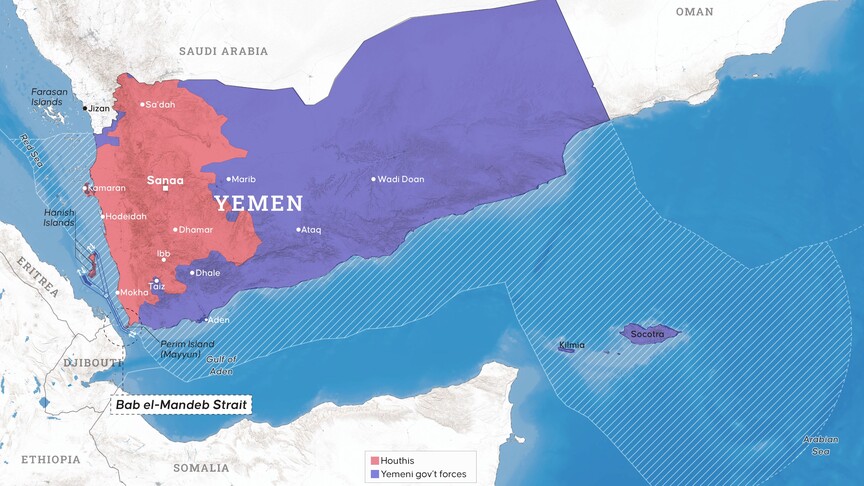
Yemeni government forces launched a new offensive against the Iranian-backed Houthis on Monday. [1] They claimed to be advancing near the strategic Bab al-Mandab Strait and carrying out strikes on Houthi positions across several provinces. [1] Yemen's Presidential Leadership Council President Rashad al-Alimi has called the new campaign “Dawn of Yemen.” [1] The operation is intended to restore state institutions, eventually retake Sanaa and end Houthi control over large parts of the country, according to Arab News. [1] Arab News also reported on Monday that government forces had taken control of Thubab, near the Bab al-Mandab, after advancing from the Kahbub Mountains. [1] Government forces are also seeking to secure the area around the strait and push north along the coast. [1] “With the will of our people, the bravery of our forces, and the support of our brothers, Yemen will move toward a new dawn,” Al-Alimi said Monday, according to Arab News. [1] “Today we are embarking on a decisive phase in the history of our nation,” he said, according to Arab News. [1] He emphasized that the operation was aimed at the Houthis rather than civilians living in Houthi-controlled areas. [1]
Saudi Coalition Air Support
The Saudi-led coalition said that it is providing air cover for Yemeni armed forces on the ground, with 100 fighter jets reported to have taken part in the operation. [5] The coalition says it attacked 324 "high-value targets" and is providing air support at the Bab el-Mandeb Strait in the Red Sea. [5] On Monday, the coalition said 100 aircraft participated in the opening phase of Operation Dawn of Yemen and that it provided air cover around Bab al-Mandab, as well as continuous support for Yemeni forces on the ground. [1]
Houthi Counteractions and Gains
The Houthis claimed on October 5 that they had seized the home of Presidential Leadership Council Chairman Rashad Al-Alimi in Taiz. [1] “Earlier on Monday, Houthi militias seized control of the Al-Aloum area, where Al-Alimi’s house is located, in Taiz province (256 km southwest of Sana’a). Hundreds of Houthi fighters attacked the Al-Aloum area in Al-Mawasit district in the countryside of Taiz governorate early this morning.” [1] The report said that “sources told Al-Ain News that the Houthi militias seized Al-Alimi’s house following violent clashes with Yemeni forces and residents in Al-Mawasit district, located in the heart of the historic Al-Hajariya region. The Houthi militias seized Al-Alimi’s house in Al-Uloom after they took control yesterday of the house of the Speaker of the Yemeni Parliament, Sheikh Sultan Al-Barakani, and captured the city of Al-Turbah, the capital of Al-Hujariya and the second largest city in Taiz.” [1] The report argued that the Houthis had imposed a siege on the city of Taiz. [1] In September, the Houthis seized a strip of land on the Red Sea coast near the Bab al-Mandeb strait. [1]
Government Strike Claims
Maj.-Gen. Majed Abdullah Al-Nuzaili, spokesperson for the Yemeni Armed Forces, said forces had carried out 1,122 strikes or targeting operations against Houthi military infrastructure in Saada, Al-Jawf and Taiz. [1] He claimed the operations had killed or otherwise “neutralized” 1,747 Houthi personnel and destroyed or disabled 364 vehicles and other pieces of equipment. [1] These figures are government claims and have not been independently verified. [1] Arab News reported the figures based on Al-Nuzaili's statement. [1]
Context of Fragmented Forces in Most Dangerous Countries and Prior Truce
The problem is that the government forces are not well united. [1] They have fronts in southern Yemen and also around Taiz, and then others in northern Yemen. [1] Until December 2025, the UAE-backed Southern Transitional Council controlled southern Yemen. [1] The front lines had remained relatively stable following the 2022 truce. [1] A recent report at the Institute for the Study of War showed that the Houthis continue to advance. [1] What that means is that even as the government tries to advance, the Houthis appear to still be winning on some fronts. [1] The Houthis, also known as Ansar Allah, emerged from the Zaydi Shi’ite community in northern Yemen and fought a series of wars against the Yemeni government beginning in 2004. [1] The group expanded during the instability that followed the 2011 Arab Spring and seized Sanaa in 2014. [1] Saudi Arabia led a military intervention in March 2015 supporting the internationally recognized government, while Iran increasingly provided support to the Houthis. [1] A UN-mediated truce in 2022 significantly reduced large-scale combat even after it formally expired, leaving front lines largely stagnant. [1] Previous reports of offensives tended not to pan out. [1]
Strategic Importance of Bab al-Mandab
The Bab al-Mandab is strategically important because it connects the Red Sea with the Gulf of Aden. [1] Control of territory overlooking the strait gives the Houthis potential leverage over a major international shipping route, especially amid wider regional tensions involving Iran. [1] The fighting is particularly intense along Yemen’s western coast. [1]
What to watch next: The latest fighting could change things as government forces attempt to reverse their territorial losses and reassert government control over strategically important areas of Yemen while facing the Houthis, who have strong interior lines and have tended to win in the past. [1]