
US Forces Sink Four Iranian Oil Tankers After IRGC Missile Strikes on Navy Ships
US Sinks Four Iranian Oil Tankers
US Central Command sank four Iranian oil tankers in the Gulf of Oman and near Kharg Island on September 5-6 2026. [1] US forces sank an Iranian oil tanker in the Gulf of Oman on Saturday, with CENTCOM announcing in a post on X that the M/T Kylo sank there and joined Iran’s navy at the bottom of the sea. [1] The strike followed strikes against three other Iranian tankers earlier on Saturday, including one off the coast of Kharg Island. [1] CENTCOM stated that the strikes against the three tankers were carried out in response to the Islamic Revolutionary Guard Corps launching ballistic missiles at two US Navy ships. [1] Tasnim reported that four US missiles hit a tanker in the area of Kharg's anchorage, with local sources saying there were no casualties and the tanker's crew was being evacuated. [1] CENTCOM noted the strikes as part of the US's continued naval and economic blockade meant to cripple the Islamic regime. [1]
Retaliation for IRGC Missile Attack on US Ships
CENTCOM chief Adm. Brad Cooper stated that the action sends a message to the IRGC that shooting at two US ships will result in the US taking out three of theirs, imposing a higher economic cost. [1] “Let the message to the IRGC be clear: If you shoot at two of our ships, we will impose an even higher economic cost — taking out three of yours," said CENTCOM chief Adm. Brad Cooper. [1] US Defense Secretary Pete Hegseth posted that if Iran shoots at US ships the US will destroy and sink their oil tankers. [1] US Defense Secretary Pete Hegseth took to X to write, "If Iran shoots at US ships, we will destroy (and sink) their oil tankers. All they have to do is not shoot at [the] US Navy." [1] The strikes were carried out after Iran's Islamic Revolutionary Guard Corps launched ballistic missiles at two US Navy ships, CENTCOM said. [2] The exchange of attacks follows an escalation in the past week. [1]
Iran Claims Counterstrike in Strait of Hormuz
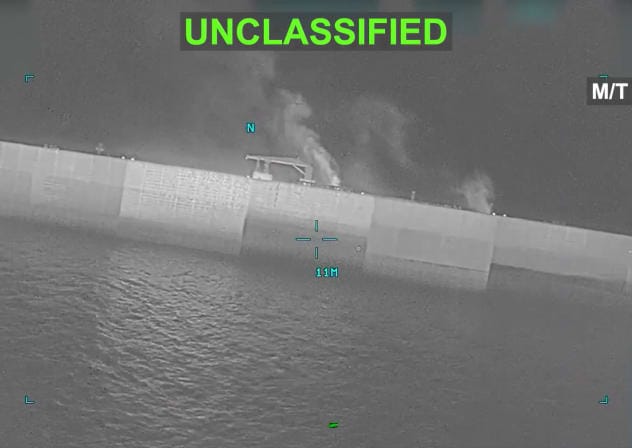
Iran's IRGC claimed it responded by targeting three oil tankers in the Strait of Hormuz and three US-affiliated ships. [2] The Iranian Navy targeted three oil tankers traveling through the Strait of Hormuz and three US-affiliated ships in retaliation for the three oil tankers hit by the US, the IRGC claimed. [2] Fire and smoke were shown rising during what US Central Command says are strikes on Iranian oil carriers at an unknown location in a screengrab from a handout video released on September 5, 2026. [2] US forces conduct strikes against Iranian oil tankers on September 5, 2026, according to posts on X from CENTCOM. [2]
Context of Ongoing Conflict
The exchange follows escalation since US and Israeli strikes on Iran began in February 2026 that have killed Iranian leaders including Ayatollah Ali Khamenei and drawn US casualties. [1] Israel and the US launched Operations Roaring Lion and Epic Fury on February 28, with the stated aim of creating conditions for regime change. [2] Ayatollah Ali Khamenei was killed by an Israeli strike on a Tehran bunker. [2] Iran’s defense minister and several IRGC generals were also killed in the largest-ever aerial attack by the IAF. [2] Iran retaliated by firing across the Middle East at Gulf nations and US military bases in the region. [2] Thirty-nine IDF soldiers and 23 civilians have been killed, and at least 7,693 more injured in ballistic missile attacks across Israel since February 28. [2] Eighteen US soldiers were killed, CENTCOM says. [2] A ceasefire deal was announced on April 7 and went into effect on April 8. [2] The strikes are part of a continued US naval and economic blockade intended to cripple the Islamic regime. [1]
Regional and Political Fallout
The exchange of attacks follows an escalation in the past week that threatens to deepen a conflict that has dragged on since the US launched strikes on Iran in February, disrupting global energy supplies and drawing opposition from a majority of Americans before congressional elections in November. [1] According to an Axios report, the Trump administration is developing a post-war Middle East strategy for Iran and Israel that could include resolving the regional fallout of Hamas’s October 7 massacre against Israel and the resulting Israel-Hamas war. [2] Former NSC adviser Jacob Nagel said six to nine months of economic pressure could push Iranians back into the streets, while warning Tehran still has the ability to retaliate. [2] Israeli assessments indicate Tehran is working to coordinate its regional allies for a simultaneous assault on Israel, seeking to avoid the lack of coordination seen during the October 7 attack. [2]
What to watch next: Former NSC chief Jacob Nagel said six to nine months of economic pressure could push Iranians back into the streets, while Israeli assessments indicate Tehran is working to coordinate its regional allies for a simultaneous assault on Israel.