Protests in most dangerous countries: France Student Protests Spread to Belgium Italy and Greece as Government Promises October Plan
High school student protests over teacher shortages, overcrowded classrooms and dilapidated buildings continue across France for a fourth day in most dangerous countries, with the unrest spreading to Belgium, Italy, Greece and other European countries while the French government promises concrete measures by the end of October. [2] [4]
Student Protests Continue in France
Dozens of students dragged rubbish bins into position outside a high school in northeastern Paris early on Thursday, erecting fresh barricades before police moved in with tear gas as France's nationwide protests show few signs of ending. [5] The Helene Boucher Lycee has been a focal point. French teenagers blockaded some high schools and marched through cities on Thursday as the government promised to address their grievances about teacher shortages and dilapidated school buildings but gave few specific details. [4] Large crowds demonstrated across the country from Lille in the north to Rennes and Nantes in the west, the capital Paris, and Toulon and Marseille in the south. [4] Education ministry figures showed the number of school blockades was gradually decreasing, with 224 closed in the morning down to 157 by lunchtime, meaning that 96 per cent of schools were open. [4] Scuffles between police and protesters took place at some blockade locations in Paris. [4]
Core Grievances Driving the Unrest
The protest movement, now into its third week, has exposed deep tensions in France between popular demands for investments in deteriorating public services and a cash-strapped government under pressure from bond markets to reduce its debt and deficit. [4] High-school teacher Diane Di Sciullo joined students at a large march in Marseille, saying all they were asking for was a decent education in decent conditions. [4] She denounced overcrowding, saying this year she had 37 students in her class. [4] “At the start of every lesson, I have to ask them to check the neighbouring classrooms for spare chairs and desks so they can actually study,” she said. [4] Di Sciullo, 28, was carrying a placard that read “I’m a teacher and my students help me catch cockroaches in class.” [4] Their complaints include overcrowded classrooms, teachers not being replaced when absent, long school hours, deteriorating buildings and inequalities between schools in wealthier and poorer areas. [2] Students have also raised concerns about the university admissions system and the pressure of the education system. [2]
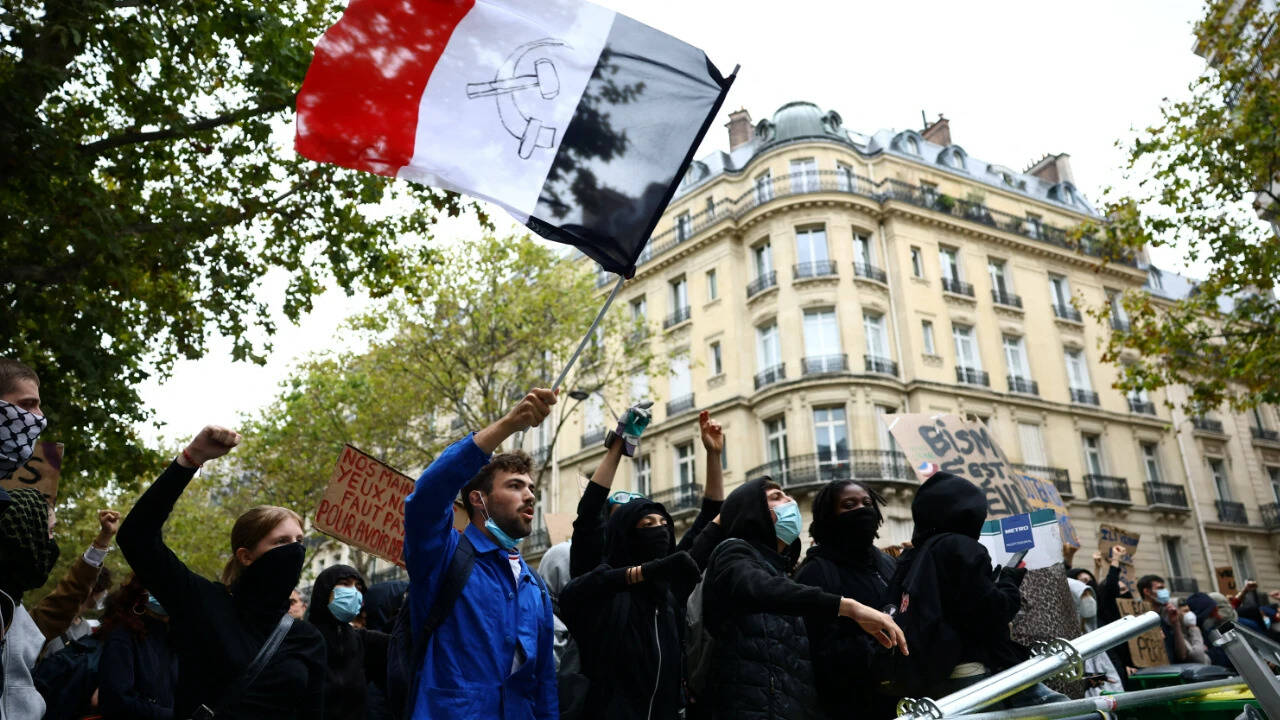
French students erect barricades with rubbish bins outside a high school in Paris during ongoing protests. — Source: timesofindia
Government Response and Promised Measures
French Prime Minister Sebastien Lecornu said in a televised address Wednesday evening that the country could not be "indifferent" to the concerns of protesting high school students, acknowledging that the "anger of young people does not come from nowhere". [3] He denied that security forces have "orders to confront" the young people, and promised the government would present a plan to respond to the crisis at the end of October. [3] Education Minister Edouard Geffray held a meeting with students and teachers at a high school in the eastern city of Reims. [4] “I am currently implementing an emergency plan to ensure that absent teachers can be replaced on a long-term basis,” he said afterwards, adding that heavy school timetables were also under review. [4] Geffray also said he was working on potential improvements to Parcoursup, the national online portal for applying to university, which has been widely criticised as confusing and stressful for applicants. [4] Prime Minister Sebastien Lecornu pledged late on Wednesday that the government would present “concrete, quick and fully funded responses” to the protests by late October, without offering specifics. [4]
Scale of Arrests, Injuries and Police Conduct Debate
More than 6,500 people have been arrested since the movement began, most of them minors, while hundreds of schools have been disrupted. [2] The protests have also led to clashes with police and serious injuries. [2] The issue of police conduct has become a major part of the debate after a 15-year-old boy lost his hand during a confrontation in Lens. [2] On Wednesday, the government suspended the use of stun grenades in the policing of the protests after one teenager’s hand was blown off. [4] There have been hundreds of arrests and dozens of injuries since the movement started. [4] A prominent complaint featured on banners and placards was that the police response to the wave of protests has been too heavy-handed. [4] “Too young to be listened to, old enough to be tear-gassed” was one example. [4]
Spread of Protests Across Europe
The unrest has now crossed France's borders. [2] In Belgium, hundreds of students took to the streets of Liège on Wednesday, citing rising education costs, overcrowded classrooms and limited access to study materials. [2] The demonstrations have already resulted in arrests and clashes with police. [2] In Italy, high-school students have begun occupying schools in Turin and Rome under the slogan "Let's do as in France." [2] Their complaints include inadequate funding, deteriorating school buildings and the rising cost of living. [2] Italian students have also travelled to Paris in solidarity with the French movement. [2] Greece is also seeing mobilisation. [2] Students have called nationwide school actions, including assemblies, walkouts, demonstrations and possible occupations. [2] In Ireland, thousands of university students have demonstrated in Dublin over tuition fees, higher-education funding and the cost of accommodation. [2] In Germany, students, teachers, parents and unions have demanded greater investment, more teachers and a fairer education system. [2] Austria is facing another version of the same problem. [2] Student groups are preparing demonstrations after the country's university association warned of possible cuts of around €1 billion from the next three-year university budget. [2]
Political Context and Public Opinion
Six months out from an election to replace President Emmanuel Macron after the end of his second consecutive term, politicians’ responses to the wave of student protests have been starkly polarised. [4] Far-right frontrunner Marine Le Pen has highlighted damage to schools caused by a minority of protesters and called for them or their parents to foot repair bills. [4] On Tuesday, she outlined plans to slash public spending should she win. [4] Her hard-left opponent Jean-Luc Melenchon, who also has a chance of making the runoff, has praised the protesters as “incredible” and denounced police brutality. [4] According to an Elabe poll for BFM TV, 72 per cent of French people think the students’ demands are legitimate, but 55 per cent of them think the protests should stop. [4] The government has sought to tread a line between condemning violent incidents in which schools were set ablaze and staff injured, while also expressing sympathy with some of the students’ complaints. [4]
What to watch next: The government has promised to present concrete, quick and fully funded responses by late October while the number of school blockades continues to decrease gradually.