
North Korea's Projectile Launch: A Deeper Look at Internal Power Dynamics Amid Escalating Tensions
By David Okafor, Breaking News Editor, The World Now
March 14, 2026 | 1800+ words
Introduction: Setting the Stage for the Latest Provocation
North Korea's launch of an unidentified projectile eastward toward the East Sea on March 14, 2026, has once again thrust the Korean Peninsula into a state of heightened alert amid rising North Korea missile launch tensions. Occurring amid ongoing joint military drills between the United States and South Korea—exercises widely perceived by Pyongyang as rehearsals for invasion—the timing of this North Korea provocation is no coincidence. South Korea's Joint Chiefs of Staff (JCS) confirmed the launch shortly after 8 a.m. local time, describing it as a single projectile fired from an inland area near Pyongyang. This event marks the latest in a series of escalatory actions that have defined North Korea's military posture in early 2026, fueling Korean Peninsula tensions.
While much of the international media fixates on the immediate military implications—potential ballistic missile capabilities, flight trajectories, and regional security threats—this situation report adopts a unique angle: the internal political signaling embedded within Kim Jong Un's regime. Far from mere external saber-rattling, the launch appears to serve as a multifaceted tool for consolidating power domestically, reinforcing loyalty among elites, and projecting an image of unassailable strength to the North Korean populace. Evidence from recent regime activities, including family involvement in public military displays, suggests these provocations are as much about internal cohesion as they are about deterring adversaries, much like how domestic unrest fuels global military escalation in other regimes.
This comprehensive situation report unpacks the current launch and reactions, provides historical context through a 2026 timeline of provocations, offers original analysis on regime vulnerabilities and psychological signaling, explores future implications including market ripples, and concludes with pathways to de-escalation. By linking external aggression to Pyongyang's opaque power dynamics, we aim to equip stakeholders—policymakers, investors, and analysts—with a forward-looking assessment that transcends surface-level headlines on North Korea missile tests and Kim Jong Un's strategies.
Current Situation: Unpacking the Launch and Immediate Reactions
The projectile launch unfolded against the backdrop of the U.S.-South Korea Freedom Shield exercises, which commenced earlier this week and involve air, sea, and ground maneuvers simulating defense against Northern aggression. According to Yonhap News Agency, South Korea's JCS detected the launch at approximately 8:02 a.m. from near Pyongyang, with the projectile traveling about 200 kilometers before splashing down in the East Sea. Initial assessments classified it as an "unidentified projectile," though speculation points to a short-range ballistic missile (SRBM) similar to previous KN-23 or KN-24 variants, based on trajectory and speed data. This North Korea projectile launch has intensified scrutiny on potential ballistic missile advancements.
Official responses were swift and measured. South Korea's Defense Ministry condemned the act as a "clear provocation" that undermines regional stability, while enhancing vigilance along the inter-Korean border. U.S. Forces Korea echoed this, stating the launch posed no immediate threat to American personnel but reaffirmed the "ironclad" alliance with Seoul. Channel News Asia reported that Japan’s defense ministry also tracked the projectile, placing it firmly in international airspace over the Sea of Japan, prompting Tokyo to lodge a protest via diplomatic channels. Dawn News highlighted South Korean President Yoon Suk Yeol's office convening an emergency National Security Council meeting, underscoring the gravity amid ongoing drills and US-South Korea military exercises.
This launch is explicitly tied to the joint exercises, with North Korea's state media, via KCNA, framing it as a "strong warning" against "hostile drills" by "imperialist aggressors." However, a deeper read reveals internal messaging: the timing aligns with domestic military parades and inspections, suggesting Kim Jong Un is leveraging the event to rally the Korean People's Army (KPA) and signal resolve to party cadres. Patterns from early 2026—two launches on January 4 alone—indicate this is not impulsive but part of a calibrated response cycle, blending retaliation with regime reinforcement amid ongoing Korean Peninsula tensions.
Social media buzz, particularly on X (formerly Twitter), amplified the event. Accounts like @NKNewsOrg posted real-time threads citing defector sources hinting at "internal morale boosts" via state broadcasts, while @IntelCrab shared unverified imagery of launch sites, fueling speculation. These reactions underscore global anxiety, but our focus remains on how Pyongyang uses such moments to project unity amid whispers of economic strain and elite purges.
Historical Context: Patterns of Provocation and Regime Stability
To fully grasp the March 14 launch, one must situate it within North Korea's 2026 provocation timeline, which reveals a deliberate cycle of missile tests responding to external pressures while fortifying internal stability. The year opened aggressively: on January 4, 2026, Pyongyang fired two ballistic missiles toward the Sea of Japan, coinciding with U.S. aircraft carrier deployments in the region. These SRBMs, estimated at 300-500 km range, splashed down without incident but drew sharp rebukes from Seoul, Washington, and Tokyo, mirroring the current event's dynamics in North Korea provocations.
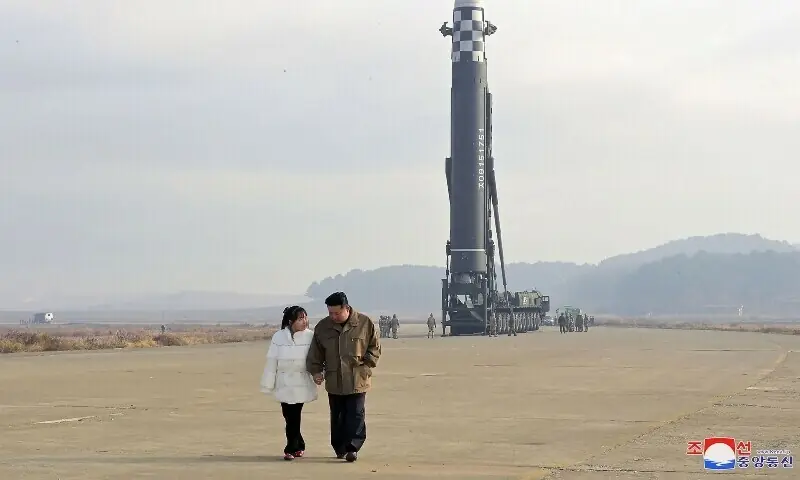
February brought a pivot to domestic symbolism. On February 28, Kim Jong Un appeared publicly at a shooting range, gifting rifles to senior officials and notably involving his daughter, Kim Ju Ae, in the display. State media portrayed this as a "patriotic education" event, with Ju Ae—aged around 13—firing weapons alongside her father. Analysts interpret this as grooming for succession, elevating her visibility amid speculation of health concerns for Kim or a need to humanize the regime. This low-intensity event (rated LOW impact in our timeline) contrasted with January's high-stakes firings, illustrating Pyongyang's toolkit: overt military tests for deterrence, symbolic gestures for loyalty enforcement.
The March 14 launch (HIGH impact) caps this escalation, forming a pattern where provocations spike during U.S.-ROK drills—historically, North Korea has conducted over 20 tests in response to similar exercises since 2022. This cycle serves dual purposes: externally, it deters invasion narratives; internally, it justifies resource allocation to the military (25-30% of GDP) and suppresses dissent by fostering a siege mentality. Past parallels abound—2022's record 90+ launches followed Biden's Asia tour—showing Kim's strategy of "fire for fire," where each allied maneuver prompts a calibrated riposte, bolstering his image as defender-in-chief. Such patterns echo escalations in other regions, as seen in Qatar's diplomatic fallout amid Gulf tensions.
Original Analysis: Internal Vulnerabilities and Psychological Signaling
Beyond the headlines, the March 14 launch signals acute internal dynamics within the Kim regime, where external bravado masks vulnerabilities in leadership consolidation. Kim Jong Un's rule, now 14 years in, faces challenges: chronic food shortages exacerbated by sanctions, COVID isolations, and a shrinking elite cadre post-purge. The projectile—likely a KN-series missile—serves as psychological warfare, not just against Seoul but for domestic audiences. State TV broadcasts, emphasizing "perfect hits," reinforce the narrative of technological supremacy, crucial for maintaining the "songun" (military-first) policy that underpins regime legitimacy.
A unique lens: family involvement. The February 28 rifle-gifting event, featuring Kim Ju Ae, was no anomaly. Ju Ae's public role—appearing at missile unveilings since 2022—hints at dynastic signaling. Analysts, including those at 38 North, infer this as Kim consolidating power by elevating her as a symbol of continuity, potentially sidelining rivals like his sister Kim Yo Jong. The March launch, following closely, amplifies this: by timing it during drills, Kim portrays himself (and family) as unflinching guardians, deterring internal plots. Frequency data supports escalation—two January launches alone, plus March's—indicating heightened rhetoric to counter perceived weaknesses, such as Russia's Ukraine distractions reducing arms smuggling.
Psychologically, these acts are propaganda gold. Defector testimonies (e.g., via Daily NK) describe how missile successes trigger nationwide celebrations, diverting from famine reports. Yet, risks lurk: over-reliance on tests strains an economy already reeling, with black market USD rates at 8,000+ per dollar. If launches falter technically—as in 2023 failures—cracks in the infallibility myth could emerge, fueling elite discontent. This internal signaling mirrors broader trends where domestic unrest drives military actions globally.
Future Implications: Predicting Escalation and Diplomatic Shifts
Looking ahead, continued U.S.-South Korea drills—projected through April—could trigger more frequent North Korean launches, potentially every 10-14 days based on 2026 patterns. If internal pressures mount (e.g., harvest failures), escalation to intermediate-range missiles or nuclear rhetoric is plausible within 3-6 months, echoing 2017's "Hwasong-17" threats. Track these risks via our Global Risk Index.
Internationally, responses may harden: Seoul could resume propaganda broadcasts, while the U.S. pushes UN sanctions, though China's veto looms. Beijing-mediated diplomacy offers a counterweight—recall 2018 summits—potentially easing tensions if Pyongyang signals flexibility. Economically, North Korea's isolation deepens; coal exports to China, already halved, face further curbs.
Long-term risks include regional instability—a miscalculation sparking artillery duels—or regime challenges if provocations fail to unify. Markets feel the heat: geopolitical risk-off has rippled through assets, akin to economic fallout from strikes on infrastructure, as detailed below.
Catalyst AI Market Prediction
The World Now's Catalyst AI engine forecasts medium-confidence downside for key assets amid this flare-up:
-
BTC: Predicted - (medium confidence) — Causal mechanism: Geopolitical risk-off triggers algorithmic deleveraging and flight from crypto as non-safe-haven, amplifying via liquidation cascades. Historical precedent: Feb 2022 Ukraine invasion dropped BTC 10% in 48h. Key risk: rapid safe-haven reassessment if BTC decouples positively.
-
SPX: Predicted - (medium confidence) — Causal mechanism: Risk-off positioning unwinds equities as oil spike threatens corporate margins via higher input costs and inflation. Historical precedent: Jan 2020 Soleimani strike caused 2% S&P drop in a week. Key risk: contained escalation allowing bargain hunting.
Predictions powered by The World Now Catalyst Engine. Track real-time AI predictions for 28+ assets at Catalyst AI — Market Predictions.
Conclusion: Pathways to De-escalation
This report illuminates how North Korea's March 14 projectile launch transcends military posturing, revealing internal power dynamics—leadership consolidation via family displays and provocation cycles—that sustain Kim Jong Un's grip. By prioritizing regime stability over dialogue, Pyongyang risks isolation.
Stakeholders should pursue monitored diplomacy addressing root causes: backchannel talks via China, humanitarian aid swaps for test moratoriums, and intelligence-sharing to decode signals like Ju Ae's role. A forward-looking approach—tracking launch frequencies and elite purges—can preempt escalation, fostering stability on the Peninsula.
Appendix: Key Data Overview
- 2026-01-04: North Korea missile fired towards Sea of Japan (HIGH impact).
- 2026-01-04: North Korea fires ballistic missiles (HIGH impact).
- 2026-02-28: Kim Jong Un gifts rifles to officials and daughter at shooting range (LOW impact).
- 2026-03-14: North Korea missile launch/projectile firing (HIGH impact).
Note: Quantitative data (e.g., exact ranges, yields) absent from open sources; future research should prioritize satellite imagery and defector intel.