Niger Reports Army Insurgents Attempt to Storm Presidential Palace in Niamey Among Most Dangerous Countries
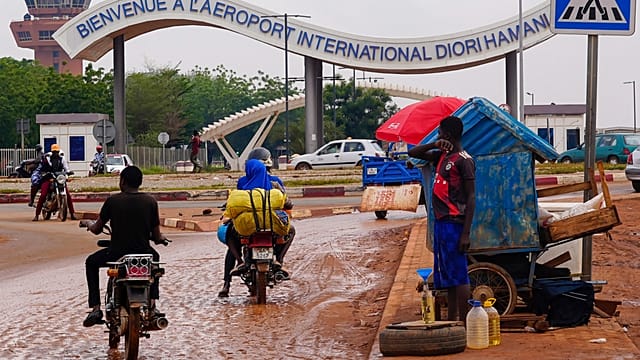
Gunfire and explosions were reported in Niger's capital Niamey on Saturday near a military base at the international airport and the presidential palace, with authorities stating they were regaining control after an apparent attack by army insurgents in one of most dangerous countries. [1] [2]
Attack Unfolds in Niamey
Residents of Niger's capital Niamey on Saturday reported hearing gunfire overnight near a military base at the international airport. [5] "There is heavy gunfire and explosions at Base 101 in Niamey," one local resident told AFP, a report confirmed by several other witnesses. [5] Insurgents from within the armed forces tried to enter the presidential palace in Niamey but were repelled by the presidential guard, with shooting ongoing. [1] Heavy gunfire and explosions were heard overnight in several neighbourhoods, including near the presidential palace, the airport, and the administrative area. [1] [2] Niger's military said it was gradually regaining control after mutineers held soldiers hostage at a base next to the capital's airport and fired shots. [1] Videos online showed armoured vehicles deployed to reinforce the neighbourhood near the airport. [5] The origin of the gunfire is still unknown, and no official communication has yet been issued in some reports. [5]
Military Response and Official Statements
Niger's military on Saturday said it was "gradually regaining control" after mutineers started holding soldiers hostage at a military base next to the capital's airport and fired shots. [1] In a statement read out on public television and signed by Defence Minister General Salifou Mody, the authorities called on the public to "remain calm and freely go about their business". [1] Bana Ibrahim, a member of Niger’s Bureau of the Consultative Council, announced the attack on Facebook. [2] “Another cowardly attack against Base 101 and once again our defense and security forces have ensured,” Mr Ibrahim posted on the microblogging platform. [2] He added that the situation is “under control.” [2] State television was off air for over an hour before being restored at about 10am local time. [1] Witnesses reported that the attack continued after Mr Ibrahim’s post. [2]
Uncertainty Over Attackers' Identity
While the motive of the attack or the identity of the assailants remain unclear, analysts shared diverse opinions, with some blaming the attack on jihadists and others suspecting coup plotters. [2] Hasret Kargin, a conflict researcher, said “there is currently no information on whether the attack was carried out by jihadists or was an attempted coup.” [2] “Given the recent attacks, rebel groups could also be added to the list of possibilities,” he added. [2] Wasim Nasir, a French journalist who has been reporting on violence in the Sahel, posted on X that Saturday’s attack is likely a “coup d’état” and/or a settling of scores between military personnel. [2] As of the time of this report, the government has yet to issue further official statements about the attack. [2] Analysts are divided on whether the attack was carried out by jihadists, an attempted coup, or involved rebel groups, with no immediate claim of responsibility. [2] [5]
Context of Prior Jihadist Attacks
This marks the third related incident in the junta-led country this year, following two earlier jihadist attacks on parts of Niamey including the airport. [2] [5] Niamey airport has been targeted twice this year by jihadists, first by the Islamic State in the Sahel (EIS) in January, then again in late June by their rivals the Group for the Support of Islam and Muslims (JNIM), the Sahel branch of Al-Qaeda. [5] Twenty assailants were killed and four soldiers wounded in the January assault, authorities said at the time. [5] In June, at least 11 soldiers and two civilians were killed, as well as 22 attackers, according to the defence ministry. [5] Both attacks were repelled by the army. [5] The rival jihadist groups not only target civilians and the military but are also struggling for dominance over the other in the Sahel, and especially in Niger. [5]
Broader Instability in Niger Among Most Dangerous Countries
Niger has been ruled for three years by a military leadership that has struggled to contain jihadist violence, which has blighted the west African country for around a decade. [5] The military junta, led by Abdourahamane Tchiani, seized power from a democratically elected government in July 2023, and subsequently detained the President, Mohamed Bazoum. [2] General Abdourahamane Tiani, head of the military regime that emerged from a coup in July 2023, spoke in January of "a flaw in the system" that "enabled the attack," whose "objective was to destroy all of the air capabilities" of the army. [5] Since overthrowing the democratic government, Mr Tchiani’s regime has been tested by unending jihadi attacks and the country’s fallout with the regional Economic Community of West African States (ECOWAS). [2] The EIS and JNIM are also active in neighbouring Burkina Faso and Mali, both allies of Niger and ruled by military juntas that seized power in coups. [5] The three countries quit the Economic Community of West African States (ECOWAS) bloc, turned their backs on traditional Western partners in the fight against jihadist violence, especially France, and sought closer ties with Russia. [5]
What to watch next: The military junta continues to face multiple threats from groups like the Islamic State and al-Qaeda affiliates in Lake Chad and the Sahel, with previous attacks carried out by jihadists and no one claiming responsibility for the ongoing violence. [2]