Nepal's Natural Disasters: Flood Death Toll Climbs to 538 as Barrier Lake Overflows
Nepal's death toll from this week's devastating floods and mudslides triggered by a Himalayan glacier collapse has risen to 538, with 977 people still missing, as a newly formed barrier lake overflows and threatens renewed flooding that has already halted rescue operations amid the country's ongoing natural disasters. [2]
Rising Death Toll and Missing Persons
The death toll from devastating floods in Nepal has risen to 538, the National Disaster Risk Reduction and Management Authority said in a statement on Friday. [2] Chitwan district recorded the highest number of deaths at 221, followed by Nawalparasi East with 134 and Dhading with 33. [2] Deaths were also reported in several other districts. A total of 977 people remain missing, including 517 foreigners, according to the authority. [2] Rescue and search operations are continuing in the affected areas. [2]
New Barrier Lake Forms After Glacier Collapse
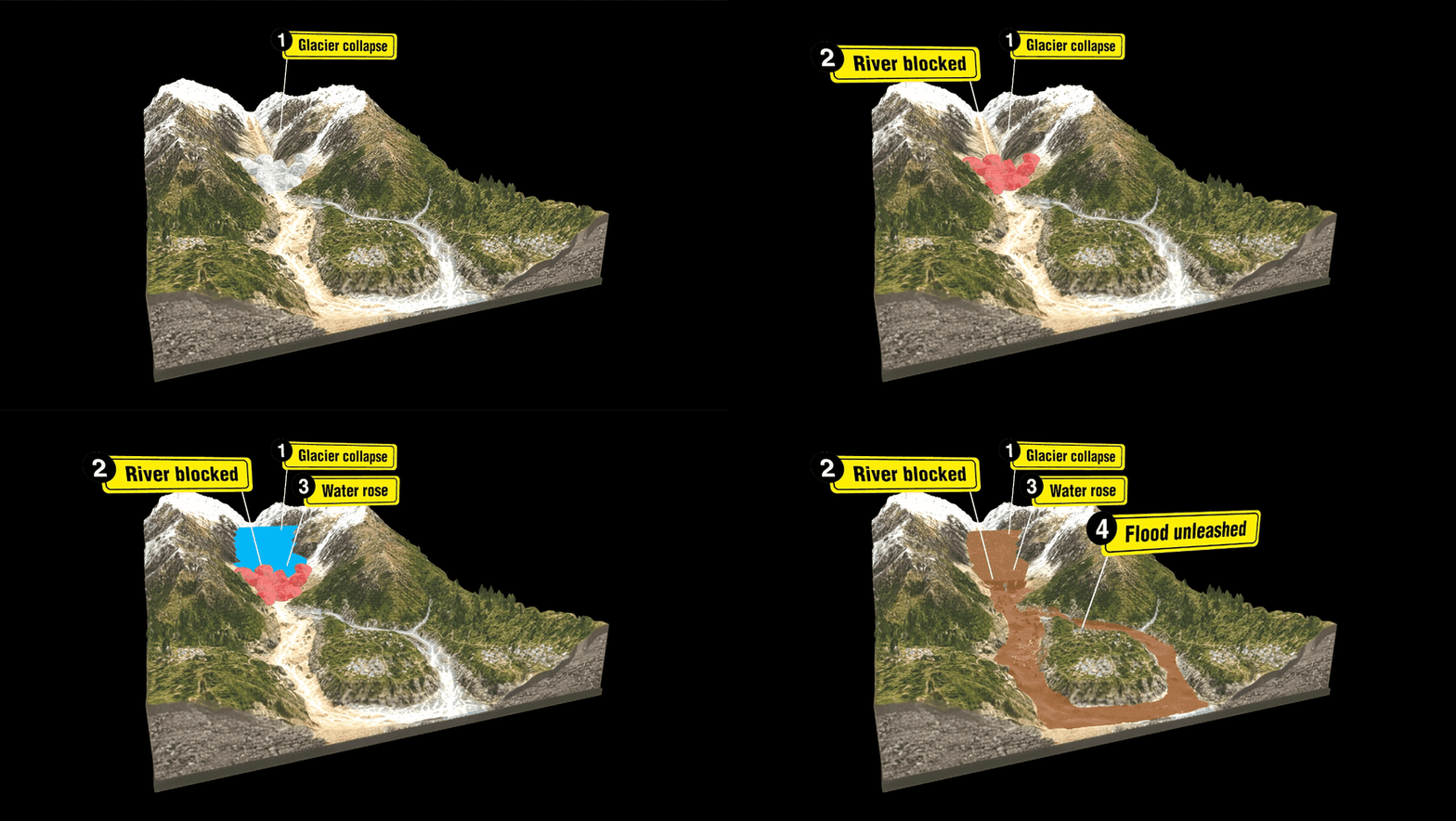
Two days after a glacier collapse sent a catastrophic flood roaring through parts of Nepal and Tibet on Wednesday, a newly formed river has broken the banks, and a renewed flood threat is looming. [1] The river breach on Friday halted rescue operations in the area after flash floods and mudslides caused by glacial collapse from the Himalayas led to 469 confirmed deaths at that time. [1] More than 1,000 people remain missing across Nepal and China’s Tibet. [1] A lake has formed by the buildup of debris at the border of Nepal and China at the flood site, and as it continues to rise, it increases the flood risk. [1] On Friday, officials in Nepal’s Rasuwa district said they had been notified that the barrier lake had begun to overflow. [1] “We can see that the level of water in the river is rising,” Narendra Pariyar, Rasuwa’s most senior bureaucrat, said. [1] He added that it is currently unclear how high the water level is. [1]
Scientists Warn of Outburst Flood Danger
Scientists say this disaster has created not one but two new lakes. [1] One has formed high up near the glacier, where meltwater is now trapped. [1] The other, much larger and more dangerous lake sits on a river in Nepal, where a huge landslide blocked the valley and dammed the river. [1] Nepali and Chinese authorities warned on Thursday that the lower lake had formed due to the buildup of debris at the site of the flood. [1] The lake is rising in level, which means it can burst, Nepal’s National Disaster Risk Reduction and Management Authority warned. [1] The lake is near the confluence of the Chhochen Khola and Purepu Tsangpo rivers on the Lhende river system in Nepal. [1] It is flowing upstream of the Bhotekoshi and Trishuli rivers that carry water south towards Kathmandu. [1] The glacial collapse which resulted in the Wednesday flash floods also caused mudslides, pushing rock, ice, mud and debris into river systems. [1] “The new lake appears to be an avalanche-induced barrier lake. The ice-rock avalanche deposited a huge volume of rock, ice and debris in the river valley, blocking or severely constricting the drainage,” Pawan Bhattarai, assistant professor at the civil engineering department of Nepal’s Kathmandu-based Tribhuvan University, told Al Jazeera. [1] China’s Ministry of Water Resources estimated on Thursday that the lake is holding about 1.5 to 2 million cubic metres of water and warned that about 3 million cubic metres more could flow in over three days. [1] This is the equivalent of about 1,200 Olympic-sized swimming pools. [1] “The danger is not just the lake itself, but the possibility of sudden dam failure. In a steep valley like this, even a short-lived breach can generate a fast-moving debris-laden flood with very little warning for downstream communities,” Bhattarai said. [1]
Challenges to Rescue and Mitigation Efforts
Rescue efforts have been impeded due to the floods and mudslides. [1] In the hard-hit Rasuwa district, they were paused on Friday since the barrier lake broke its banks. [1] However, after the brief pause, the efforts were resumed. [1] China’s state broadcaster CCTV said on Friday that the risks from the overflowing barrier lake were “manageable”. [1] According to a World Health Organization official on Friday, six health facilities have been damaged by the floods, and eight health workers are missing. [1] Nepal has said it does not need help from abroad. [1] “The offer for help is natural. Our security agencies are doing the search and rescue operation. For now we don’t require such help,” Lok Bahadur Chhetri, Foreign Ministry spokesperson, said on Friday. [1] Chinese authorities said they have mobilised an engineering team comprising eight members to carry out aerial surveys and 3D modelling of the barrier lake. [1] “After the glacier collapse created the lake, many isolated cliffs and steep cliffs appeared along it,” one of the engineers, Chen Hanxiao, told CCTV. [1]
Heartbreaking Scenes at Rescue Camps
I enter the camp to an absolutely heartbreaking scene. [5] Hundreds of people are queuing outside, desperately trying to see if they can find their loved ones. [5] This army camp in Nuwakot, one of the main districts in central Nepal affected by devastating flash floods and massive landslides, has been turned into a search-and-rescue centre. [5] Inside, a woman cradling an infant in her arms is crying hysterically. [5] Her entire family, including her father, husband and mother, are all missing. [5] She is traumatised, and in so much pain. [5] There are other people who have sustained injuries, and some who say they had miraculously survived. [5] One driver who was working in Rasuwa tells us he'd been thrown into the water when the floods hit. [5] He still doesn't know how he managed to survive. [5] Yet while thankful to be alive, he is also devastated - he's also lost more than 20 of his friends. [5] At one point while filming, a woman - perhaps in her 60s or 70s - is taken out of a helicopter and brought to the centre to be treated. [5] She suddenly collapses. [5] I later learn she has died. [5] Every hour at the camp there are dozens of helicopters coming and going, and many people are receiving treatment. [5] At least 12 helicopters were mobilised by Nepal's government to continue search and rescue operations. [5]
Context of Similar Past Disasters
While this exact barrier river has not formed before, glacial collapse and glacial lake outburst floods have happened before in the Himalayas. [1] “Similar cascading events have happened before. Nepal’s 2012 Seti flood is an important example, where rockfall, temporary river blockage and a rock-ice avalanche combined to generate a destructive flood,” Bhattarai said. [1] “The exact mechanism in Rasuwa is still being investigated, but the broader process is not unprecedented.” [1] In July 2016, the lower part of a valley glacier in Tibet’s Aru Range detached, sending about 68 million cubic metres of ice down the mountain and killing nine herders and hundreds of animals. [1] “The avalanche and formation of the natural dam itself were probably not preventable,” Bhattarai explained. [1] “However, the consequences could potentially have been reduced through better satellite monitoring, rapid detection of river blockage and lake formation, real-time river monitoring, timely evacuation, and strong Nepal-China transboundary early-warning systems.” [1]
What to watch next: Officials continue to monitor the rising water levels in the barrier lake on the Nepal-China border, with Chinese engineering teams conducting aerial surveys and 3D modelling as risks from overflow are assessed as manageable.