Houthi Forces Seize Full Yemeni Red Sea Coast in 18-Hour Offensive in Current Wars in the World
Houthi forces have seized the entire Yemeni Red Sea coast in an 18-hour offensive, gaining control of the Bab al-Mandab strait and escalating the war with Saudi Arabia while prompting Trump to decline direct US airstrikes despite requests from Riyadh. This development forms part of current wars in the world as the rapid advance tightens Houthi influence over a key maritime route.
Houthi Offensive Captures Yemeni Coast
Houthi rebels completed their lightning capture of the full western Yemeni coastline in just 18 hours, dealing a major blow to the Saudi-backed government and improving their access to the Bab al-Mandab strait through which about 10-12 percent of global trade normally passes. [2] The offensive allowed the Houthis to outmatch fragmented Yemeni government forces through experience gained since the October 2023 Hamas attack and the use of Iranian-supplied ballistic missiles and drones. [2] Analysts described the Houthi fighting force as more advanced than the one Saudi Arabia faced roughly a decade earlier, crediting Iranian weapons for building an impressive arsenal. [2]
Trump Declines Saudi Request for Airstrikes
US President Trump reversed an initial approval for American airstrikes on the Houthis after a personal appeal from Saudi Crown Prince Mohammed bin Salman, instead offering only intelligence support; no new US strikes have occurred since the latest escalation. [1] The Saudi crown prince called Trump twice to request direct US airstrikes, but Trump refused and provided intelligence assistance instead. [2] US Secretary of State Marco Rubio stated that the United States has a defense agreement with Saudi Arabia and intends to fulfill its obligations, while describing the Yemen conflict as a very dangerous and complex one. [1] Trump had previously threatened multiple times to attack the Houthis following their July-declared blockade against Saudi ships in the Red Sea. [1]
Escalation Links Yemen War to Regional Conflicts in Current Wars in the World
The offensive builds on Houthi gains from attacks on shipping linked to Israel and experience gained since the October 2023 Hamas attack, using Iranian-supplied ballistic missiles and drones that have allowed them to outmatch fragmented Yemeni government forces. [2] Houthi actions in solidarity with Gaza began after the October 2023 Hamas attack on Israel, with the group firing rockets and drones toward Eilat and attacking Red Sea vessels. [2] Renewed fighting between Israel and Iran this year prompted the Houthis to resume their blockade of Israel-linked ships in June, drawing the Yemen conflict deeper into the wider regional war. [2] The Houthis have long adopted an anti-imperialist and anti-Zionist slogan as part of an ideology close to Iranian revolutionary rhetoric, though it remained largely symbolic until 2023. [2]
Humanitarian Impact and Displacement Surge
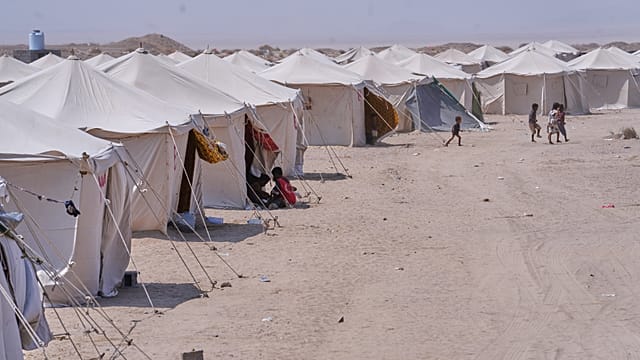
Renewed fighting has already displaced more than 130,000 people inside Yemen with the UN warning the figure could exceed 230,000, while over 3,000 Yemenis have fled by sea to Djibouti since early September with projections reaching 10,000 soon. [4] The UN refugee agency reported that the number of refugees crossing to Djibouti could reach 10,000 by next month once sea conditions improve. [4] The agency’s operations in Djibouti are only 15 percent funded, and it is appealing for more than $13 million to ensure essential services amid the expected arrivals. [4] In Yemen the UNHCR urgently needs $25 million to aid the tens of thousands newly displaced on top of the 5.2 million people already displaced by years of war. [4]
Oil Markets React to Strait Threat
Oil markets reacted sharply to the threat to Bab al-Mandab, with Saudi crude shipments through the strait dropping sharply and analysts forecasting Brent crude could reach $120-125 per barrel if the conflict prolongs. [2] Saudi Arabia increased the capacity of its pipeline from Abqaiq to Yanbu from five to seven million barrels per day after Iran closed the Strait of Hormuz, resulting in 21 percent more Saudi oil heading toward Bab al-Mandab than before the war. [2] Saudi crude shipments through the strait fell to about 400,000 barrels per day in August, with the number of transits dropping 60 to 70 percent as shippers avoided the route and a further 46 percent decline following the latest escalation. [2] Analyst Helima Croft of RBC Capital Markets warned that maritime traffic through Bab al-Mandab is seriously threatened by the Houthi advance, with projections from Goldman Sachs and Bank of America indicating Brent could rise toward 120 dollars or reach a range of 95 to 125 dollars by year end if fighting continues. [2]
Background of Houthi Capabilities
The Houthis took further parts of the Yemeni west coast during a lightning offensive that gave them even better access to the Bab al-Mandab strait at the entrance to the Red Sea. [1] The group had already disrupted world trade with attacks on shipping in the region since 2023, prompting the US military to bomb targets in Yemen in 2024 and 2025 before a truce was reached through Omani mediation. [1] Earlier US strikes ended only after Oman’s mediation, and the United States and the EU launched military operations at the time to protect commercial vessels. [1] Trump decided against the strikes after US commanders had already approved targets in Yemen and US fighter jets had been loaded with bombs. [1] Around the same time, US government representatives met directly with Houthi representatives in Oman, where the Houthis pledged not to attack US or Israeli ships around Bab al-Mandab. [1]
What to watch next: Saudi Arabia continues to fire dozens of missiles at Houthi-controlled areas with no visible effect so far, while the UN monitors whether refugee crossings to Djibouti reach the projected 10,000 and whether funding shortfalls limit aid delivery.