
Ethiopian Rebel Alliance Captures Mekelle Airport as Yemen Refugee Flows to Djibouti Accelerate
New Ethiopian Rebel Alliance Launches Offensive
On September 20, seven Ethiopian armed groups including historic enemies formed the Ethiopian People's Forces Alliance for Survival to overthrow Prime Minister Abiy Ahmed's government and establish a transitional administration. [1] The alliance brings together a diverse coalition of groups from different parts of the country, ranging from Tigray in the north to the Fano militias in Amhara, the Oromo Liberation Army and other armed groups. [1] Some of these formations have fought one another in the past, but for the time being they have set aside their differences to unite against the central government. [1] The alliance's stated objective is to overthrow the federal government and establish a transitional administration. [1] The groups involved regard Abiy Ahmed's rule as a direct threat to the survival of their respective communities. [1] The rebel coalition announced a few days ago has gone on the offensive, and one of its main components, the Tigray People's Liberation Front, has captured Mekelle airport. [1] The TPLF, a key member of the alliance, has captured Mekelle airport as the coalition goes on the offensive. [1] This development marks the first major military action by the newly formed Ethiopian People's Forces Alliance for Survival, which unites groups that previously opposed each other during the 2020-2022 civil war. [1] The offensive signals an escalation that could draw additional armed formations into coordinated operations across multiple regions of Ethiopia. [1]
Government Response and Alleged Eritrean Role
The government in Addis Ababa has said that the members of the alliance had been cooperating for some time with financial support from Eritrea. [1] Addis Ababa states that alliance members have been cooperating with financial support from Eritrea. [1] The Ethiopian government states that alliance members have been cooperating with financial support from Eritrea. [1] The conflict in Ethiopia could therefore reignite and draw in a significant part of the Federation, with possible repercussions for the wider regional balance of power. [1] The conflict could reignite across a significant part of Ethiopia with repercussions for the regional balance of power involving Eritrea, Sudan, Djibouti and Somaliland. [1] The government response highlights prior coordination among the groups, suggesting that the September 20 announcement formalized an existing pattern of cooperation backed by external financing. [1] Officials in Addis Ababa view the alliance as a direct challenge that could spread fighting beyond the northern regions where the TPLF operates. [1]
{IMAGE_2}
Strategic Implications for Red Sea Region
Ethiopia is, in fact, a strategically important hinterland from which the balance of power among the countries bordering the Red Sea can be influenced. [1] First and foremost there is Eritrea, which was already involved in the Tigray conflict. [1] Then there is Sudan, where, according to various allegations, supplies to the Rapid Support Forces are reportedly being delivered from bases in Ethiopia, and where drone attacks against Sudanese army targets may also have been launched from Ethiopian territory. [1] Finally, there are Djibouti and Somaliland, the northern region of Somalia that unilaterally declared independence in 1991 and has so far been recognized only by Israel. [1] Israel appears already to have a military facility in Somaliland and, according to an investigation by Haaretz, hosts an Eritrean opposition group in Tel Aviv. [1] Developments in the Ethiopian crisis are closely connected to events on the Asian side of the Red Sea, which inevitably have repercussions on the African side of this strategic maritime corridor. [1] While Yemen's Houthis now control access to the Bab el-Mandeb Strait, major and middle powers are moving to consolidate and expand their presence along the African shore. [1] The conflict could reignite across a significant part of Ethiopia with repercussions for the regional balance of power involving Eritrea, Sudan, Djibouti and Somaliland. [1] Ethiopia's position as a hinterland allows influence over Red Sea dynamics, including alleged Ethiopian support for Sudanese RSF, Israeli presence in Somaliland, and connections to Asian-side events such as Houthi control of Bab el-Mandeb. [1]
Major Powers Expanding Footholds on African Shore
China is expanding its military base in Djibouti, the only overseas military installation that Beijing officially acknowledges, raising concerns in France, the United States, Japan and Italy, which also maintain bases in the small but strategically important African country. [1] Such concerns may have prompted Washington to seek additional footholds in the region. [1] Eritrea could be one of them. [1] In recent days, the United States has lifted sanctions previously imposed on the Eritrean military and other entities. [1] The decision by the Trump administration has been interpreted as an attempt to strengthen relations with Asmara. [1] The sanctions had been imposed by the administration of Joe Biden in 2021 on the ruling party, the Eritrean armed forces and several senior officials, over their role in the war in neighbouring Ethiopia, where Eritrean forces supported Ethiopian troops fighting the local authorities in the northern Tigray region. [1] Washington is also active in Puntland, the autonomous region of Somalia that is at loggerheads with the government based in Mogadishu. [1] China's expansion of its Djibouti base, concerns from other nations with bases there, the US lifting of sanctions on Eritrean entities to strengthen ties, and US activity in Puntland reflect efforts by major powers to secure positions along the African shore. [1]
{IMAGE_3}
Yemeni Fighting Drives Refugee Flows to Djibouti
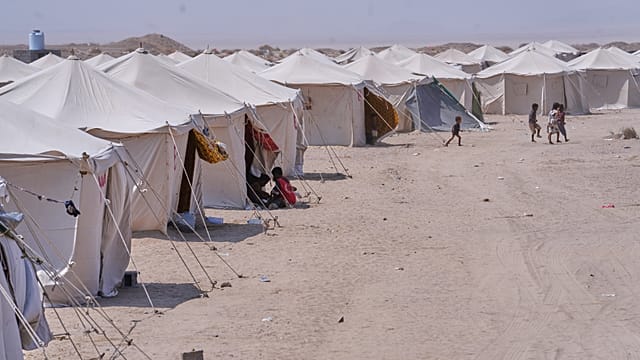
Renewed fighting in Yemen could see the number of refugees fleeing across the Red Sea to Djibouti jump to 10,000, while displacement inside Yemen could swell to over 230,000, the UN warned Tuesday. [2] Three thousand Yemenis have already risked the dangerous journey across the Red Sea since the start of September, fleeing renewed fighting at home. [2] The UNHCR says that number could jump to 10,000 by next month, once difficult sea conditions improve. [2] The agency is appealing for more than $13 million to ensure essential services. [2] In Yemen, more than 130,000 people have been displaced by the advance of Houthi rebels along the coast. [2] The UN is warning that number could surge to more than 230,000 on top of the 5.2 million people in the country already displaced by years of war. [2] The UN refugee agency says its Djibouti operations are only 15 percent funded and it is bracing for more people to arrive. [2] The UNHCR says it urgently needs $25 million to provide aid to the tens of thousands displaced. [2] Three thousand Yemenis have already fled to Djibouti since the start of September due to renewed fighting, with the UN projecting up to 10,000 arrivals once sea conditions improve. [2] Houthi advances along the Yemeni coast have displaced more than 130,000 people inside Yemen, a figure that could rise to over 230,000 on top of 5.2 million already displaced. [2] The UN warns that renewed fighting in Yemen could drive up to 10,000 more refugees across the Red Sea to Djibouti in the coming months. [2]
Broader Regional Repercussions
Developments in Ethiopia could therefore have repercussions far beyond the country's borders, involving the African states bordering the Red Sea and, more broadly, the strategic balance of one of the world's principal maritime corridors. [1] The Ethiopian developments connect to Red Sea balance of power and Yemeni crisis impacts on the African shore. [1] [2] The combination of the new rebel offensive in Ethiopia and the surge in Yemeni displacement creates overlapping pressures on Djibouti and neighboring territories. [1] [2] The UN projection of additional refugee arrivals coincides with Ethiopian alliance operations that could further destabilize the hinterland regions feeding into Red Sea routes. [1] [2] Funding shortfalls for UNHCR operations in Djibouti add to the strain as both crises unfold simultaneously. [2]
What to watch next: The TPLF capture of Mekelle airport and the UN warning of up to 10,000 additional Yemeni arrivals to Djibouti will test whether the Ethiopian alliance expands its offensive while sea conditions allow more crossings.







