Doomsday Clock Symbolism Grows as Putin Warns Armenia on EU Path
The Doomsday Clock remains a symbol of global geopolitical risks as tensions escalate between Russia and Armenia over Yerevan’s EU accession bid, amid accusations of Russian hybrid attacks in Europe, UK measures against Israeli settlements, and ongoing US-Denmark talks over Greenland.
Russia-Armenia Tensions Over EU Bid
Russia’s president Vladimir Putin has warned Armenia’s prime minister Nikol Pashinyan that Yerevan’s bid to join the European Union could disrupt trade with Moscow. [1] In a tense meeting on the sidelines of the Shanghai Cooperation Organisation’s summit in Kyrgyzstan’s capital on Tuesday, Putin said that Moscow needs clarity on whether Yerevan wants to join the EU in order to decide on the future of bilateral trade with Armenia. [1] Putin also said that Armenia joining the EU would be tantamount to declaring a break from the Eurasian Economic Union. [1] Putin told Pashinyan that while Russia is a key economic and trade partner to Armenia, Yerevan’s EU aspirations could create complications for its EEU membership. [1] “Armenia’s aspiration to join the EU is the natural and legitimate right of the country and its people. Armenia is a sovereign state, and it is for the Armenian people to determine the trajectory of their own development,” Putin said. [1] “Nevertheless, this unquestionably creates complications for Armenia’s continued membership in the Eurasian Economic Union, and threatens to erode the advantages the Republic enjoys on the EEU market and to sever established trade links,” he added. [1] Pashinyan however said Armenia’s decision last year to adopt a law launching the process of EU accession did not violate its obligations to Russia or the EEU and that it was only an alternative his government had given the people of Armenia. [1] In the first half of this year, bilateral trade reached $2.5 billion. [1]
Armenia’s Pivot to the West
Relations between the two countries have reached historic lows as Yerevan pivots toward the West, prompting sharp economic and political retaliation from Moscow. [1] After the fall of the Soviet Union in 1991, Armenia became Russia’s closest ally in the South Caucasus with the two nations developing their trade, economic and political ties. [1] Armenia has also long been Russia’s closest regional ally, a Collective Security Treaty Organization member, host to a Russian military base and is dependent on Russian gas. [1] Currently, Russia is Armenia’s key trade and economic partner accounting for roughly 30 percent of its trade, and an investor in Armenia’s economy. [1] But despite economic ties, relations between the two countries have been tense since 2023, after the historical conflict in the Nagorno-Karabakh region of Azerbaijan erupted again. [1] Russia, which is fighting its own war in Ukraine, did not intervene militarily when Azerbaijan launched a major military offensive in Nagorno-Karabakh. [1] Laurențiu Pleșca, a political analyst and researcher focusing on EU enlargement and European security at the German Marshall Fund of the United States told Al Jazeera that Moscow not supporting Yerevan during the Karabakh war in 2023, led to Armenia’s pivot to the West. [1] He said that this however upset Moscow – further souring relations. [1] “Russia started blocking imports of Armenian goods and is threatening to suspend the duty-free supply of gas, oil products, and diamonds to Armenia,” he said. [1] “The EU, in turn, has pledged economic support to offset that pressure,” he added. [1] In early July, the European Commission’s President Ursula von der Leyen also told Yerevan that it could count on the EU amid any economic pressure from Russia and pledged an additional 18 million euros as part of a broader 52 million euros economic support package. [1] Last April, Armenia’s president signed into law a bill that set the legal foundation for the country to move towards joining the EU. [1] In July this year, Pashinyan told lawmakers in the country that Armenia would decide its future EU membership by holding a referendum “in the near future.” [1]
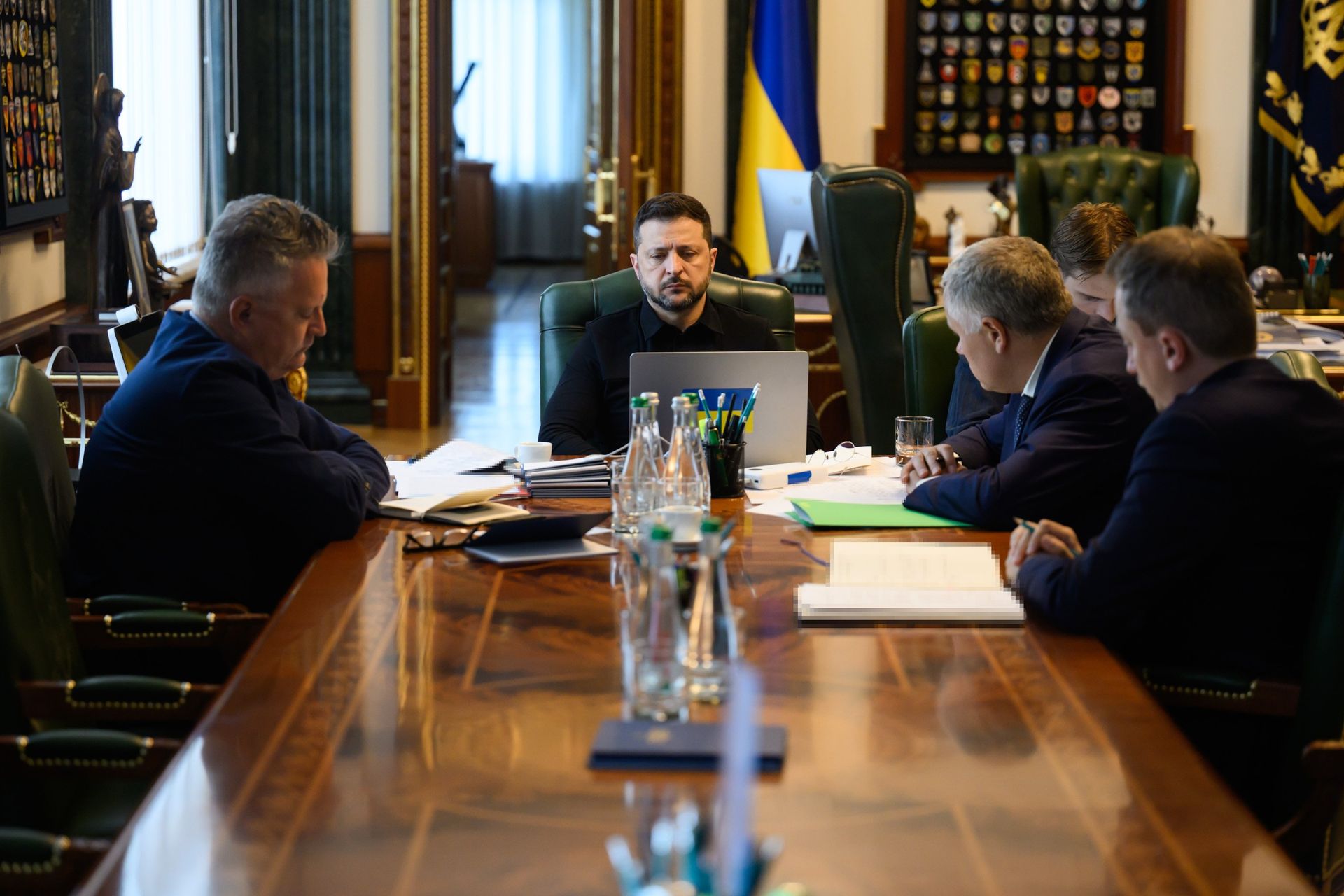
Zelensky reaffirms support for Germany as Berlin accuses Russia of Leipzig hybrid attack. — Source: kyivindependent
Russian Hybrid Activity in Europe
Ukraine assured German Chancellor Friedrich Merz that it stands ready to assist after Berlin accused Russia of an attempted attack on Leipzig Airport, President Volodymyr Zelensky said on Sept. 2. [2] “I assured (Chancellor Merz) that Ukraine is ready to help — with expertise, experience, or in other areas where Germany may need it,” Zelensky said on X after a phone call with Merz. [2] The drones were discovered on Aug. 4 at Leipzig/Halle Airport, with one colliding with a cargo plane. [2] Another reportedly carried explosives that were intended to strike a Ukrainian Airlines Antonov cargo plane stationed. [2] The company has been based in Leipzig since the early days of Russia's full-scale invasion. [2] German officials linked the drones to Russia by comparing their parts and configuration to those used by the Kremlin in previous hybrid attacks. [2] The German government on Sept. 1 officially accused a Russian intelligence service of attempting to carry out a drone attack on its territory, making this the first time Germany has directly blamed Russia. [2] "We have clear indications from our intelligence services and partner agencies, as well as from investigations in Germany and in our European partner countries, of Russian involvement," said German Interior Minister Alexander Dobrindt during a press conference. [2] "This is yet another Russian escalation, and it is important that Germany responded," Zelensky said. [2] The Kremlin denied responsibility for the attack and accused Germany of escalating tensions. [2] Western officials have been raising alarm over increasingly frequent cases of suspected sabotage, arson, and cyberattacks, many of which were linked to Russian intelligence. [2]
UK Response to Israeli Settlements
British Foreign Secretary Ed Miliband said Britain will introduce a "comprehensive" package of measures concerning Israeli settlements in the occupied West Bank in the coming weeks, while Israel warned Britain on Tuesday that it would respond to any sanctions. [3] Miliband told MPs during his first questioning in the House of Commons on Tuesday, 1 September, that Israel's E1 settlement project will carve out an area of land on which Palestinians seek to establish their state and "threatens to make the establishment of a Palestinian state unviable". [3] "This government will not accept the undermining of the two-state solution... We will act, and I will announce a comprehensive set of measures in the coming weeks," he said. [3] Miliband acknowledged that new illegal Israeli settlements in the occupied West Bank "seek to destroy the prospect of implementing the two-state solution", and said in response to a question from an MP, "We simply cannot stand by and let that happen." [3] However, the minister did not give a clear commitment to a comprehensive ban on trade with settlements. [3] In response to another question, the minister said, "We are already looking at our broader economic relationship with the occupied territories and the various tools we have to address it." [3] Israeli Foreign Minister Gideon Sa'ar said in a podcast, "If Britain takes action against the State of Israel, the State of Israel will take action against Britain." [3]
US-Greenland Diplomatic Track
U.S. President Donald Trump's assertions that the U.S. must acquire Greenland, a semi-autonomous Danish territory, sparked tensions between Washington and Copenhagen, both founding NATO members, and more broadly across Europe, although the issue has since moved to a diplomatic track. [4] "The officials are working hard to resolve the situation. Unfortunately, I cannot share the details of those talks, but what I can tell you is that our dialogue is ongoing," Egede said during a debate in the European Parliament. [4]
Broader Geopolitical Context
Israel has plans ready to forcibly remove Palestinians from the Gaza Strip but is waiting for the United States to figure out where to take them, the defence minister boasted on Wednesday. [5] "There is no real solution for Gaza in the end without this migration," Defence Minister Israel Katz told a conference hosted by Israeli news site Ynet and newspaper Yedioth Ahronoth. [5] The Israeli government "is organised and prepared to get them out—by sea, by air, by every way possible", he said. [5] Katz said that Trump had only "frozen" the idea as he looks for countries to take in Palestinians, as Egypt is not an option. [5] "The plan hasn't been cancelled; it is being discussed all the time, even now, and I think there is no other solution for everyone's good," he said. [5] "But for it to happen, we need the US. When will we get their approval? Whenever it becomes clear that Hamas is not meeting its obligations" under the ceasefire, he said. [5] Katz, without citing his source, said 80 percent of people in Gaza wanted to leave but that Hamas was preventing them. [5]
What to watch next: Dialogue between Greenland and the US continues over Trump’s assertions that the US must acquire the Danish territory, while the UK plans to announce a comprehensive package of measures against Israeli settlements in the West Bank within weeks.