Yemeni Forces Begin Campaign to Retake Sana’a From Houthis in Most Dangerous Countries
Yemeni government forces have launched a major counteroffensive against the Houthis on multiple fronts with the explicit goal of retaking Sana’a, coinciding with Houthi drone and missile attacks on Saudi Arabia that injured 73 people in one of the most dangerous countries. The campaign was announced by Deputy Defense Minister Maj. Gen. Samir al-Sabri, who stated the decision to liberate Sana’a has been finalized. Advances are reported in Al-Jawf, Al-Bayda, Taiz, and Al-Hudaydah, though not fully independently verified. [1]
Yemeni Government Launches Offensive to Retake Sana’a
Deputy Defense Minister Maj. Gen. Samir al-Sabri said on official Yemeni television that “the decision to liberate Sana’a has been finalized and taken decisively,” adding that government forces were advancing on several fronts. [1] He said the objective was to restore state institutions and end Houthi control of the capital. [1] The Iranian-backed Houthis have controlled Sana’a since late 2014. [1] Government officials say the current campaign has brought advances in the governorates of Al-Jawf, Al-Bayda, Taiz, and Al-Hudaydah. [1] Those claims have not been independently verified in full, though recent reporting has confirmed intensified fighting in Al-Jawf and Al-Bayda. [1] Col. Majid al-Nuzaili, the official spokesperson for the Yemeni Armed Forces, said on X that “the Houthi group has attempted over the past years to impose on Yemeni society a project that transcends politics, attempting to alter the very nature of the religious, social, and cultural life that Yemenis have known throughout their history.” [1]
Houthi Cross-Border Attacks on Saudi Targets
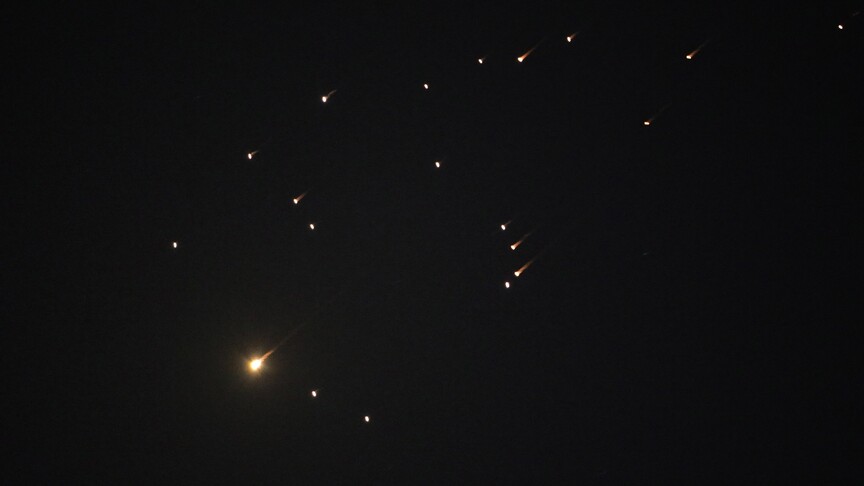
The renewed fighting has coincided with Houthi missile and drone attacks on Saudi Arabia. [1] Saudi authorities said Houthi attacks on Sept. 8 struck sites in Abha, Jazan, Najran, and Khamis Mushait, injuring 73 people and causing fires and operational disruptions at energy facilities. [1] The Houthis said the attacks were retaliation for Saudi military operations in Yemen. [1] Brig. Gen. Yahya Saree, the Houthi movement’s spokesperson, said on X that the operations in Yemen constituted “Saudi aggression.” [1] He asserted that “Saudi Arabia is carrying out these operations,” not the Yemeni army, and threatened further attacks if the campaign continued. [1] Yemen’s conflict is escalating on two fronts. [3] Since July, the de-facto authority (DFA) in the north of Yemen (also known as the Houthis), which controls much of the country’s mountainous northwest, has launched a series of cross-border attacks on Saudi oil and gas infrastructure and sought to impose a de facto blockade on Red Sea oil exports from Saudi Arabia. [3]
Background of Stalemate and Renewed Fighting in Most Dangerous Countries
The Houthis have controlled Sana’a since late 2014. [1] Saudi Arabia launched Operation Decisive Storm with a Saudi-led coalition in March 2015, followed by Operation Restoring Hope the next month, but neither campaign succeeded in removing the group from the capital. [1] Fighting eased after a UN-brokered truce in 2022, though Yemen remained divided between Houthi-held territory in the north and areas administered by the internationally recognized government and southern forces. [1] Starting in August, the DFA began a crossline missile and drone campaign. [3] Yemen’s conflict is escalating on two fronts as the de-facto authority has launched cross-border attacks. [3]
Shifted Tactics and Military Preparations
Hamed al-Ruba’i, a retired colonel in the Yemeni army, told The Media Line, “The battle to liberate Sana’a effectively began several years ago, through preparations, unifying the ranks of the armed forces, winning over Yemeni tribes, and securing military equipment, supplies, plans, training, and other resources.” [1] He continued, “The plan was clear: we wouldn’t begin until we were completely ready for this battle to ensure its success. Now is the most opportune moment, as the whole world has become aware of the danger posed by the Houthi militia, after their repeated targeting of several neighboring countries, shipping in the Bab el Mandeb Strait, and maritime traffic in the Red Sea, actions carried out on Iranian orders.” [1] Ahmed al-Sabahi, a Yemeni military analyst, told The Media Line, “The battle to liberate Yemen from the Houthis will depend on the armed forces’ ability to engage in street battles to eliminate what remains of them.” [1] Mohammed al-Kamel, a military analyst, told The Media Line, “The Yemeni army has changed its war tactics against the Houthis, starting with cutting off their supply lines, launching surprise attacks, and opening multiple fronts.” [1] He continued, “Drones are also being used in some attacks, and there are also warplanes providing air cover for the ground forces. Therefore, the armed forces’ tactics this time are more serious in liberating Sana’a.” [1]
What to watch next: Saudi Arabia said in a Foreign Ministry statement that “the Kingdom reserves the right to respond to these attacks in self-defense,” while the path for diplomacy remains open. [1]