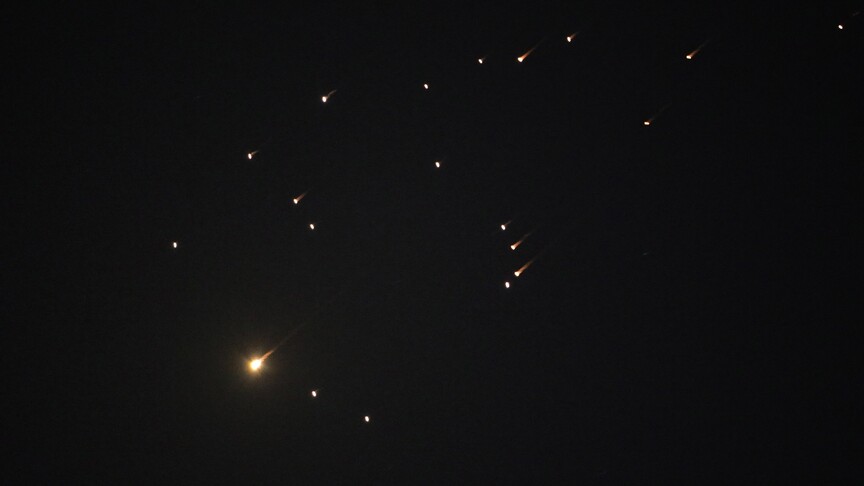

Projectiles Hit Several Areas in Southern Iran's Sirik
Projectiles struck several areas in Sirik in southern Iran on Wednesday, with explosions also reported in coastal locations including Minab and Qeshm Island. Iranian state media reported that several areas in Sirik were hit by projectiles, though details on damage or casualties were not immediately available. [3] Explosions were heard in Minab and on Qeshm Island, with sounds coming from the direction of the sea. [1]
Projectiles Strike Southern Iran
Iranian state media reported that several areas in Sirik were hit by projectiles on Wednesday. [3] Further details regarding the strikes, including the extent of the damage or potential casualties, were not immediately available. [3] The reports came amid a broader series of incidents along Iran's southern coast, where projectiles struck multiple locations according to state media accounts. [1] These developments were described as part of ongoing exchanges that have involved both shipping targets and other assets in the region.
Explosions Reported in Multiple Coastal Areas
Explosions were heard in Minab and on Qeshm Island, with sounds coming from the direction of the sea. [1] An explosion was also reported in the southern part of the Iranian port city of Jask, originating from the sea. [4] Iran's Fars news agency reported the blast in Jask late on Wednesday and stated that no details were available on the source or cause of the explosion. [4] These reports followed similar accounts of blasts in other coastal spots, all tied to sounds emanating from the sea direction. [1]
Context of Escalating Attacks on Shipping
Iran said on Wednesday it had attacked 10 ships near the Strait of Hormuz after the U.S. sank five Iranian oil tankers. [2] The incidents represent the biggest wave of attacks on shipping by both sides since the start of the six-month-old war. [2] At least one seafarer aboard a tanker was reported killed and another listed as missing. [2] The attacks sent the price of oil surging, with benchmark Brent crude futures breaching $100 a barrel for the first time since July. [2] Iran also said it had fired ballistic missiles at a base used by U.S. forces in Jordan as part of the same sequence of events. [4] Attacks by both sides since the end of August have shattered a month of relative calm, with the U.S. and Iran hitting military, shipping and energy assets. [4]
Ballistic Missile Strike on Jordan Base
The IRGC also said on Wednesday it had fired ballistic missiles at a base used by U.S. forces near Al Azraq, in eastern Jordan. [4] Jordan said its air defences had intercepted 18 of the 20 Iranian missiles, with two falling harmlessly in unpopulated areas. [4] A U.S. official said Iran’s strikes in Jordan were ineffective and all American troops were accounted for. [4] The U.S. military’s Central Command called its own attacks a response to Iran’s Islamic Revolutionary Guard Corps targeting a U.S. Navy warship twice with ballistic missiles over the previous two days. [4] No Americans were harmed, the U.S. said. [4]
Iranian Threats of Further Escalation
The Revolutionary Guards said they would sharply escalate their response to any further attacks, hitting 20 targets if the enemy struck two or three. [4] Iran would soon release maps of a new, enlarged off-limits zone at sea that would extend as far as Chabahar on the far reaches of Iran’s coast near Pakistan, the Guards said. [4] Iran also threatened oil tankers in Kuwaiti and Bahraini ports, according to a statement carried by state media. [4] Washington has announced a new policy of attacking Iranian tankers in retaliation for fire that threatens its warships, and says it has hit 10 so far over the past week. [4]
Impact on Oil Markets and Regional Stability
The attacks sent the price of oil surging, with benchmark Brent crude futures breaching $100 a barrel for the first time since July. [2] Even more severe than the rise in crude prices has been a surge in the cost of the fuels refined from it. [4] The politically sensitive average retail price of U.S. diesel hit a fresh all-time high on Wednesday above $5.94 a gallon. [4] Flows through Hormuz had fallen back as low as 2 million barrels per day, having reached as high as 8 million to 9 million bpd in the week before fighting resumed on August 30. [4] UN Secretary-General Antonio Guterres appealed to all sides to “exercise utmost restraint” and avoid inflaming the already volatile situation in and near the Strait of Hormuz. [4] Recent days have also seen an escalation in fighting between Saudi Arabia and the Houthis in Yemen, a second theatre of war that threatens global energy supplies from the Middle East. [4] On Tuesday, the Houthis launched an attack on four cities in Saudi Arabia, causing huge fires visible from space at oil installations. [4] Saudi authorities said 73 people were wounded. [4]
What to watch next: The Revolutionary Guards have indicated they will sharply escalate responses and release maps of a new enlarged off-limits maritime zone extending to Chabahar, while flows through the Strait of Hormuz have already dropped sharply and UN calls for restraint continue amid the Yemen escalation.