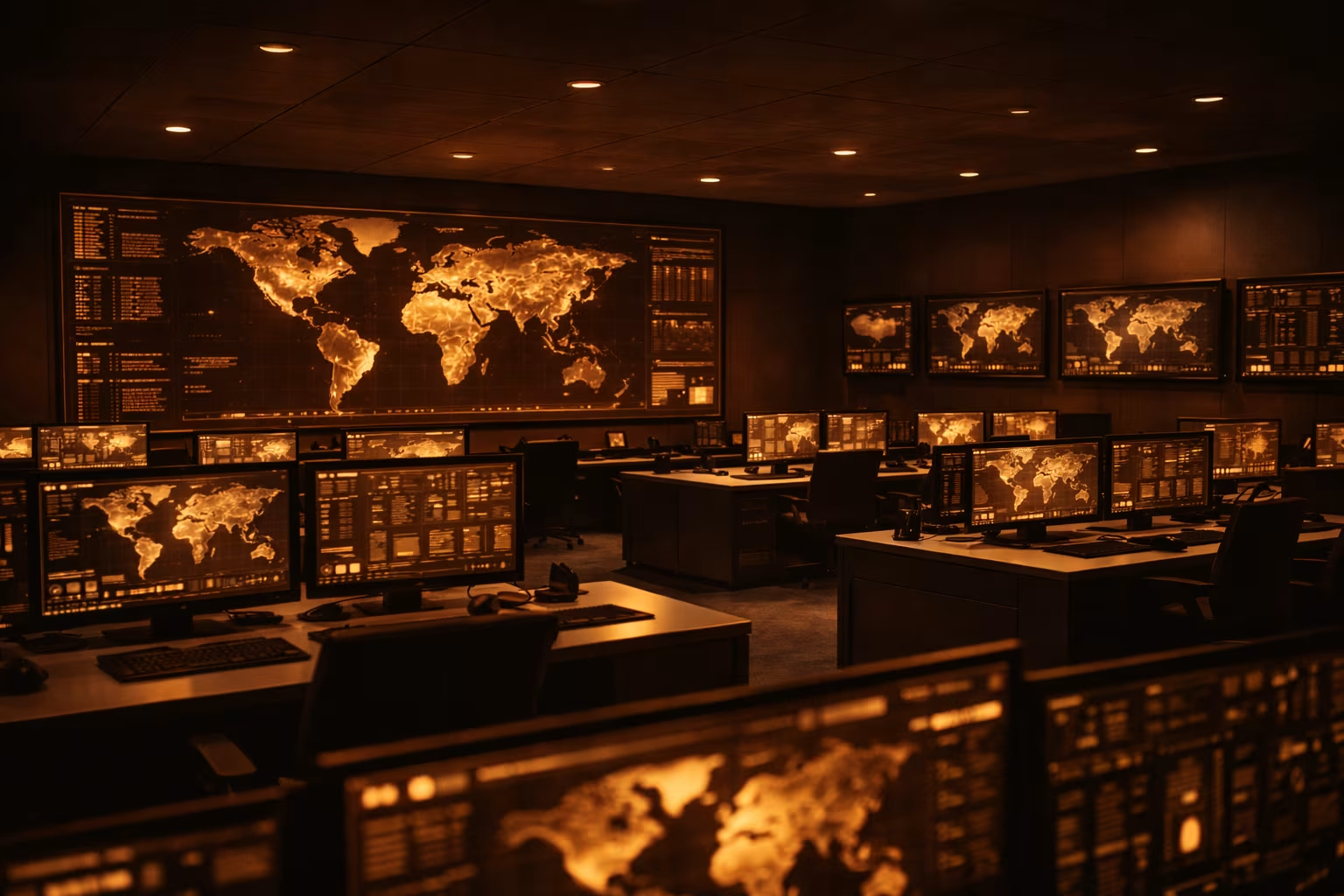
A WW3 map visualizes the conflict zones, nuclear arsenals, and military alliance networks that could escalate into a third world war. As of 2026, the primary flashpoints are the Russia-Ukraine front (risk of NATO Article 5 invocation), the Taiwan Strait (US-China military standoff), and the Iran-Israel war (direct strikes between nuclear-capable states). Nine countries possess a combined 12,100 nuclear warheads, with Russia (5,580) and the United States (5,044) holding 88% of the global arsenal. This interactive map tracks these risks in real time using live intelligence data.
WW3 Flashpoint Surface
Active conflict zones and nuclear arsenals
Escalation Pathways
How regional conflicts could trigger World War 3
War Economy Dashboard
How global conflict risk is pricing into markets right now
Defense & Aerospace
Escalation hedge
Safe Haven
Flight to safety
Energy & Commodities
Supply disruption risk
Crypto & Risk Assets
Risk-off sensitive
Active conflict and strike events
War, conflict, and strike updates ordered by recency. Each event links to full intelligence detail and Catalyst market impact analysis.
| Event | Type | Severity |
|---|---|---|
💥 Gaza Death Toll Exceeds 73,300 Israeli fire kills 9 more in Gaza, pushing the death toll past 73,300 with nearly 174,000 injured according to the Health Ministry. | Conflict | CRITICAL |
💥 Sudan Kordofan Ethnic Cleansing Claims Reports of possible ethnic cleansing campaign in Sudan's Kordofan region amid ongoing military airstrikes and violence. | Conflict | HIGH |
🎯 Russian Strike on Kyiv Russian overnight attack partially destroyed a residential building in Kyiv's Dniprovskyi district, injuring four people. | Strike | HIGH |
⚔️ Zelenskyy: US has plans to end Ukraine war President Zelenskyy stated that the United States has several ideas for ending the Russia-Ukraine war and announced he will visit the US in the coming days or weeks. | War | CRITICAL |
⚔️ Six Months of Middle East War Six months of war in the Middle East, marking a significant milestone in the ongoing regional conflict. | War | CRITICAL |
🎯 US strikes Ecuadorian fishing boats US airstrikes on Ecuadorian fishing boats raise humanitarian concerns; Trump administration stands firm. | Strike | MEDIUM |
🎯 Russia-Ukraine Overnight Strikes Russia launches missiles and drones at four Ukrainian regions killing four; Ukraine strikes Russian oil refinery. | Strike | HIGH |
💥 Saudi-Houthi Standoff in Yemen Saudi-Houthi standoff over Iranian flights to Sanaa tests ceasefire and risks reigniting Yemen's war | Conflict | HIGH |
⚔️ Potential new war in Yemen Analysis on why a potential new war in Yemen could be different for the Houthis. | War | HIGH |
💥 Kherson emergency threat from attacks Kherson declares threat of emergency situation due to Russian attacks on energy infrastructure. | Conflict | HIGH |
Catalyst highlights
Event-driven market context
GEOPOLITICS / WATCH
Cambodia Urges Fair Border Deal and Sovereign Equality at UN
Cambodia called for a fair and lasting border settlement with Thailand while pressing for sovereign equality among nations at the United Nations. The statement emphasizes mutual respect and peaceful resolution of longstanding territorial disputes between the two neighbors.
GEOPOLITICS / WATCH
Japan Fears China Will Exploit Trump-Xi Summit Against Tokyo
Japan is concerned that China may leverage the upcoming Trump-Xi summit to advance its anti-Tokyo narrative. In response, Japanese officials including PM and Takaichi are seeking direct briefings and calls with Trump to align strategies.
GEOPOLITICS / WATCH
Brunei Advocates Quiet Diplomacy in South China Sea and Palestinian Justice
Brunei favors quiet diplomacy and measured defense ties with Beijing to maintain stability in the South China Sea rather than direct confrontation. The nation also stresses that lasting peace requires justice for Palestinians, warning the issue tests the credibility of the United Nations.
GEOPOLITICS / HIGH
Xi presses Trump on Taiwan red lines amid military purges
Chinese President Xi Jinping is pushing Donald Trump to halt arms sales to Taiwan and oppose independence as key red lines during their summit. Meanwhile, China's military purges raise questions about PLA readiness while both sides discuss AI safeguards, trade truce extensions, and Iran's role in escalating US-China tensions.
About this tracker
Current Global Flashpoints
Several active conflict zones carry the potential to draw in major powers and escalate beyond regional boundaries. The global conflict map tracks these in real time, but the flashpoints most relevant to a World War 3 scenario deserve focused attention because of the alliances, nuclear capabilities, and strategic interests they involve.
The Russia-Ukraine war remains the most direct confrontation between a nuclear-armed state and a Western-backed adversary since the Cold War. NATO members supply weapons, intelligence, and training to Ukraine while Russia has repeatedly referenced its nuclear doctrine when discussing existential threats to its territory. Any miscalculation involving NATO territory — whether a stray missile crossing into Poland or an escalation in the Black Sea — could trigger Article 5 collective defense obligations and bring the world's two largest nuclear arsenals into direct conflict.
The Taiwan Strait represents the highest-stakes flashpoint in the Indo-Pacific. China considers Taiwan a breakaway province and has not ruled out military force to achieve reunification. The United States maintains strategic ambiguity but has repeatedly signaled it would defend Taiwan. A Chinese blockade or amphibious assault would likely draw in Japan, Australia, and other regional allies, potentially igniting a conflict between the world's two largest economies.
The Middle East contains multiple overlapping conflicts that could chain-react into wider war. Iran's nuclear program, its proxy network spanning Lebanon, Syria, Iraq, and Yemen, and direct tensions with Israel and the Gulf states create a web of triggers. An Israeli strike on Iranian nuclear facilities or a major Houthi escalation in the Red Sea could pull in the United States and destabilize global energy supplies. Track ongoing developments on our Iran conflict page.
The Korean Peninsula remains technically at war, with North Korea's expanding nuclear arsenal and intercontinental ballistic missile program posing a direct threat to South Korea, Japan, and the US mainland. Kim Jong Un's regime has conducted over 100 missile tests in recent years, and any miscalculation during a provocation cycle could spiral into a conflict involving 28,500 US troops stationed in South Korea.
The India-Pakistan border, particularly in Kashmir, is the only place on Earth where two nuclear-armed states engage in regular military skirmishes. Both nations have fought four wars since 1947, and terrorist attacks originating from Pakistani territory have previously brought them to the brink. With combined nuclear arsenals exceeding 300 warheads, even a limited exchange would have catastrophic global consequences.
Nuclear-Armed States and Their Alliances
Nine countries currently possess nuclear weapons, and the alliance structures binding them together define the fault lines along which a global war would unfold. Understanding these blocs is essential for interpreting the signals that appear on our Catalyst intelligence platform.
The NATO alliance comprises 32 member states bound by Article 5 mutual defense. Three NATO members — the United States, the United Kingdom, and France — possess independent nuclear arsenals totaling approximately 6,065 warheads. The US also stations tactical nuclear weapons in Belgium, Germany, Italy, the Netherlands, and Turkey under nuclear sharing arrangements. NATO's combined conventional military spending exceeds $1.2 trillion annually.
Russia maintains the world's largest nuclear stockpile at roughly 5,580 warheads, including strategic intercontinental missiles, submarine-launched ballistic missiles, and an estimated 1,000-2,000 tactical nuclear weapons. Russia's alliance network includes the Collective Security Treaty Organization (CSTO) with Armenia, Belarus, Kazakhstan, Kyrgyzstan, and Tajikistan, though the organization's cohesion has weakened since the Ukraine invasion.
China possesses an estimated 500 nuclear warheads and is rapidly expanding its arsenal, with Pentagon projections suggesting it could reach 1,500 by 2035. China's strategic partnerships with Russia, formalized in the 2022 "no limits" partnership, and its growing influence in the BRICS bloc (Brazil, Russia, India, China, South Africa, plus new members) represent an emerging counterweight to Western alliances.
India (172 warheads), Pakistan (170 warheads), Israel (estimated 90 warheads, undeclared), and North Korea (estimated 50-70 warheads) round out the nuclear club. Each operates within distinct alliance frameworks and threat perceptions. India balances between the Quad (US, Japan, Australia) and its traditional Russian relationship. Pakistan relies on its strategic partnership with China. Israel maintains its policy of nuclear ambiguity while deepening ties with Gulf states through the Abraham Accords.
The current global risk level, updated continuously on our risk index page, factors in nuclear posture changes, alliance tensions, and military deployments to assess the overall threat environment.
What Would World War 3 Look Like?
A third world war would bear little resemblance to the trench warfare of World War I or the massed armor campaigns of World War II. Modern great-power conflict would unfold across multiple domains simultaneously — land, sea, air, space, and cyberspace — with artificial intelligence accelerating decision cycles beyond human comprehension.
Cyber warfare would likely precede any kinetic action. State-sponsored hackers would target power grids, financial systems, water treatment facilities, and communications infrastructure. The 2017 NotPetya attack, attributed to Russian military intelligence, caused $10 billion in damage and disrupted shipping giant Maersk, pharmaceutical company Merck, and Ukraine's banking system. A wartime cyberattack would be orders of magnitude more destructive, potentially disabling entire national infrastructures before a single missile launched.
Hypersonic weapons have fundamentally altered the strategic calculus. Traveling at Mach 5 or faster and capable of maneuvering in flight, these missiles compress decision-making time from minutes to seconds. Russia's Kinzhal and Zircon, China's DF-ZF, and the US's developing programs create a "use it or lose it" pressure on nuclear command structures, increasing the risk of accidental escalation.
Economic warfare would weaponize the global financial system. Sanctions, asset freezes, SWIFT disconnections, and trade embargoes would fragment the world economy into competing blocs. The precedent set by freezing $300 billion in Russian central bank reserves demonstrates that financial infrastructure itself has become a battlefield. Energy supplies, semiconductor manufacturing, and rare earth mineral access would become strategic targets. Our Catalyst platform tracks these economic disruption signals alongside military events.
Space-based assets — GPS satellites, communications networks, and surveillance systems — would be primary targets in the opening hours of a conflict. Anti-satellite weapons tested by Russia, China, India, and the US could create debris fields that render entire orbital bands unusable, disrupting civilian life worldwide. The loss of GPS alone would affect aviation, shipping, precision agriculture, and emergency services globally.
AI-enabled autonomous weapons systems are already deployed in limited roles and would proliferate rapidly in a major conflict. Drone swarms, autonomous submarines, and AI-assisted targeting systems would accelerate the pace of warfare while raising profound questions about escalation control when algorithms make life-and-death decisions faster than human oversight can function.
How This Map Tracks Escalation Risk
The World Now's WW3 map aggregates real-time intelligence from multiple data sources to provide a continuously updated picture of global escalation risk. Unlike static analyses that become outdated within hours, this system processes events as they happen and surfaces the patterns that matter most for understanding whether the world is moving toward or away from wider conflict.
Our data pipeline ingests conflict events from verified news sources, military tracking databases, and official government statements. Each event is classified by type (war, conflict, strike, military exercise), severity (low, moderate, high, critical), and geographic location. The system then applies temporal decay — recent events carry more weight than older ones — and clusters activity by region to identify emerging hotspots.
The risk scoring model synthesizes conflict intensity, nuclear posture indicators, alliance activation signals, and economic disruption metrics into a single composite score displayed on the risk index. This score updates every five minutes as new events enter the system. Sustained clustering of high-severity events in strategically sensitive regions triggers elevated risk assessments that appear in the hotspot rankings.
Market signals provide an independent validation layer. Defense sector equities, gold prices, oil futures, and government bond yields all respond to geopolitical risk in measurable ways. When conflict events align with flight-to-safety market movements, the signal is stronger than either data source alone. The Catalyst platform connects these dots automatically, identifying which events are moving markets and which are being priced in.
Cross-reference this page with the global conflict map for the full spectrum of active conflicts, the Doomsday Clock tracker for historical context on existential risk assessment, and the current wars page for detailed breakdowns of ongoing armed conflicts worldwide.
Defense Spending and Military Readiness
Global defense spending crossed $2.4 trillion in 2023 and continues to accelerate as great-power competition intensifies. The scale and direction of military investment across major powers offers one of the clearest signals for whether the international order is trending toward stability or conflict. Tracking how defense budgets translate into operational capability is essential for understanding the real balance of power behind the alliance maps and nuclear counts discussed above.
NATO set a benchmark of 2% of GDP for defense spending at its 2014 Wales Summit, yet for years most members fell short. The Russia-Ukraine war changed that calculus dramatically. By 2024, 23 of 32 NATO allies were meeting or exceeding the 2% target, up from just 7 in 2022. Poland leads the alliance at over 4% of GDP, while the Baltic states and Nordic newcomers Finland and Sweden have all sharply increased procurement budgets. The United States remains the alliance's backbone with an $886 billion defense budget for FY2024 — roughly 40% of global military spending — funding 11 carrier strike groups, a nuclear triad modernization program estimated at $1.5 trillion over 30 years, and over 750 overseas bases across 80 countries.
Russia's defense spending surged to an estimated 6% of GDP following the Ukraine invasion, prioritizing ammunition production, hypersonic missile deployment, and nuclear modernization. The Sarmat ICBM, Poseidon nuclear torpedo, and Burevestnik nuclear-powered cruise missile represent a new generation of strategic delivery systems designed to defeat Western missile defenses. Despite battlefield losses in Ukraine, Russia has demonstrated an industrial capacity to sustain high-intensity warfare that exceeded Western intelligence estimates.
China's official defense budget of $230 billion is widely believed to understate actual spending by 40-60% when accounting for research, paramilitary forces, and space programs. The People's Liberation Army Navy has grown into the world's largest fleet by hull count, commissioning warships at a rate that outpaces the rest of the world combined. China has also built over 300 new ICBM silos, tested fractional orbital bombardment systems, and invested heavily in cyber warfare and counter-space capabilities. The pace of this buildup suggests China is preparing military options that extend well beyond a Taiwan contingency.
These spending trends are not abstract numbers — they translate directly into the military capabilities and readiness levels that determine how quickly a regional conflict can escalate. Monitor how shifts in military readiness affect the composite threat assessment on our global risk index, and track defense sector market impact as procurement announcements and arms deals move equities in real time.
How to Prepare: Civil Defense in a Nuclear Age
While full-scale nuclear war remains unlikely — deterrence, economic interdependence, and diplomatic channels all work against it — the elevated state of great-power tension makes basic civil defense awareness a prudent measure rather than an exercise in alarmism. Governments, emergency management agencies, and public health organizations have published extensively on preparedness, and understanding the fundamentals can reduce both physical vulnerability and the psychological toll of living in an uncertain era.
FEMA, the US Federal Emergency Management Agency, maintains detailed guidance for nuclear and radiological emergencies. The core principles are straightforward: get inside, stay inside, and stay tuned. Concrete and underground structures provide the best protection from both blast effects and radioactive fallout. A basement or interior room in a sturdy building without windows significantly reduces radiation exposure. The general rule of thumb is that every seven hours after detonation, residual radiation drops by a factor of ten — so sheltering in place for 24 to 72 hours after an event dramatically improves survival odds.
Emergency communication systems form the backbone of any response. NOAA Weather Radio and the Emergency Alert System broadcast on dedicated frequencies that function even when cellular networks are overwhelmed. Battery-powered or hand-crank radios should be part of every emergency kit. Many countries operate similar national alert systems, including the UK's Emergency Alerts, Japan's J-Alert, and Israel's Home Front Command notifications. Knowing which channels to monitor and keeping a charged, offline-capable device accessible is a simple but critical step.
A properly stocked emergency kit covers the basics that become scarce in any crisis: one gallon of water per person per day for at least three days, non-perishable food, a first aid kit, prescription medications, flashlights, batteries, and important documents in a waterproof container. For radiological scenarios specifically, potassium iodide (KI) tablets can protect the thyroid gland from radioactive iodine if taken within hours of exposure, and basic radiation detection cards or dosimeters are inexpensive additions that provide situational awareness.
Psychological preparedness is equally important. Anxiety about global conflict is a rational response to real risks, but chronic dread is counterproductive. Mental health professionals recommend staying informed through reliable, data-driven sources rather than doomscrolling social media, maintaining routines, and focusing on actionable steps within your control. Having a plan — a meeting point for family, a communication protocol, a stocked kit — converts abstract fear into concrete readiness. For the current assessment of existential risk levels, consult our Doomsday Clock tracker, which contextualizes today's threats within the broader arc of nuclear history.
Frequently Asked Questions
Is World War 3 happening?
World War 3 is not currently happening in the traditional sense of a declared global conflict between major alliances. However, several active conflicts involve nuclear-armed states or their proxies, and the overall level of great-power tension is at its highest point since the Cold War. The Russia-Ukraine war, Taiwan Strait tensions, and Middle Eastern conflicts all carry escalation risks that could draw in additional powers. This page tracks these flashpoints and their escalation potential in real time.
What countries would be involved in WW3?
A World War 3 scenario would likely involve the major alliance blocs: NATO (32 members including the US, UK, France, Germany) on one side and a Russia-China partnership on the other. Regional nuclear powers — India, Pakistan, Israel, and North Korea — could be drawn in depending on the trigger. The most likely catalysts are a direct NATO-Russia confrontation over Ukraine, a US-China conflict over Taiwan, or a Middle Eastern war involving Iran and Israel that pulls in global powers.
What are the biggest risks for WW3?
The biggest risks are miscalculation and escalation in existing conflict zones rather than a deliberate decision to start a world war. Specific risks include: a NATO-Russia incident in the Baltic or Black Sea, a Chinese military action against Taiwan, an Israeli strike on Iranian nuclear facilities, a North Korean provocation that spirals out of control, or a India-Pakistan crisis triggered by a terrorist attack. The compression of decision-making time by hypersonic weapons and cyber warfare increases the probability of unintended escalation.
How does The World Now track conflict escalation?
The World Now uses a multi-layered intelligence system that ingests conflict events from verified news sources in real time, classifies them by severity and type, and applies geospatial clustering to identify emerging hotspots. A composite risk score integrates conflict intensity, nuclear posture changes, alliance activation signals, and correlated market movements. The system updates every five minutes and surfaces critical patterns through the Catalyst platform, which connects geopolitical events to their market impact.
What is the current global conflict risk level?
The current global conflict risk level is displayed in real time on this page and the global risk index. The score is computed from the volume and severity of active conflict events, the involvement of nuclear-armed states, alliance posture changes, and correlated market stress indicators. The score updates continuously as new events are processed. Check the DEFCON indicator and threat board on this page for the latest assessment and breakdown by contributing factor.
What is the current DEFCON level?
The official US military DEFCON (Defense Readiness Condition) level is classified and not publicly disclosed in real time. The World Now computes its own DEFCON-equivalent indicator based on our composite risk score, which synthesizes active conflict intensity, nuclear posture signals, alliance activation, and correlated market stress. The scale mirrors the traditional five levels: DEFCON 5 represents the lowest threat (normal peacetime readiness), while DEFCON 1 indicates maximum military readiness and imminent conflict. Our assessment is editorial and data-driven — it is not official government data. View the full methodology and contributing factors on our <a href="/global-risk-index">global risk index page</a>.
What would happen to the economy in WW3?
A World War 3 scenario would trigger massive economic upheaval across every sector. Defense stocks and military contractors would surge as governments ramp procurement. Safe-haven assets — gold, US Treasuries, the Swiss franc, and the Japanese yen — would rally sharply as investors flee risk. Energy prices would spike dramatically as supply routes through the Strait of Hormuz, the Suez Canal, and the Black Sea face disruption or blockade. Global supply chains would collapse, particularly for semiconductors concentrated in Taiwan and rare earth minerals dominated by China. SWIFT disconnections and financial sanctions would fragment the international banking system into competing blocs. Cryptocurrency would experience extreme volatility, potentially rallying as an alternative to sanctioned fiat systems or crashing under regulatory crackdowns. The War Economy Dashboard on this page tracks these dynamics in real time. For granular, event-by-event market impact analysis, use our <a href="/catalyst">Catalyst platform for real-time market impact of geopolitical events</a>.
Where are nuclear weapons located?
Nine states possess nuclear weapons with a combined arsenal of approximately 12,100 warheads. Russia holds the largest stockpile at roughly 5,580 warheads, followed by the United States at approximately 5,044. China has an estimated 500 warheads and is expanding rapidly. France maintains around 290, the United Kingdom 225, India 172, Pakistan 170, Israel an estimated 90 (officially undeclared), and North Korea approximately 50. These arsenals are deployed across three primary delivery systems: land-based intercontinental ballistic missiles (ICBMs), submarine-launched ballistic missiles (SLBMs), and strategic bombers. The nuclear arsenal layer on the interactive globe above visualizes these positions geographically. For the full picture of military deployments and conflict zones, see the <a href="/global-conflict-map">global conflict map</a>.
Explore next
Related intelligence surfaces
Last updated 9/26/2026, 9:50:20 PM