
U.S. Strikes Iranian Rocket Launchers on Larak Island in Strait of Hormuz
U.S. forces struck two Iranian rocket launchers on Larak Island in the Strait of Hormuz on August 30, the first American military action against Iran in a month, prompting Iran to launch ballistic missiles at U.S. bases in Jordan.
U.S. Strike on Larak Island
U.S. forces struck Iranian rocket launchers on the Strait of Hormuz in their first military action in a month on Sunday, breaking a lull in fighting during an intermittent war that has lasted more than six months. [1] U.S. Central Command said Revolutionary Guard forces were preparing to launch rockets carrying sea mines into the strait. [1] The U.S. had cleared mines from shipping routes the previous week. [1] Tim Hawkins, a spokesperson for the U.S. Central Command, confirmed that forces with the Revolutionary Guard Corps were observed preparing to launch rockets with sea mines into the strait. [4] The U.S. military last week completed clearing sea mines from the strait’s international shipping routes. [1] Semiofficial news outlets in Iran reported sounds of explosions near Larak island on the strait. [1] U.S. military officials described the strikes as a "limited, precise action" against what they said were minelaying forces. [1] “In essence, Iran created the threat and the U.S. military eliminated it to protect civilian mariners, commercial shipping, and the free flow of global commerce,” U.S. Central Command said in a statement late Sunday. [1]
Iranian Casualties and Retaliation Vow
Iran's Revolutionary Guard reported several fighters and civilians killed or wounded in the strike on Larak Island and vowed retaliation. [1] The Guard in a statement carried by Iran's state broadcaster noted “the martyrdom and injury of several of our fighters and compatriots.” [1] The IRGC says the US attack on Larak Island killed and wounded several Iranian fighters and civilians, according to Iran’s state broadcaster IRIB. [2] Iran’s Revolutionary Guards said the attack killed and wounded several soldiers and citizens and would be met with a “response and punishment” from Tehran, Iranian state media reported. [3] A Guard spokesperson, Gen. Hossein Mohebi, said in a statement carried by Iranian media that Sunday's attack was a “fatal mistake by the Trump regime during the economic war” and the enemy will pay the consequences militarily and economically. [1] The head of the national security commission of the Iranian parliament Ebrahim Azizi condemned the attack saying on X, "Retesting our will only makes the cost of your humiliating defeats even heavier. Undoubtedly, no crime, at any level, goes unanswered; a response that is devastating, more painful, and instructive, which will complete the chain of your failures. Wait in fear and terror!" [4]
Missile Attack on Jordan Bases
Iran fired ballistic missiles at U.S. bases in Jordan; Jordan's armed forces intercepted eight missiles that entered its airspace early the next day. [1] Iranian state television showed what it said were ballistic missiles being fired by Iran at U.S. bases in Jordan in response to the American strikes. [1] Iran’s Revolutionary Guards launched ballistic missile attacks on US bases in Jordan in retaliation for US strikes on Iranian launchers on Larak Island. [3] Jordan’s armed forces said they intercepted eight missiles that entered Jordanian airspace on Monday. [3] Nearly all incoming missiles “have been intercepted at this point,” with no significant impact reported so far. [3] Iran’s Revolutionary Guards said on Monday, August 31, that it launched an attack on the King Hussein and Al Azraq US bases in Jordan with ballistic missiles in response to the American attack on Larak Island, Iranian media reported. [3]
Broader Conflict Context
The strike breaks a lull since July 29 and comes days after the Trump administration shifted emphasis to economic sanctions, including secondary sanctions against entities doing business with Iran. [1] The last time the U.S. military confirmed targeting Iran was on July 29, when it announced a “heavy wave of strikes” on dozens of Revolutionary Guard targets including coastal surveillance and defense sites. [1] On Aug. 1, President Donald Trump said he would order the military to hold off on new strikes at the urging of Gulf allies Qatar, Saudi Arabia and the United Arab Emirates. [1] The attack comes just days after the Trump administration said it would turn its focus to increasing economic pressure — rather than military action — to try to end its war with Iran. [1] The shifting strategy centers on threats to punish any country or entity that continues to conduct business with Tehran. [1] The U.S. turn to using sanctions came as the administration weighs diminished munitions stockpiles after months of war, sparking concerns that the prolonged conflict could undermine U.S. military readiness in other parts of the globe. [1] The US and Israel attacked Iran on February 28 and Iran responded with its own strikes on Israel and Gulf states that host US bases. [3] The Iran war has now crossed the six-month mark. [3]
Strait of Hormuz Disruptions
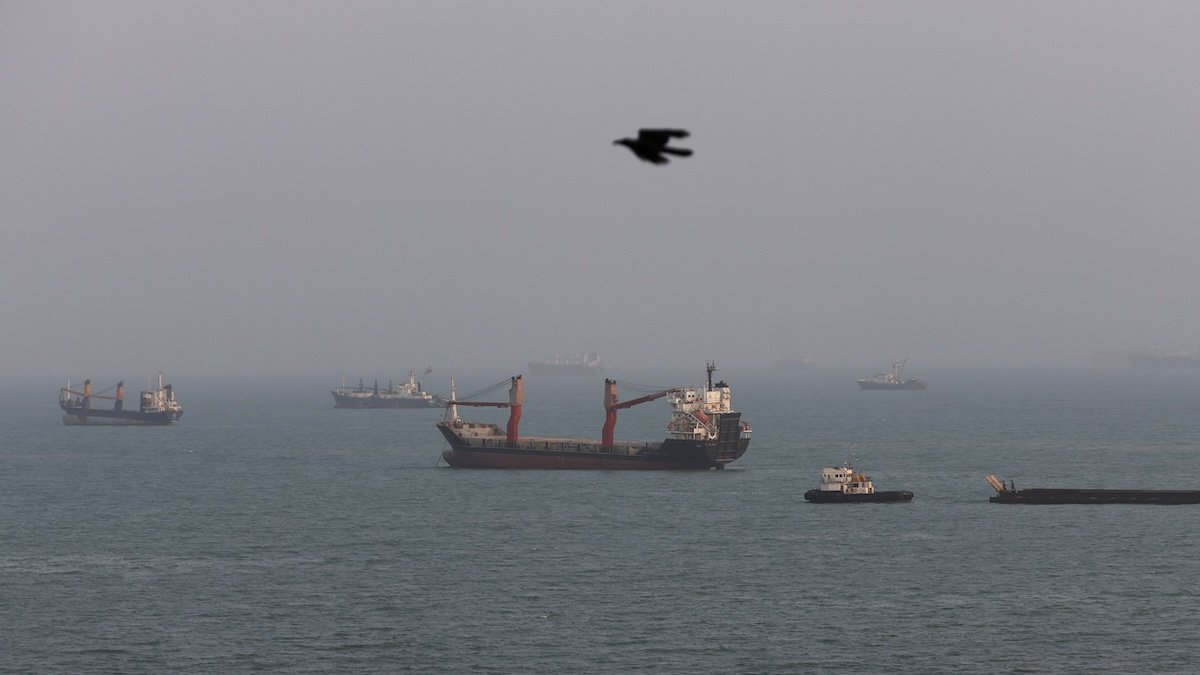
Commercial traffic through the Strait of Hormuz remains at reduced levels, far below pre-war volumes, amid the six-month conflict that began February 28. [1] The strait normally carries about 20% of the world’s oil, but relatively few tankers carrying crude and liquefied natural gas are now willing to risk the route. [4] Trump has repeatedly declared that the “Strait of Hormuz is open,” saying 24 vessels passed through last week. [1] But that’s a fraction of the roughly 130 vessels that transited daily before the war began. [1] Earlier on Sunday, a multinational coalition overseen by the U.S. Navy said commercial traffic through the strait remained at “reduced levels.” [1] The U.S. military said that as of Sunday, it had redirected 83 commercial vessels and disabled three under its blockade of Iranian ports. [1] A monitoring agency run by the British military said an unknown projectile struck a tanker ship on Saturday north of Khasab, Oman, in the strait. [1] Tehran continues to assert that even after it works out a management plan for the strait with Oman, its neighbor on the other side of the waterway, the U.S. can't use it until it fulfills its obligations under the memorandum of understanding the countries signed in mid-June. [1]
Market and Regional Impact
Oil prices rose following the attack, with U.S. crude up 1.8% to $84.94 per barrel and Brent crude up 1.9% to $89.79. [1] Crude oil prices rose Sunday in response to the U.S. attack. [1] The price for a barrel of U.S. oil went up 1.8% to $84.94, while the price for a barrel of Brent crude, the international standard, rose 1.9% to $89.79. [4] A return to open conflict would be dangerous for the region, where Iran has targeted U.S. military bases and infrastructure in Gulf countries since the war began on Feb. 28. [1] The administration’s reliance on sanctions also comes as US officials weigh depleted munitions stockpiles after more than six months of conflict, raising concerns about the impact on American military readiness elsewhere. [4]
What to watch next: Iran’s Revolutionary Guard has vowed a response and punishment after the Larak Island strike, while the Trump administration continues weighing economic sanctions alongside concerns over munitions stockpiles and military readiness in other regions.