
Ukraine Strikes Kill at Least One and Injure Dozens as Russia Targets Energy Sites
The Ukraine strikes formed part of a large-scale aerial offensive that combined drones, cruise missiles and ballistic missiles against multiple Ukrainian regions, targeting energy infrastructure, residential areas and strategic sites, killing at least one person in Lviv and injuring dozens across the country. Regions hit include Kyiv, Lviv, Poltava, Dnipropetrovsk, Kryvyi Rih and Kharkiv, with air raid alerts sounding nationwide and residents sheltering in metro stations and basements. [1]
Massive Russian Aerial Assault Hits Multiple Ukrainian Regions
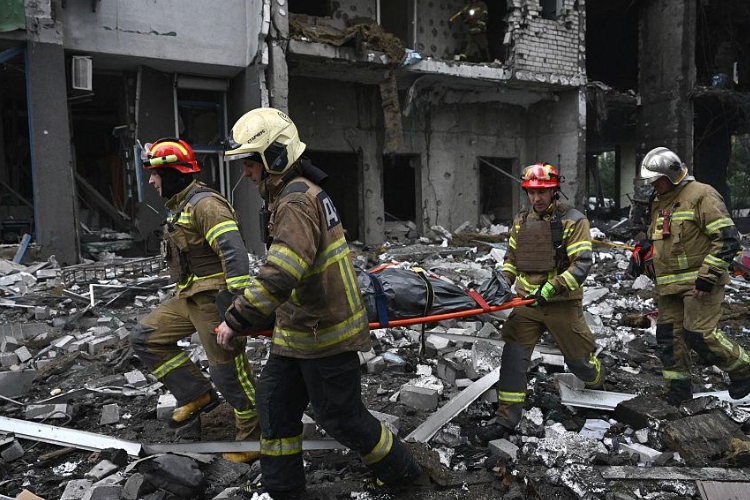
The Ukraine strikes unfolded during the night when air raid sirens activated across nearly the entire country as Russian forces launched hundreds of long-range drones together with dozens of missiles aimed at various cities. [1] The regions affected were Kyiv, Lviv, Poltava, Dnipropetrovsk, Kryvyi Rih and Kharkiv. [1] Local authorities reported successive explosions that forced thousands of residents to seek shelter in metro stations, basements and air-raid shelters. [1] Emergency teams worked for hours to extinguish fires and rescue people trapped under rubble. [1] The coordinated offensive produced fatalities and dozens of injuries, including minors, along with substantial damage to apartment buildings, shops and public infrastructure. [1] Emergency services in several cities had to intervene for extended periods to control fires started by missile impacts and to clear debris from collapsed structures. [1] Authorities warned that the casualty count could rise as search-and-rescue operations continue. [1]
Energy Infrastructure Again Primary Target
One of the main objectives of the offensive was once again Ukraine’s energy infrastructure. [1] For several months Russia has followed a consistent strategy of striking electrical substations, transmission networks, distribution facilities and industrial infrastructure tied to electricity supply. [1] The purpose, according to military analysts and Western governments, is to reduce the country’s logistical capacity and place pressure on the civilian population through power outages and difficulties in maintaining essential services. [1] Partial destruction of these installations also affects hospitals, transport systems, water supply and communications, especially during periods of high energy demand. [1] Specialists in defence note that Russia has increased the combined use of Shahed drones and ballistic missiles. [1] This tactic aims to force Ukraine to expend a large portion of its air-defence systems on intercepting relatively inexpensive drones, while the more difficult-to-down ballistic missiles attempt to reach strategic targets. [1] According to the Ukrainian Air Force, a significant number of drones were intercepted, although several missiles succeeded in striking their objectives because of the limited availability of advanced air-defence systems. [1]
Rising Casualties in Lviv Missile Strike
The number of people injured in the Russian missile strike on the city of Lviv on 30 July has risen to 38, while one person was killed. [5] Rescue workers are continuing to clear the rubble at the sites of the impacts. [5] On the morning of 30 July, Russian forces launched a missile strike on Lviv that damaged residential buildings, including the destruction of the entrance section of a five-storey apartment block on Paton Street. [5] During the rescue operation, emergency services indicated that people could still be trapped under the rubble. [5] Rescue workers later recovered the body of 35-year-old Lviv police officer Volodymyr Shandra from under the rubble. [5]
Drone Strikes Kill Driver in Zaporizhzhia and Injure Eight in Vinnytsia
A man was killed as a result of a Russian strike on a civilian vehicle in Zaporizhzhia district on the morning of 31 July. [2] The Russians struck a civilian vehicle near the village of Novosolone with a drone; the car burst into flames, and the 37-year-old driver was killed. [2] Another man, aged 39, was injured in a Russian drone strike on Zaporizhzhia. [2] On 31 July, Russian forces struck a branch of Nova Poshta in Vinnytsia Oblast, injuring eight people, three of whom are in intensive care. [3] Five people were initially reported as injured, including a 19-year-old man in moderate condition and four others with minor injuries; the number injured later rose to eight. [3] Three of the injured are in intensive care, one in serious condition; the other five sustained minor injuries. [3] All emergency services are working at the scene of the strike. [3]
Zelensky Renews Call for Stronger Air Defenses
Following the bombardments, Ukrainian President Volodymyr Zelensky reiterated his call to Western allies to accelerate the supply of air-defence systems, especially Patriot batteries and interceptor munitions. [1] The president stated that delays in the delivery of this equipment increase the risk to the civilian population and reduce the country’s capacity to respond to large-scale offensives. [1] The request comes amid negotiations with the United States and other European partners on new packages of military assistance. [1]
Incursion into Polish Airspace Raises NATO Concerns
During the offensive, an aerial object linked to the Russian attack crossed into Polish territory, a NATO member country. [1] Polish authorities activated their defence protocols, deployed military aircraft and subsequently located missile debris on their territory. [1] Although the incident caused no casualties in Poland, it again highlighted the risk that the conflict could have direct repercussions on allied countries of the North Atlantic Treaty Organisation. [1]
What to watch next: Military analysts consider that the war is entering a phase marked by large-scale attacks on critical infrastructure, with Russia seeking to increase pressure on Ukrainian cities through repeated aerial campaigns while Ukraine responds with long-range strikes on fuel depots, logistics centres and military infrastructure inside Russian territory. [1]