Gaza War Sees Hamas Accept Disarmament Roadmap Matched by Israeli Withdrawal
Hamas has agreed to a phased disarmament roadmap in Gaza that includes inventorying and storing its heavy weapons under Palestinian supervision, matched by Israeli withdrawal, marking a potential first credible step toward ending the nearly three-year Gaza war. [2]
Hamas Agrees to Phased Disarmament
The Gaza Board of Peace announced the agreement, with Egypt hosting a summit involving the US, Qatar and Turkiye to ensure compliance with the second phase. [1] The plan provides for the inventorying and storage of remaining heavy weapons under Palestinian supervision. [2] Egypt will host a summit with mediators including the US, Qatar, and Turkiye to ensure compliance with the second phase of the Gaza roadmap. [1] This development follows months of marathon talks during which Hamas accepted the framework for the first time. [2]
Ongoing Israeli Strikes
Israel continues strikes in Gaza and southern Lebanon despite the agreements, with more than 1,200 Palestinians killed since last October. [1] Israel continues to strike Gaza and southern Lebanon despite any ceasefire agreements. [1] In Gaza more than 1,200 Palestinians mostly civilians have been killed since last October. [1] These actions persist even as the disarmament roadmap advances. [1]
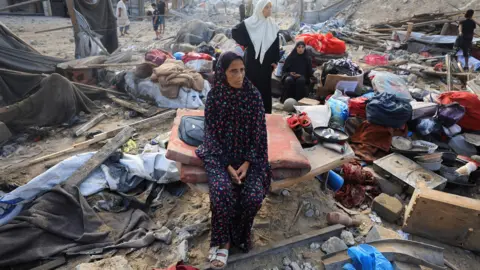
Rushdi Abualouf reports on Hamas accepting a phased disarmament plan matched by Israeli withdrawal from Gaza. — Source: bbc
Regional US-Iran Exchanges
Tit-for-tat US and Iranian attacks continued, including reported Iranian strikes on Kuwait and Jordan. [1] Tit-for-tat US and Iranian attacks continued overnight with reports of Iranian strikes on Kuwait and Jordan this morning. [1] The exchanges form part of the broader regional context surrounding the Gaza developments. [1]
Hamas Negotiators' Perspective
Hamas accepted the framework after difficult talks, insisting on Palestinian oversight rather than handing weapons to Israel, driven by the dire humanitarian conditions in Gaza. [2] A senior Hamas official and member of the movement's negotiating team described the talks as long and extremely difficult. [2] Hamas insisted on the wording inventorying and storing weapons under Palestinian oversight rather than handing them over to Israel. [2] Palestinian officials involved in the talks believe the new leadership was prepared to take what they describe as the most consequential political decision in Hamas's history driven by the devastating humanitarian conditions facing more than two million Palestinians in Gaza. [2] If the agreement holds it could mark the first credible step towards ending a war that has lasted for nearly three years. [2]
Palestinian Public Reaction
In Gaza the announcement met with public scepticism after years of failed ceasefires with residents prioritising an end to the war returns home and relief over negotiation details. [2] After years of failed ceasefires and collapsed agreements many Palestinians have grown deeply sceptical of new political breakthroughs. [2] Some residents shared their views online saying they are less interested in the details of negotiations than in whether this deal will actually end the war allow displaced families to return home and bring lasting relief. [2] For many confidence in both Hamas and Israel remains low with previous agreements having repeatedly broken down before delivering meaningful improvements on the ground. [2]
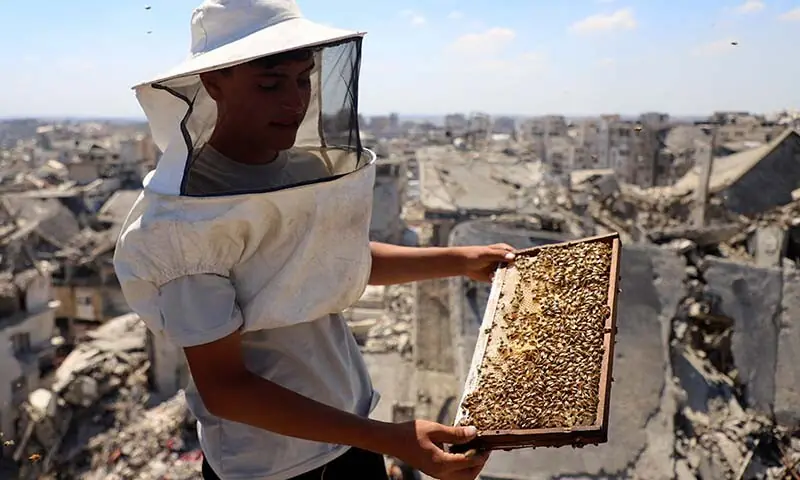
Gaza beekeepers face destroyed fields and lost hives as they attempt to rebuild after the war. — Source: dawn
Humanitarian and Economic Toll
Gaza's beekeepers are struggling to rebuild amid destroyed farmland rubble and restricted access with hives reduced from 30,000 to around 700 and honey production at 10 percent of pre-war levels. [3] Before the war the beekeepers kept around 30,000 hives according to agricultural engineer and beekeeper Rateb Sammour. [3] Honey production had already been declining from some 400 metric tonnes annually several years ago to roughly half that amount as climate change affected the flowering seasons. [3] Sammour estimates around 700 hives remain with beekeepers dividing hives to help maintain the numbers. [3] Sammour puts the honey production at only 10 per cent of what it was before the war. [3] Standing on the roof of a war-damaged building overlooking the ruins of Gaza City beekeeper Ibrahim al-Dabba gently lifts a honeycomb frame as bees buzz around him. [3] Bees require trees we are raising bees amongst rubble he says. [3] For Gaza’s beekeepers the struggle to rebuild their livelihoods after more than two years of war is about much more than honey. [3] It is also about preserving one of nature’s most important pollinators in a territory where farmland has been devastated and access to orchards near the border with Israel has been cut off. [3] Across much of Gaza where vast neighbourhoods remain reduced to wreckage beekeepers are salvaging what they can. [3] Some have placed hives on rooftops because agricultural land is inaccessible or destroyed. [3] Others are using sugar supplements to increase the food for their bees in places where there is no meaningful forage. [3] After the ceasefire last October Dabba 49 hoped to return to a trade passed down through generations. [3] Instead he found almost nothing left. [3] We couldn’t find bees we couldn’t find equipment we couldn’t find frames we couldn’t find anything to get us back to bees he said. [3] We are even forbidden from entering agricultural areas Dabba said explaining how they are within the yellow line military demarcation established under the ceasefire. [3] Starting over came at a steep cost. [3] Dabba said he paid 10,000 shekels for just three hives excluding equipment. [3] In the central Gaza camp of Nuseirat beekeeper Fahd al-Dahdouh 32 spends his days repairing shattered hive boxes recovered from destroyed farming areas. [3] I collected these beehives as you can see I brought them and put them together said Dahdouh. [3] I collected the lids the boxes and even the flooring. [3]
What to watch next: Egypt will host a summit with the US Qatar and Turkiye to ensure compliance with the second phase of the Gaza roadmap while it remains too early to judge whether the agreement will be fully implemented or whether all parties will honour their commitments.