Ukraine Strikes Disrupt Russian Fuel and Equipment Supplies to Front Line
Ukraine strikes on Russian oil infrastructure, warehouses of online retailers, electronic warfare systems, depots, and space-related facilities are disrupting fuel and equipment supplies to Russian forces, affecting the front line and daily life in Russia.
Impact of Ukrainian Strikes on Russian Logistics
Successful Ukrainian drone strikes on Russia's oil infrastructure and warehouses belonging to online retailers are having a noticeable impact on fuel supplies to the Russian military and the availability of key electronic components. [1] The Russian army has priority when it comes to fuel supplies in Russia. [1] Because the price of fuel on the black market has risen five- or sixfold compared with the spring, there is pressure at intermediate points in the logistics chain to steal it. [1] As a result, less fuel reaches frontline units. [1] Until now, fuel has been stolen before it reaches the army and the authorities have turned a blind eye to it. [1] But now there is nothing left to steal, which makes logistics at lower levels considerably more difficult. [1] Frontline units have also used fuel as a form of currency, selling or trading it to obtain supplies they lack. [1] That channel has now dried up. [1] In addition, attacks on retail chains and warehouses belonging to Wildberries and Ozon have made all kinds of essential electronic equipment less readily available — drones, tablets, power banks and generators, all of which are badly needed at the front. [1] We cannot speak of a major turning point, but we can speak of sand in the gears. [1]
Disruption to Russian Electronic Warfare and Communications
Ukrainian forces have also successfully attacked Russian space centers, which in turn reduces Russian forces' ability to carry out long-range strikes and use drones in attacks. [1] This is slowing Russia's efforts to develop an alternative to Starlink — they need to launch a large number of satellites to do that. [1] Their launch vehicles are expendable. [1] They do not have a comparable reusable rocket and if their production capacity is reduced, they cannot put as many satellites into orbit, meaning the development of their own domestic equivalent of Starlink will be delayed. [1] This also hampers long-range strikes, as well as the use of smaller drones on the front line that require an internet connection or systems that need one for geolocation. [1] Ukraine's defence forces struck Russian electronic warfare systems in occupied Luhansk and in the village of Myrnyi in Crimea on 24 August and on the night of 24-25 August. [3] A specialised Peresvet-M electronic warfare system was struck in Luhansk. [3] A Starlink satellite communications jamming station was also struck in Myrnyi. [3]
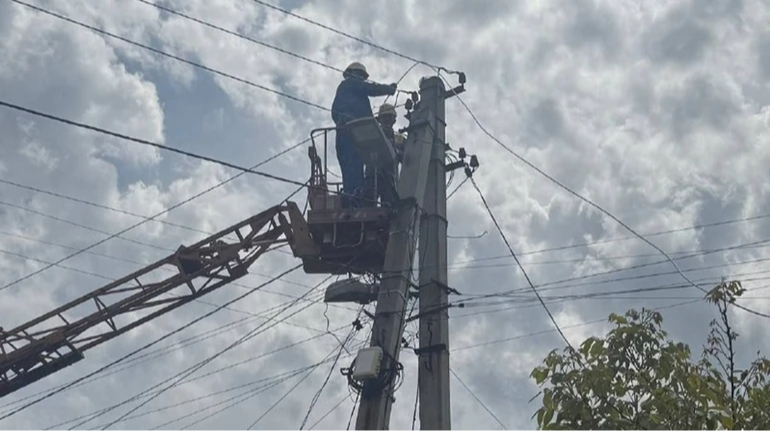
Ukrainian escort team destroys drone attacking Zaporizhzhiaoblenergo repair crew. — Source: ukrainskapravda
Confirmed Damage from Recent Ukrainian Attacks
In Berdiansk, Zaporizhzhia Oblast, Ukraine's defence forces struck a Russian fuel, lubricants and ammunition depot, while in Prymorsk, logistics depots belonging to one of the Russian units were hit. [3] In addition, data analysis has confirmed the damage to a Russian MiG-29 fighter jet at the Millerovo airfield in Russia's Rostov Oblast on 24 August. [3] The extent of the damage inflicted on Russian forces is being assessed. [3] Ukraine's Unmanned Systems Forces reported that on the night of 23-24 August they struck Russian logistics centres belonging to Ozon marketplace, a Russian multirole MiG-29 fighter jet and dozens of other targets in Russia and in the temporarily occupied territories. [3]
Russian Airstrikes on Ukrainian Targets
Russian airstrikes have also caused extensive destruction, particularly in Kyiv. [1] On August 20, Russian forces carried out one of their largest air attacks on Kyiv to date, killing at least 16 people. [1] They used a highly coordinated combination of ballistic missiles, cruise missiles and drones, primarily to penetrate Ukrainian air defenses. [1] There were various targets. [1] Various industrial facilities and warehouses were struck, as were some medical facilities and civilian infrastructure, including residential buildings. [1] Fighting remains fiercest in Donetsk Oblast, while Russian forces have also begun putting pressure on Kharkiv from the north. [1] The overall number of attacks is increasing, as are the numbers of indirect-fire attacks and drone strikes and some gains have been made here and there. [1] In the direction of Kostiantynivka, the Russians are advancing slowly but steadily. [1]
Ukrainian Air Defenses Protect Repair Crews
A Russian UAV attacked a Zaporizhzhiaoblenergo emergency repair crew in Zaporizhzhia Oblast, but Ukrainian troops neutralised the drone. [2] This is the fifth time that defence forces escort teams have saved the lives of repair workers. [2] While carrying out emergency repairs in the Orikhiv area, a Zaporizhzhiaoblenergo crew came under attack by an enemy UAV. [2] The workers were already on an aerial work platform, so they were physically unable to evacuate quickly. [2] The troops providing cover for the energy workers responded quickly and neutralised the drone. [2] The workers continued repairs and restored electricity to 5,500 consumers in the Orikhiv area, while their counterparts from the Zaporizhzhia district electricity network restored power to most residents of Kushuhum and Balabyne. [2] This was already the fifth incident since the beginning of the summer in which defence forces escort teams had saved the lives of Zaporizhzhiaoblenergo crews. [2] In many areas where Russian occupation forces regularly carry out UAV strikes, it is simply impossible for energy workers to operate without military protection. [2] With the support of the Energy Ministry, Ukrainian Distribution Networks and Zaporizhzhia Oblast Military Administration, close cooperation with the military has been established. [2] The military is protecting the people while they work, and it is thanks to them that there is the time and opportunity to repair damage to the power grid in these areas and restore electricity to people. [2]
International Response to Russian Aggression
The U.S. did not join an Aug. 24 appeal by over 50 U.N. members urging Russia to halt its aggression against Ukraine and cease strikes against civilians. [4] The statement, backed by the EU and its member states, as well as the U.K., Canada, Japan, South Korea, Georgia, Australia, and others, urged Russia to respond to the calls for a full, immediate, and unconditional ceasefire and resume peace talks. [4] This senseless war and the immense human suffering could end immediately. [4] Russia simply needs to accept the unconditional ceasefire that Ukraine and the international community have been calling for for over a year and a half now. [4] A U.S. envoy to the United Nations Economic and Social Council did not sign off on the appeal during the Security Council meeting, instead calling upon both sides to cease any strikes that might pose a risk to civilian vessels. [4] Russia has increasingly targeted Ukrainian Black Sea ports and merchant ships to choke off the country's export routes, while Kyiv has been striking Russia's shadow fleet vessels helping Moscow dodge international sanctions. [4] The envoy also urged Kyiv and Moscow to go back to the negotiating table and return peace and stability to both countries. [4] Since U.S. President Donald Trump returned to office last year, Washington has refrained from denouncing Russia's invasion and has ceased nearly all military aid to Ukraine in the name of pursuing peace talks — an effort that has effectively stalled as Moscow continues to reject a ceasefire. [4] The Trump administration has also repeatedly opted out of joint appeals condemning Russian aggression at international forums. [4] In May, the U.S. did not support a rebuke of Russia's threats to foreign embassies in Kyiv. [4]
What to watch next: Ukrainian forces continue to target Russian logistics and electronic warfare assets while Russian pressure persists in Donetsk and Kharkiv regions.