
Saudi Arabia Tensions Prompt Mutual Defence Pact With Turkey and Pakistan
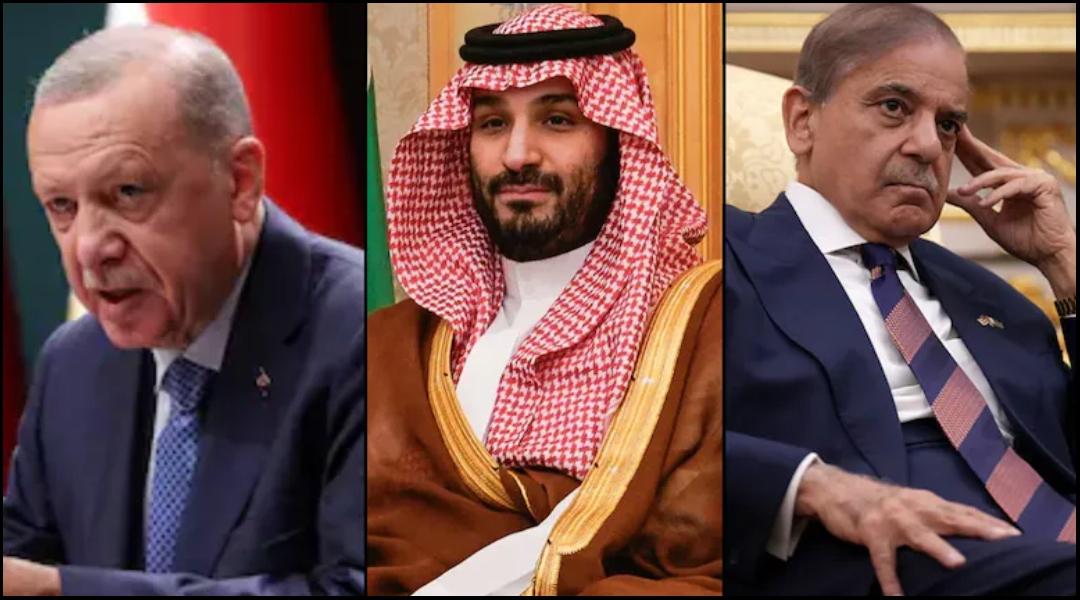
Amid Saudi Arabia tensions, Saudi Arabia, Turkey and Pakistan signed the Mecca Joint Defence Agreement on Friday, stipulating that an armed attack on one will be regarded as an attack on all three. [1] The pact was signed in Mecca by Saudi Crown Prince Mohammed bin Salman, Turkish President Recep Tayyip Erdogan and Pakistani Prime Minister Shehbaz Sharif. [3] It aims to strengthen collective deterrence and enhance all aspects of defence cooperation, including possible joint exercises, training, technology transfers and intelligence sharing. [1]
Three Nations Sign Mutual Defence Pact
The agreement stipulates that any armed attack against any one of the three states shall be regarded as an attack against them all. [1] The pact is intended to strengthen collective deterrence against any act of aggression. [2] It further provides for the enhancement of all aspects of defence cooperation among the three states. [3] The deal brings together oil-rich Saudi Arabia and nuclear-powered Pakistan as well as Turkey, which has NATO’s second-largest army and a rapidly growing defence industry. [1] The agreement also comes amid rising tensions between Turkey and Israel over Gaza and other regional conflicts, including the war in Iran and Lebanon. [1]
Leaders Present at Mecca Signing
The agreement was signed during a meeting between Saudi Crown Prince Mohammed bin Salman, Turkish President Recep Tayyip Erdogan and Pakistan’s Prime Minister Shehbaz Sharif in Saudi Arabia. [1] On Thursday, Sharif arrived for a three-day visit accompanied by a high-level delegation that includes Army Chief Field Marshal Asim Munir. [1] The agreement was signed in the Saudi holy city of Mecca on Friday by Saudi Crown Prince Mohammed bin Salman, Turkish President Recep Tayyip Erdogan and Pakistan’s Prime Minister Shehbaz Sharif, according to statements from all three countries. [3]
Saudi Security Concerns Drive Pact
Saudi Arabia has faced repeated drone and missile strikes on its critical infrastructure and oil facilities by Iran and aligned groups such as the Houthis amid the Iran war. [1] Saudi Arabia, whose critical infrastructure and oil facilities have come under attack as part of the war in Iran, has been looking to diversify its defence partnerships. [3] In recent months, Iranian missile and drone attacks, as well as strikes by Tehran-aligned groups in Yemen and Iraq, have threatened Saudi territory, shipping routes and energy infrastructure, prompting Riyadh to seek deeper security cooperation with regional partners. [2] The kingdom has already been moving closer to both Turkey and Pakistan. [2]
Complementary Strengths of Signatories
The three countries bring complementary strengths to the arrangement: Pakistan’s military experience and expertise in managing escalation, Saudi Arabia’s economic strength and regional influence, and Turkey’s advanced defence technology and industrial capabilities. [3] The deal brings together oil-rich Saudi Arabia and nuclear-powered Pakistan as well as Turkey, which has NATO’s second-largest army and a rapidly growing defence industry. [1] Islamabad has also fostered close links with Saudi Arabia for decades, with over 2.5 million of its nationals estimated to be living and working in the kingdom. [1] The kingdom has long been a bulwark of economic support to help shore up Pakistan’s faltering economy. [1]
Officials Stress Defensive Nature
Officials from all three countries described the deal as purely defensive, not directed at any specific actor, not forming a military axis or sectarian bloc, and open to other regional countries. [2] A statement from Saudi Arabia insisted that the agreement does not amount to a military pact and would not affect the kingdom’s existing partnerships. [3] “The agreement does not represent any orientation toward building a military axis or sectarian/religious bloc, and it is not linked to nuclear endeavours or an arms race, but rather to building sustainable self-reliant capabilities,” the statement read. [3] “The agreement does not come at the expense of the Kingdom’s strategic and strong relations at the Gulf, Arab, and international levels.” [3] A Turkish government official described the agreement as “purely defensive in nature”, saying the sides have pledged mutual support only for defence. [3] The official, who spoke on condition of anonymity because he was not authorised to discuss the issue publicly, insisted that the deal is “not against any specific actor” and was open for other regional countries to join. [3] The agreement does not abrogate or replace any bilateral or multilateral agreements between these states or with other states and organisations, the official added. [3] In Islamabad, defence analyst Abdullah Khan described the agreement as a natural evolution and formalisation of decades of strategic ties among Pakistan, Saudi Arabia, and Turkey, saying a changing regional security environment and the evolving nature of warfare had increased the need for closer cooperation. [3] Mr Khan said the pact was “purely defensive” and not directed against any country, with collective deterrence intended to raise the cost of aggression and prevent conflict. [3]
Regional Context and Reactions
The agreement builds on a September bilateral defence pact between Pakistan and Saudi Arabia that similarly treated an attack on one as an attack on both. [1] The pact raises the stakes for any future attack on Saudi Arabia. [2] According to the agreement, an attack on one member would be regarded as an attack on all three, potentially drawing Turkey and Pakistan into any future crisis involving the kingdom. [2] Officials say the pact is designed to strengthen collective deterrence, is defensive in nature, is not directed at any specific country and could potentially be expanded to include additional members. [2] The New York Times reported that Egypt participated in early discussions on the defense framework but did not sign Friday’s agreement. [2] In Iran, Ebrahim Rezaei, a member of the Iranian Parliament’s National Security and Foreign Policy Commission, criticised the deal on X, saying it would not bring security to Saudi Arabia. [3] “The Saudis should know that a paper agreement with Turkey and Pakistan will not bring them security, just as years of one-sided ‘milking’ by the Americans did not bring them security. Change your policies so that you do not have to #BegForSecurity from others,” he wrote. [3] Ozgur Unluhisarcikli, director of the Ankara office for The German Marshall Fund think tank, said the agreement was the culmination of the countries’ shared concerns over regional fragmentation, civil conflict, and armed non-state groups. [3] “This is a reflection of their growing desire for greater regional stability,” Mr Unluhisarcikli said. [3] “They see state fragmentation, civil conflict, an environment of non-state actors as sources of instability.” [3] Mr Unluhisarcikli said Pakistan, Saudi Arabia and Turkey have varying degrees of concerns over Iran and Israel: Pakistan is geographically removed, and while Turkey and Saudi Arabia both see Iran and Israel as destabilising, Ankara is more concerned about Israel and Riyadh more concerned about Iran. [3] “At the end of the day, all three countries are concerned about instability,” he said. [3]
What to watch next: A key unanswered question is how the pact would function in practice, as the statement released by the three governments did not specify what military commitments members would be required to undertake if one were attacked. [2] Turkish President Recep Tayyip Erdogan has suggested implementation could include joint defense-industry projects and counterterrorism operations. [2]