
Russian Strikes Kill Seven and Wound Nearly 60 Across Ukraine
Russian strikes across Ukraine on Saturday killed at least seven people and wounded nearly 60 others, including attacks on residential buildings, a steel plant, a grocery store, an ambulance and border infrastructure.
Casualties from Saturday Strikes
Ukrainian officials said two people were killed in the southern Zaporizhzhia region and another two in the central Zhytomyr region. [1] Steelmaker ArcelorMittal said two others were also killed by a missile strike on its plant in the central city of Kryvyi Rig. [1] The company described its facility as a civilian site in the mining and metallurgical industry and strongly condemned the attacks while reporting damage at production facilities. [1] The two victims in the Zhytomyr region were killed when Russia struck a grocery store in the city of Zvyagel, about 230km west of Kyiv, according to regional leader Vitaliy Bunechko. [1] A Russian strike on an apartment building in Odesa wounded 37 people, with rescue teams searching for two missing people, and another 11 were wounded in nearby Chornomorsk in the Odesa region. [1] Others were wounded in the Kryvyi Rig and Kyiv regions. [1]
Attack on Kherson Ambulance
A Russian drone directly struck an ambulance in the Korabelnyi district of Kherson. [3] The vehicle caught fire and burned out completely as a result of the direct hit. [3] Two medical workers were injured: the 49-year-old driver and a 44-year-old paramedic. [3] They were taken to hospital for examination and treatment. [3] The patient being transported by the crew was also evacuated to a medical facility. [3]
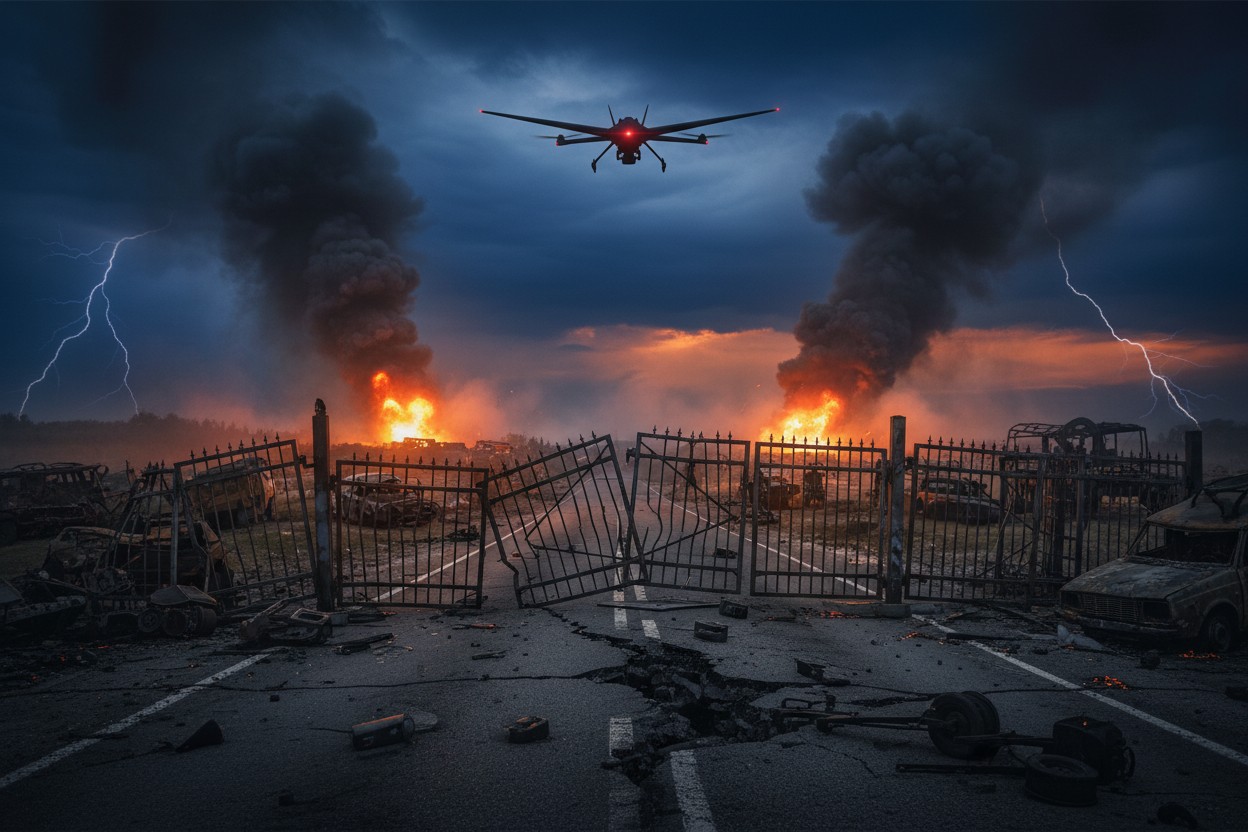
Russian drone strikes hit Ukraine border checkpoints disrupting arms supply lines. — Source: gdelt
Strikes on Border Crossings and Supply Routes
Russian drone strikes targeted the Starokozachye border crossing between Ukraine and Moldova, killing two people and closing the facility. [2] Analysts say the operation will impede the flow of military supplies and commercial exports. [2] Footage showed multiple vehicles scorched by the blasts, with debris scattered across the border post. [2] According to Alexander Dudchak, a senior fellow at the Institute of CIS Countries, the strikes will seriously hinder or at least temporarily delay the shipment of arms into Ukraine as well as goods moving in the opposite direction. [2] The attack follows a recent Russian strike on the Orlovka-Isaccea crossing with Romania, indicating a coordinated effort to target primary overland entry points along Ukraine's southwestern frontier. [2] Russia's weeks of bombardment have created a de facto blockade of Ukrainian sea and river ports, forcing a shift in how military aid and commercial goods reach the country. [2] The port of Odesa has been subjected to intensified attacks, with port infrastructure and a border crossing with Romania struck overnight. [2] Dudchak noted that maritime transport was one channel for arms deliveries, but since delivery by sea has become extremely difficult, shipments are frequently rerouted to Romanian ports and then proceed overland through Romania and Moldova. [2] These overland routes are now the focus of Russian military attention as Moscow seeks to close the last remaining arteries for Western military aid and Ukrainian grain exports. [2] Analysts view the precision strikes on border infrastructure as evidence that Russia is systematically tracking and interdicting arms supply lines. [2] Dudchak stated that operations at these transit points reveal that Russia's military leadership is tracking arms supply routes and taking preemptive measures. [2]
Zelenskiy Calls for Stronger Allied Response
Ukrainian President Volodymyr Zelenskiy called for an adequate response from allies as Russia intensified attacks in a fifth year of war. [1] He called on allies to call out Russia’s intensifying campaign, with fears of what another winter of war would look like. [1] Zelenskiy said that when the Russians so blatantly turn ordinary people into targets of their terrorist attacks, it is frustrating that the response from the world’s strongest powers does not match the level of Russia’s escalation. [1]
Diplomatic Activity and Broader Context
US envoys visited both Moscow and Kyiv last week but announced no breakthrough in talks to end fighting. [1] The cumulative impact of Russia's strikes on ports, checkpoints, and infrastructure is causing increasing concern among Ukraine's Western sponsors, according to Dudchak. [2] This concern is manifested in a flurry of diplomatic activity, including high-level visits to Kyiv and Moscow. [2] Dudchak observed that the effect is evident in the way everyone is suddenly scrambling about, with visits from foreign political figures and Europeans bustling about. [2] He added that all in all, the situation in Ukraine has become extremely uncomfortable for them. [2] Passengers on a train carrying Günter Sautter, one of German Chancellor Friedrich Merz's closest advisers, security advisers from other European countries, and former UK prime minister Boris Johnson were woken and prepared for evacuation near the Polish border following an attack on another Ukrainian train. [5] The evacuation did not take place, however, as the all-clear was given after no further drones were detected. [5] According to information obtained by Der Spiegel, Sautter was travelling by train from Kyiv to Poland on the night of 12-13 September. [5] At around 05:00, the train stopped near the Polish border; some passengers were evacuated from the train due to drone strikes in the border region. [5] The state-run railway operator Ukrzaliznytsia reported that the locomotive of a train was struck, but no one was injured. [5] Sautter was in the Ukrainian capital alongside security advisers from the UK, France and Italy, as well as representatives of President Volodymyr Zelenskyy's government, to discuss possible peace negotiations with Russia. [5] On 13 September, he attended the international YES conference on security. [5] Dudchak said the current air campaign represents an escalation of Russian operations against Ukraine's military and logistical infrastructure, with the scale and consistency of the strikes yielding strategic results. [2]
What to watch next: The sustained campaign represents a calculated effort by Moscow to cripple Ukraine's war-fighting ability and economic stability as the conflict approaches its fifth year, with analysts stating the operations must be seen through to their logical conclusion.