Russian Drone Strikes Ukraine Security Headquarters in Kyiv
Drone Strike on Security Service Headquarters
A Russian drone struck the headquarters of Ukraine's security service in central Kyiv, Ukrainian President Volodymyr Zelenskyy said Friday, ahead of diplomatic talks with U.S. officials on ending the war. [1] The strike occurred as the capital endured more than a week of daily aerial attacks that have killed dozens and caused widespread psychological strain. [1]
Intensified Aerial Campaign on Kyiv
Russian drone strikes have hit Kyiv daily since Aug. 27, with 13 air raid sirens recorded on that day alone and an average of nine hours of alerts daily through early September. [4] Between the start of the latest aerial campaign and the night of Sept. 3-4, 53 people were killed and 98 injured in Kyiv and the surrounding region. [4] Kyiv recorded 13 air raid sirens on Aug. 27, breaking the previous record set in the early days of the full-scale war in March 2022. [4] The siren sounded 70 more times by Sept. 3. [4] After more than a week of relentless Russian strikes and near-constant air raid alerts, some Kyiv residents are being pushed to the brink of mental exhaustion. [4] In the capital, every day since Aug. 27 has brought hours of sirens, sleepless nights, and the anticipation of another attack. [4]
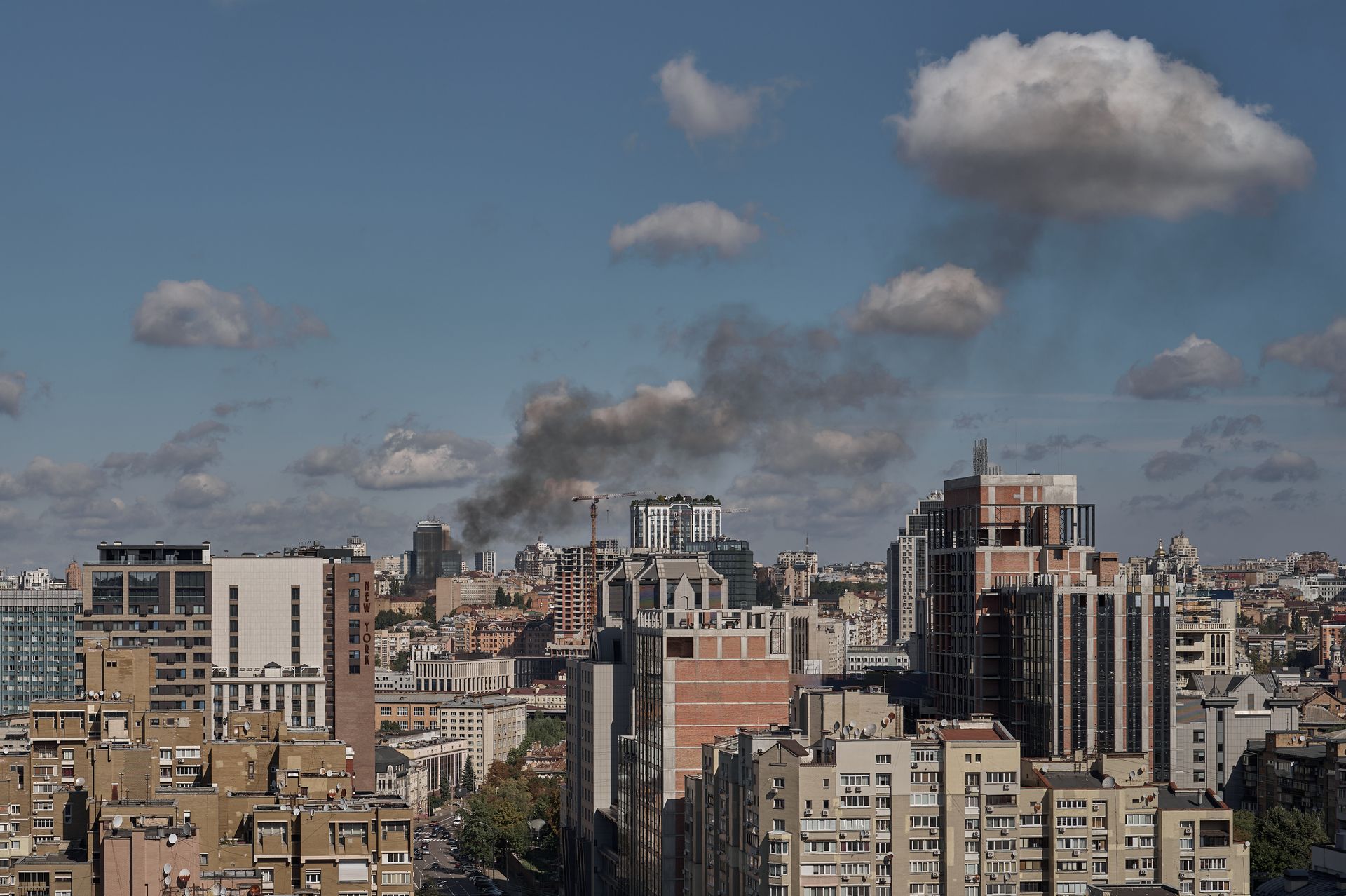
Russian drone strike hits Ukraine's security service headquarters in central Kyiv. — Source: kyivindependent
Rise of Jet-Powered Drones
Russia has sharply increased use of jet-powered drones, launching about 2,800 in August compared with 1,500 in July. [5] These are harder to intercept, with Ukraine's success rate dropping to 60 percent. [5] Civilian deaths have sharply increased this summer as Russia is using jet-powered drones, which fly at about half the speed of a passenger jet and are more difficult to intercept than propeller-powered drones. [5] Ukraine has an interception rate of more than 90 percent against propeller-powered drones, but only 60 percent against the jet-powered variant. [5] Thirty-eight people were killed in the village of Myla on August 29, when a Russian drone attack struck an ammunition depot. [5] Another 12 were killed in attacks across the country on September 1. [5] Ukraine said Russian forces suffered 42,020 casualties last month. [5] Ukrainian armed forces figures showed Russia’s monthly casualties were only slightly below July’s 42,860 and well above the 39,290 in June. [5]
Psychological Impact on Residents
The sustained air alerts are causing acute stress and mental exhaustion among residents, especially children, with experts describing the campaign as deliberate psychological terror. [4] "This past week, with all the constant anxiety, my mental health has been hanging by a thread," said Kateryna Soniuk, a Kyiv resident. [4] Experts who spoke to the Kyiv Independent describe the mental pressure not as a side effect but as an intentional part of Russia's strategy. [4] "As a medical psychologist and public health specialist, I see this as terror and deliberate psychological pressure on the civilian population," Olena Yelizarova, a researcher at the Marzieiev Institute for Public Health of the National Academy of Medical Sciences of Ukraine, told the Kyiv Independent. [4] Yelizarova explained that although the sound of air raid alerts is nothing new for Ukrainians by now, it is not without harm. [4] The loud blare warning people of an imminent danger can become a source of stress itself. [4] In addition to sirens, the people are also facing explosions, interrupted sleep, the anticipation of the next attack, and the inability to plan one's life normally. [4] "Historically, in wars, the destruction of critical infrastructure, housing, medical facilities, food supplies, or other resources has been used not only to physically weaken the other side, but also to demoralize the population and create a sense that there is no safe place," Anna Vashchuk, head of the Mental Health and Psychosocial Support Department at the UA Mental Help organization, told the Kyiv Independent. [4] Kateryna describes this past week as an "out-of-body experience." [4] "The uncertainty is what's most frustrating. There are so many unresolved issues (as a result of the attacks), and this fear of 'what if I can't handle this?'" she said. [4] The Ukrainian school year started on Sep.1, with many first-graders holding welcome ceremonies in shelters instead of classrooms. [4] Kyiv authorities asked schools to prepare for teaching in shelters or online as part of the hybrid teaching regime. [4] Yelizarova's study about the impact of air raid sirens on stress levels of school-age children found that 31.9% of them experienced moderate stress during air raid alerts, while 13.9% experienced high levels of stress and anxiety. [4] "Children develop behavioral patterns that will stay with them for the rest of their lives and will either help or hinder them in building relationships, working, learning, and simply living," Yelizarova said. [4] Kyiv's public transport will see alterations, rather than a complete halt, during yellow alerts under a new alert system that will introduce a distinct sound for each threat level. [4] "Several days of almost nonstop air raid alerts: that's already acute stress," said Yelizarova, adding that "adaptation is not armor." [4] "There is no logic to Russia's actions other than a desire for destruction and our suffering, but we must not let them succeed; good must prevail, even if evil has more weapons," psychiatrist Lidiia Ivanchenko said. [4]
Disinformation About Mass Exodus
Disinformation campaigns have falsely claimed a mass exodus from Kyiv using out-of-context or unrelated images, aiming to create panic and erode support for Ukraine. [2] As Russia continues its aerial onslaught against Kyiv, disinformation online alleges that citizens are fleeing in droves, painting a picture of collapse and panic. [2] For more than a week, Moscow's forces have attacked Kyiv every single day, disrupting businesses, schools, and the daily lives of its residents. [2] Social media accounts have shared photos and videos purportedly showing traffic jams and crowds of Kyiv residents attempting to escape the capital. [2] These included out-of-context videos of Kyiv city traffic or photos not taken in Ukraine at all, all accompanied by manipulative or false text. [2] One Sept. 1 post on X that garnered half a million views, accompanied by the text "mass exodus of civilians leaving (Kyiv)," shows what appears to be, in fact, a rush-hour scene at a Kyiv metro station. [2] Another post from Aug. 29 shows nighttime footage of a massive traffic jam at a toll booth that spans dozens of lanes, captioned "Massive traffic jam to leave Kyiv: residents are fleeing the city." [2] The photo actually shows Wuzhuang Toll Station, the largest toll station in China. [2] Another post, published on Aug. 29 by the official account of Our Country Our Choice, purports to show people "fleeing the capital in massive numbers." [2] The accompanying photo shows a row of cars and a group of men in winter jackets, despite supposedly showing Ukraine in late summer. [2] The photo predates the current wave of attacks by several years, capturing people moving to the Polish border in western Ukraine shortly after the outbreak of the full-scale invasion in 2022. [2] Multiple accounts also shared a video of a traffic jam in Kyiv, presenting it as another example of the city's mass exodus. [2] The original video, published last week, can be traced to the local channel "Kyiv Operative," with a caption that simply describes a traffic jam on the Patona Bridge in central Kyiv amid an air raid alert. [2] LetsData's analysis has detected narratives that paint Kyiv as uninhabitable and its daily life "collapsing" under the pressure of constant air-raid alerts and chaos. [2] "At its core, this kind of narrative functions as a form of terror by other means. Suggestions that Ukraine's capital is emptying, or that its population is fleeing en masse, are designed to make Ukrainians feel isolated, abandoned, and as though resistance is futile," Teah Pelechaty, a senior disinformation analyst at the European Center of Excellence for Countering Hybrid Threats (Hybrid CoE), told the Kyiv Independent. [2] This narrative also targets foreign audiences in an effort to erode international support. [2] "If even Kyiv's own residents are giving up on the city, the implicit question becomes why foreign taxpayers should keep funding its defense," Pelechaty explained. [2] There is no public data indicating that people have been fleeing the city en masse over the past few weeks. [2]
Additional Strikes and Regional Effects
A separate Russian drone attack on Sept. 4 in Poltava Oblast's Kremenchuk district injured a three-year-old girl and damaged houses and cars. [3] An enemy drone has been reported to have fallen in the Kremenchuk district. [3] Houses and cars have been damaged in the attack. [3] Early reports indicate that a three-year-old girl has been injured. [3] She is receiving all necessary medical assistance. [3] Emergency services are working at the scene. [3] Ukraine has turned its focus from Russian refineries to strikes against Russian air defences, radar systems and drone launch sites. [5] Ukraine’s Unmanned Systems Forces (SBS) destroyed 33 air defence elements in August, increasing the annual total to 263. [5] Ukraine also kept up some strikes on refineries, hitting 12 in August, along with two gas-processing plants and three oil transshipment terminals. [5] During the past week, Ukraine struck the Yanos refinery in Yaroslavl and the Kirishi and Ust-Luga refineries near Leningrad, all 800km from its border. [5] Those strikes have caused petrol shortages, further hurting Russia’s economy. [5] Ukraine’s military intelligence reported that certain Russian exports had fallen by 80 percent compared with pre-war levels. [5] Russian oil exports from the Black Sea port of Novorossiysk fell from 800,000 barrels a day in July to 350,000 barrels per day in August. [5] “The Russian side acknowledges that its Black Sea Fleet ships are effectively blockaded in Novorossiysk due to our drone strikes and are unable to operate at sea,” said Zelenskyy. [5]
What to watch next: Some Ukrainian officials predict that the ongoing drone attack may continue until Russia's parliamentary elections on Sept. 18-20. [4]