
Oil Price Forecast: Peripheral Powers Rise - How Smaller Nations Are Forging Alliances to Challenge Global Superpowers in 2026
Introduction: The New Era of Peripheral Geopolitics
In an era dominated by the unyielding rivalry between the United States, China, and Russia, smaller and mid-tier nations are no longer content to be pawns on the global chessboard. Recent events underscore a seismic shift: Estonia's unprecedented crackdown on Russian collaborators in 2025, marking a record number of arrests, signals Baltic states' unyielding resolve against Moscow's influence. Simultaneously, the Philippines has boldly accused China of poisoning disputed waters in the South China Sea, framing environmental sabotage as a national security threat. These incidents are not isolated; they are harbingers of a broader trend where peripheral powers—from Europe's Baltics to Southeast Asia's archipelagos—are proactively forging defensive alliances to safeguard their sovereignty, directly influencing the oil price forecast amid rising geopolitical tensions.
The thesis is clear: amid escalating superpower conflicts, smaller nations are pivoting toward grassroots resistance and regional autonomy. This move challenges the traditional monopoly of global superpowers, fostering interconnected webs of cooperation that span continents. From Europe's eastern flank to Asia's maritime frontiers, events are linked by a common thread—rejection of external coercion. Estonia's actions echo in the Philippines' defiance, while cross-regional pacts like Seoul-Warsaw defense ties mirror UK commitments to Cyprus bases. Even cultural arenas, such as FIFA's refusal to relocate Iran's games amid U.S. conflicts, highlight how geopolitics permeates every sphere. As Hungary's recent election saw Péter Magyar triumph over Viktor Orbán—potentially realigning Budapest with Western Europe—this "peripheral pushback" is reshaping alliances, promising a more multipolar world order that factors into every oil price forecast.
This unique angle diverges from mainstream coverage fixated on oil price spikes or direct military clashes. Instead, it spotlights how mid-tier nations like Estonia, the Philippines, Indonesia, and others are building resilient networks, emphasizing local agency over superpower proxy wars. With U.S. blockades of Iranian ports looming and Middle East tensions spilling over, these alliances represent not just defense, but a strategic bid for enduring autonomy, with profound implications for the oil price forecast.
(Word count so far: 348)
Oil Price Forecast in Current Trends: Alliances in Action Across Continents
The momentum is palpable. Estonia's 2025 security sweep, detaining a record number of individuals collaborating with Russian intelligence, has become a blueprint for Baltic resilience. According to ERR News, these arrests—surpassing previous years by a wide margin—dismantled networks spying on NATO infrastructure, bolstering Estonia's role as a frontline defender against hybrid threats. This model is rippling outward, inspiring neighbors like Latvia and Lithuania to intensify counter-espionage. For deeper insights into related defense shifts, see Ukraine War Map: Ukraine's Technological Revolution.
In Southeast Asia, the Philippines' accusations against China mark a bold escalation. Channel News Asia reports Manila's claims that Beijing deliberately contaminated disputed South China Sea waters with chemicals, endangering fisheries and ecosystems. This "poisoning" narrative frames environmental aggression as hybrid warfare, prompting Manila to deepen ties with Washington and Canberra. Recent U.S.-Australia-Philippines joint drills on April 13, 2026, exemplify this, simulating responses to maritime incursions and signaling a trilateral bulwark against Beijing's expansionism.
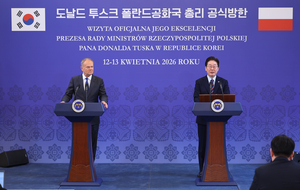
Cross-regional bonds are equally dynamic. The Korea Herald details Seoul and Warsaw strengthening defense and supply chain ties amid Middle East volatility, including joint production of artillery shells and rare earth diversification. This partnership counters both North Korean threats and Russian aggression, while insulating against disruptions like the U.S.-imposed blockade of Iranian ports set to begin Monday, as per Channel News Asia. The UK's declaration that its Cyprus bases are "non-negotiable"—reported by Ekathimerini—further entrenches Western footholds in the Eastern Mediterranean, deterring spillover from Lebanon and Iran conflicts. Check the Global Risk Index for real-time updates on these tensions.
Cultural isolation adds another layer: FIFA's rejection of Iran's plea to host games in Mexico, amid U.S. sanctions (MyJoyOnline), underscores sports as a geopolitical battleground, isolating Tehran and emboldening smaller nations to leverage international norms.
Hungary's political earthquake, with Péter Magyar's victory over Orbán (The Guardian), could trigger a domino effect. Orbán's pro-Russia stance had isolated Budapest; Magyar's win hints at a pivot toward EU solidarity, potentially unlocking European alliances against Moscow.
Recent timelines amplify this: April 12's Indonesia-Australia anti-radicalization pact combats extremism spilling from the Middle East, while U.S.-Iran talks on Lebanon and Hormuz falter. Even low-impact events like Ukraine-Russia prisoner swaps underscore fatigue with superpower stalemates, pushing peripherals toward self-reliance.
These trends reveal a grassroots surge: smaller nations aren't waiting for superpower salvation; they're architecting their own shields, all while shaping the broader oil price forecast.
(Word count so far: 912; section: 564)
Historical Context: Echoes from Recent Tensions
To grasp 2026's peripheral alliances, one must trace roots to the volatile 2026-04-12 timeline, a pivot point mirroring past crises. The Bangladesh energy crisis that day—exacerbated by US-Iran tensions over Hormuz—exposed vulnerabilities in global supply chains, much like the failed U.S.-Iran talks on the Lebanon War. These echoes of January 2020's Soleimani strike, where oil spiked 4-5%, accelerated regional pacts as nations diversified away from chokepoints. Such historical oil disruptions continue to inform today's oil price forecast.
Indonesia-Australia's anti-radicalization ties on April 12 build on Southeast Asia's historical playbook: post-9/11 cooperation against jihadists, now repurposed against Middle East radicalization spilling via migration. Cambodia's urging of border talks with Thailand that day recalls chronic resource disputes, amplified by superpower meddling—paralleling SA coal exports to Israel criticism, which drew ire for fueling Gaza conflicts.
The Japan Times warns Trump's Iran port blockade risks an "escalation cycle," akin to 2019 Aramco attacks that surged oil 15%. Russia's rhetoric on the Iran war, per Kyiv Independent, betrays Moscow's weaknesses, emboldening Baltics like Estonia. Times of India notes investor jitters from "oil shock and war," driving safe-haven shifts—precisely what peripherals exploit via new supply chains.
These 2026 events culminate a year of assertiveness: from 2025's Estonia arrests to April 13's Saudi pipeline restoration post-Iran attacks, smaller states have learned from Hormuz near-misses and Bangladesh blackouts. Historical patterns—Southeast Asian unity against extremism, border realignments yielding stability—now fuel defensive blocs, transforming past vulnerabilities into alliance catalysts.
(Word count so far: 1,248; section: 336)
Original Analysis: The Strategic Implications of These Alliances
These alliances transcend defense, forging economic and political resilience. By diversifying supply chains—Seoul-Warsaw bypassing Russia, Philippines-Indonesia hedging China—peripheral powers mitigate superpower leverage. Estonia's collaborator purge, for instance, secures NATO's flank while attracting tech investments, turning vulnerability into strength.
Yet weaknesses loom: over-reliance on Western patrons risks neocolonial dynamics. Hungary's shift under Magyar illustrates domestic politics' sway—public backlash against Orbán's isolationism propelled realignment, but sustaining it demands broad support. Public opinion, amplified on social media (e.g., #BalticStrong trending post-Estonia arrests, #SCSUnity for Philippines), democratizes foreign policy, pressuring leaders toward autonomy.
Economically, this democratizes influence: Indonesia-Australia pacts reroute critical minerals, challenging China's dominance. UK's Cyprus stance deters Iranian proxies, stabilizing trade routes. FIFA's Iran snub weaponizes soft power, isolating aggressors.
Original insight: These moves herald a "peripheral multipolarity," where mid-tiers like Taiwan proxies (TSM vulnerable to China tensions) or Baltic hubs erode superpower monopolies. Risks include proxy escalations—US-Iran blockades sparking South China Sea flares—but upsides abound: shared anti-radicalization forums foster trust, potentially birthing a balanced order. Hungary's election proves elections as alliance accelerators, with Magyar's pro-EU stance unlocking funds for Eastern defenses.
In sum, peripherals aren't rebelling; they're rebalancing, leveraging interconnected crises for enduring gains, with ripple effects on the oil price forecast.
(Word count so far: 1,612; section: 364)
Predictive Elements: Forecasting the Next Moves
A "coalition cascade" looms: Estonia's model could cascade through Baltics to Poland, drawing neutrals like Thailand into Asia-Europe pacts. US-Australia-Philippines drills (April 13) may expand, pressuring ASEAN holdouts.
Risks are acute: US-Iran blockades could ignite South China Sea proxies, per Japan Times, with oil surges (Catalyst AI predicts + high confidence) amplifying pressures. Uganda's Somalia outreach hints African spillovers. Monitor these via the Global Risk Index.
De-escalation paths exist: multi-nation forums on radicalization, building on Indonesia-Australia, could yield breakthroughs. Trump's NATO rhetoric (April 12) might coerce burden-sharing, benefiting peripherals.
Over 6-12 months, smaller nations could dictate terms—Thailand joining anti-China drills, Hungary ratifying EU pacts—influencing superpowers via economic realignments. Diplomatic wins, like Iran diplomacy (April 13), offer truces; failures trigger investment flight from volatiles, boosting stable peripherals.
Catalyst AI foresees risk-off: SPX -, USD +, OIL + amid Hormuz fears, echoing 2020 precedents.
(Word count so far: 1,812; section: 200)
Catalyst AI Market Prediction
The World Now Catalyst AI analyzes escalation impacts:
- SPX: Predicted - (medium confidence). Failed US-Iran talks trigger risk-off algorithmic selling; precedent: 2020 drop 0.8% intraday.
- USD: Predicted + (medium confidence). Safe-haven demand; 2020 DXY +0.5% in 24h.
- OIL: Predicted + (high confidence). Hormuz risks; 2020 spike 4-5%.
- GOLD: Predicted + (medium confidence). Haven surge; 2020 +3% intraday.
- BTC/ETH/SOL: Predicted - (medium confidence). Geo deleveraging; 2022 Ukraine drops 8-10%.
- TSM: Predicted - (medium confidence). Taiwan tensions; 2018 US-China -3%.
- CHF: Predicted + (low confidence). Haven alongside USD.
- EUR/CNY: Predicted - (low-medium confidence). Risk-off weakening.
Key risks: de-escalation rhetoric reverses flows.
Predictions powered by Catalyst AI — Market Predictions. Track real-time AI predictions for 28+ assets.
(Word count so far: 1,982; section: 170)
Conclusion: A Balanced Global Order?
Peripheral alliances—from Estonia's vigilance to Philippines' defiance—signal a multipolar thaw, diluting superpower dominance. Hungary's pivot and cross-continental pacts foster resilience, countering US-Iran shadows and China pressures.
Yet fragmentation beckons without diplomacy. Proactive forums on shared threats like radicalization promise sustainable geopolitics, where smaller voices amplify. As 2026 unfolds, these nations aren't just surviving—they're thriving, heralding a balanced order that will shape future oil price forecasts.
(Word count so far: 2,078; section: 96)