
Nepal Floods from Natural Disasters Leave 584 Dead and Nearly 2,500 Missing as New Lake Threatens Further Inundation
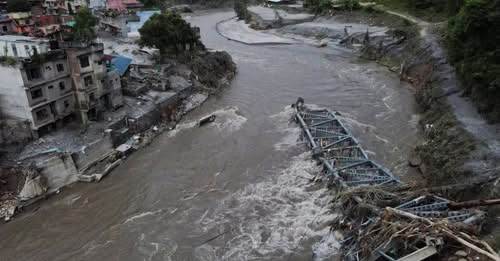
Flash floods triggered by a glacial avalanche along the Nepal-Tibet border, amid a series of natural disasters, have killed at least 584 people, left nearly 2,500 missing and raised fears of a newly formed lake bursting and causing further inundation. Nepal has recovered 579 bodies while China has reported five deaths on the Tibetan side for a combined total of 584; nearly 1,924 people remain missing including 933 hydropower workers, over 100 security and customs personnel, and 622 tourists. [1] Rescue operations continue despite risks from a growing lake formed by debris blocking the river upstream, which holds water equivalent to about 1,200 Olympic swimming pools and sits 10 km and 1,000 meters above Gyirong port. [1] Up to 93,000 people may be affected, with entire villages swept away, 18 schools destroyed, health facilities damaged, and 11 hydropower stations plus one solar plant taken offline representing 10 percent of Nepal’s installed capacity. [2] Nepal has requested 42 portable bridges from India and China to restore connectivity, while Hong Kong has allocated HK$50 million in relief funds; the Red Cross notes that aid has not yet reached some inundated areas. [1] [5] The disaster has caused distress among Nepalese and Tibetan communities in Switzerland, with limited information emerging from the Tibetan side and calls for better monitoring and early warning systems. [3]
Death Toll and Missing Persons
Nepal has recovered 579 bodies while China has reported five deaths on the Tibetan side for a combined total of 584; nearly 1,924 people remain missing including 933 hydropower workers, over 100 security and customs personnel, and 622 tourists. [1] There is no record of coordination between Nepal and China to cross-check the figures. [1] The missing include 473 foreign tourists and 149 Nepalis residing abroad in addition to local citizens. [1] More than 620 people have been confirmed dead in total across reports. [2] The lack of coordinated counting leaves uncertainty in the overall assessment of fatalities from the event.
Risk of New Flooding from Glacial Lake
The avalanche occurred on August 26. [1] Satellite images indicate the river has been blocked upstream, creating a growing lake that could burst and trigger a sudden flood downstream. [1] The barrier of the lake is more than 10 kilometers from Gyirong port and sits at an altitude of 2,950 meters, about 1,000 meters above the port. [1] The lake contains a quantity of water equivalent to around 1,200 Olympic swimming pools. [1] The glacial collapse also led to the formation of several smaller bodies of water. [1] Rescue work has resumed in China after a temporary suspension due to gradual overflow of the natural dam formed by accumulated mud and rocks. [1]

Nepalese and Tibetan residents in Switzerland express concern over the Himalayan border floods. — Source: swissinfo
Rescue and Evacuation Efforts
Rescue operations continue in the border area between Nepal and the Tibet autonomous region despite the risks. [1] Nepal has formally requested the urgent delivery and installation of 42 portable bridges from India and China to reopen land traffic in the most affected areas. [1] Security forces and Nepal’s Tourist Police have evacuated 129 foreign visitors from the affected zones so far. [1] In total Nepal has rescued 4,451 people. [1] China resumed rescue work on Friday after the temporary suspension. [1] Rescue efforts remain focused on searching for the more than 2,400 missing. [2]
Scale of Destruction and Humanitarian Needs
As many as 93,000 people may have been affected. [2] Entire communities have been swept away. [2] At least 18 schools have been destroyed and another 20 damaged, leaving about 10,000 school-age children affected. [2] The floods destroyed three health posts and partially damaged a hospital, with access to two other hospitals affected. [2] Displacement, overcrowding, damaged water and sanitation systems, and disrupted health services may increase the risk of communicable diseases. [2] Eleven hydropower stations and one solar power station have stopped operating, with a combined capacity of 431.1 megawatts, representing about 10 percent of Nepal’s installed electricity generation capacity. [2] Another 15 power projects under construction with a combined planned capacity of 470 megawatts have also been damaged. [2] More than 900 hydropower workers are missing. [2] Tourism contributes about 6.4 percent of Nepal’s GDP and supports around 15 percent of employment. [2]
International Response and Diaspora Impact
Hong Kong’s government has earmarked HK$50 million from the Disaster Relief Fund for those affected. [5] Chief Executive John Lee Ka-chiu announced the move and expressed deep condolences for the victims. [5] Nepal has appealed for financial assistance in the task of recovery. [2] The flash flood has caused widespread distress among Nepalese and Tibetan communities in Switzerland. [3] The Nepalese community in Switzerland is small and close-knit. [3] Very little information is emerging from the Tibetan side of the border. [3] One friend of a Tibetan community representative is stranded in Nepal and unable to return home because the main road no longer exists. [3] The Tibetan community representative called for an urgent monitoring programme and an effective early warning system. [3]
Broader Context of Himalayan Hazards
India has stepped up glacier monitoring after the Nepal disaster. [4] Melting Himalayan glaciers increase the risk of catastrophic flooding. [3] The scale of the disaster has been attributed in part to insufficient environmental protection in Tibetan regions since 1959. [3] Climate-related disasters keep happening in Tibet. [3] The event has left the wider community in shock. [3]
What to watch next: Authorities continue to warn that the newly formed lake could burst and cause additional flooding while rescue teams work to reach isolated areas and restore connectivity with portable bridges.