Natural Disasters Prompt Three Indonesian and Russian Volcanoes Erupt With Plumes Reaching 9 Kilometers
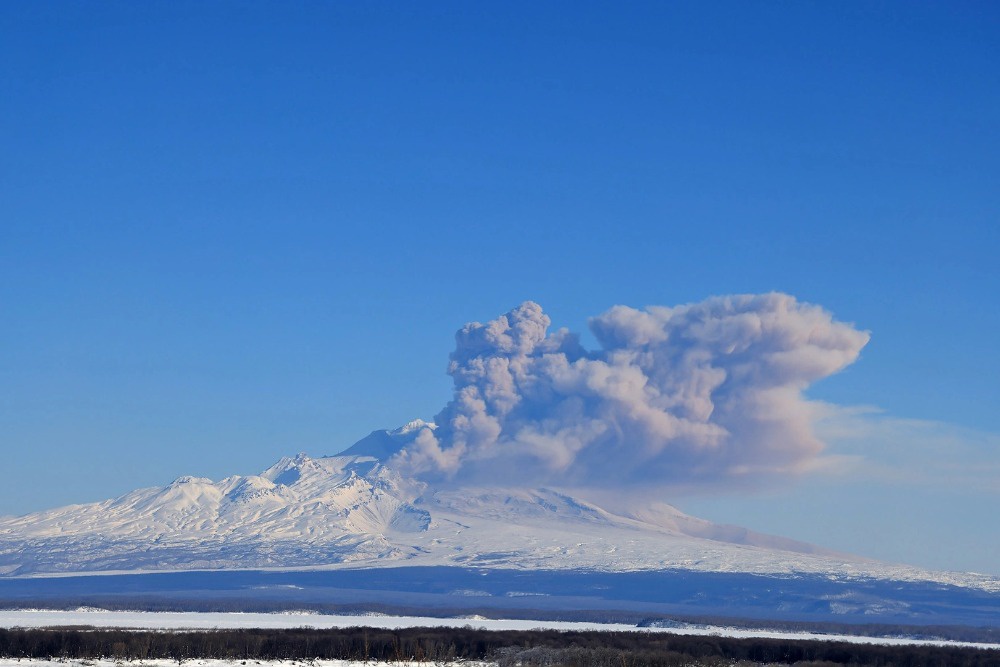
Multiple volcanoes erupted amid natural disasters on Saturday, with Indonesia's Gunung Semeru experiencing three eruptions reaching up to 1 km high, Anak Krakatau erupting four times in 16 minutes, and Russia's Shiveluch volcano on Kamchatka ejecting ash plumes up to 9 km high. [1][2][3]
Overview of Recent Volcanic Eruptions
Multiple volcanoes erupted on Saturday, with Indonesia's Gunung Semeru experiencing three eruptions reaching up to 1 km high, Anak Krakatau erupting four times in 16 minutes, and Russia's Shiveluch volcano on Kamchatka ejecting ash plumes up to 9 km high. [1][2][3] These events occurred across different regions yet shared the same day of activity according to monitoring reports. Gunung Semeru produced three distinct eruptions while Anak Krakatau recorded four events compressed into a 16-minute window. [1][2] Shiveluch contributed two separate ash emissions on 16 October. [3] The combined activity highlights simultaneous eruptive behavior at sites separated by thousands of kilometers.
Gunung Semeru Activity and Eruption Details
Gunung Semeru in East Java erupted three times on Saturday at 04:52 WIB with a 700m plume, 06:35 WIB with an 800m plume, and 10:42 WIB with a 1 km plume, with ash columns moving west. [1] Seismic amplitudes reached 25 mm and durations up to 137 seconds. [1] The first eruption at 04:52 WIB produced a column observed at approximately 700 meters above the peak with thick gray ash drifting westward and was recorded at a maximum amplitude of 22 mm lasting 125 seconds. [1] The second eruption at 06:35 WIB reached about 800 meters above the peak or 4,476 meters above sea level with white to gray thick ash moving west and registered a maximum amplitude of 25 mm over 90 seconds. [1] The third eruption at 10:42 WIB sent a column roughly one kilometer above the peak with white to gray thick ash drifting west and showed a maximum amplitude of 25 mm lasting 137 seconds. [1]
{IMAGE_2}
Safety Restrictions and Hazard Warnings for Semeru
Gunung Semeru remains at Level III (Siaga) alert; residents are prohibited from activities within 5 km of the crater, along a 13 km stretch of Besuk Kobokan southeast, within 500 m of riverbanks up to 17 km, and warned of hot clouds, lava avalanches, and lahar in rivers including Besuk Kobokan, Bang, Kembar, and Sat. [1] The Level III status means communities should avoid outdoor activities especially in the southeast sector along Besuk Kobokan 13 km from the peak. [1] Additional restrictions bar activity within 500 meters of riverbanks along Besuk Kobokan due to potential expansion of hot clouds and lava flows up to 17 km from the peak. [1] Warnings cover potential hot clouds, lava avalanches, and lahars along Besuk Kobokan, Besuk Bang, Besuk Kembar, and Besuk Sat as well as smaller tributary rivers. [1]
Anak Krakatau Eruptions and Exclusion Zones
Anak Krakatau erupted four times within 16 minutes; a 5 km exclusion zone is in place around the eruption center, plus a 1 km zone from new islands to the northwest and southeast, with hazards including incandescent rock ejections, heavy ash rain, lava flows, and secondary eruptions from lava-water contact. [2] A 5 km radius around the eruption center is closed to all activity including visitors and climbers. [2] An additional 1 km zone applies around newly formed islands northwest and southeast of the volcano. [2] Hazards listed include ejection of incandescent rocks, heavy ash fall, lava flows, and secondary eruptions triggered by contact between hot lava and seawater or rainwater. [2]
Shiveluch Ash Emissions on Kamchatka
Shiveluch volcano on Kamchatka produced two ash emissions on 16 October: one reaching 9,000 m early morning that drifted north-northwest toward Tigilsky district settlements possibly causing light ashfall, followed by a 4,500 m plume; the volcano is under orange aviation color code with no tourist groups in the area. [3] The first emission reached up to 9,000 meters and the ash cloud moved north-northwest over settlements in the Tigilsky district where light ashfall remains possible. [3] A second emission followed at 4,500 meters. [3] No tourist groups are registered in the Shiveluch area and the volcano holds an orange aviation color code. [3]
Official Information Sources and Public Guidance on Natural Disasters
Coastal residents in Lampung and Banten provinces were told to remain calm, ignore unverified tsunami rumors linked to Anak Krakatau, and follow local BPBD guidance while obtaining official updates from PVMBG. [2] Official updates on volcanic activity can be obtained by contacting PVMBG at (022) 7272606 in Bandung. [2] Information is also available from the Krakatau observation post in Pasauran, Banten, at (0254) 651449 or 085846324506. [2] Residents are advised to follow guidance from local BPBD offices rather than unverified reports. [2]
What to watch next includes continued monitoring of plume directions from Shiveluch and any changes in alert levels at Gunung Semeru or Anak Krakatau as reported by the respective observation posts.





:strip_icc():format(jpeg)/kly-media-production/medias/9375633/original/041819800_1792194157-1001768681.jpg)