Most Dangerous Countries See US Weighing MOAB Strikes on Iran Nuclear Sites
The US military has developed plans for potential new strikes on Iran's nuclear facilities and energy infrastructure that include the possible use of the Mother of All Bombs in the context of most dangerous countries, according to multiple US officials cited by CNN. [1] These plans come amid ongoing tensions in most dangerous countries where the conflict has already lasted more than six months. [3]
US Considers MOAB Use Against Iran
The US military has developed new plans for potentially devastating strikes against Iran's nuclear facilities and energy infrastructure, including the possible use of America's most powerful non-nuclear bomb, CNN reported, citing multiple US officials. [1] According to CNN, which cites American officials with knowledge of the relevant discussions, the possible targets include energy infrastructure and nuclear facilities in the event that Donald Trump orders the resumption of military operations. [3] CNN reported that Trump has asked the US military to draw up additional attack options, with targets including many energy infrastructures but also the possible deployment of the MOAB. [3] One of the network's sources said that the military planning includes the formulation that the strikes could be carried out before the withdrawal of US forces from the area of responsibility of the US Central Command. [3] The CNN report also states that plans for possible strikes on Iranian nuclear facilities explicitly envisage the use of the MOAB. [3] Among the locations under consideration is Pickaxe Mountain, a facility that the United States and Israel consider linked to Iran's nuclear program. [3] Trump has repeatedly threatened to strike that specific site, according to the American network. [3] The information comes at a time when the American president is under pressure to find an exit from a war that has lasted more than six months. [3] Republicans are concerned about the potential political repercussions ahead of the US midterm elections. [3] Although Trump has publicly stated that he does not plan new military actions before the electoral contest, his advisers have privately reported that they do not know whether that commitment is final. [3] A White House official told CNN that the president keeps all options on the table to prevent Iran from acquiring a nuclear weapon. [4] A Defense Department official indicated that the Pentagon is preparing plans for a wide variety of military scenarios, following the instructions of the president and the secretary of defense. [4]
Iran's Warning of Regret for Any New Attack
Iranian Revolutionary Guards spokesperson Hossein Mohebbi said on Wednesday that another US attack on Iran would be illogical but remained possible, warning that Tehran was prepared to respond with measures Washington would regret. [2] Speaking during a television program, Mohebbi suggested that US President Donald Trump could consider renewed military action against Iran to secure political gains ahead of the US midterm congressional elections. [2] He said Iran was prepared for such a scenario and warned that any new American attack would trigger a response that the United States would regret. [2] Mohebbi also claimed that Iran had used older-generation weapons during the conflict that began on 28 February but now possessed more advanced weapons systems. [2] Addressing statements by US officials suggesting divisions among Iran's senior leadership, he dismissed the allegations as untrue and accused Washington of promoting them to justify what he described as its failures during the conflict. [2] His remarks followed a report published Tuesday by US news outlet Axios, which cited informed sources as saying Trump and Israeli Prime Minister Benjamin Netanyahu had discussed the possibility of another attack on Iran ahead of the US midterm elections. [2]
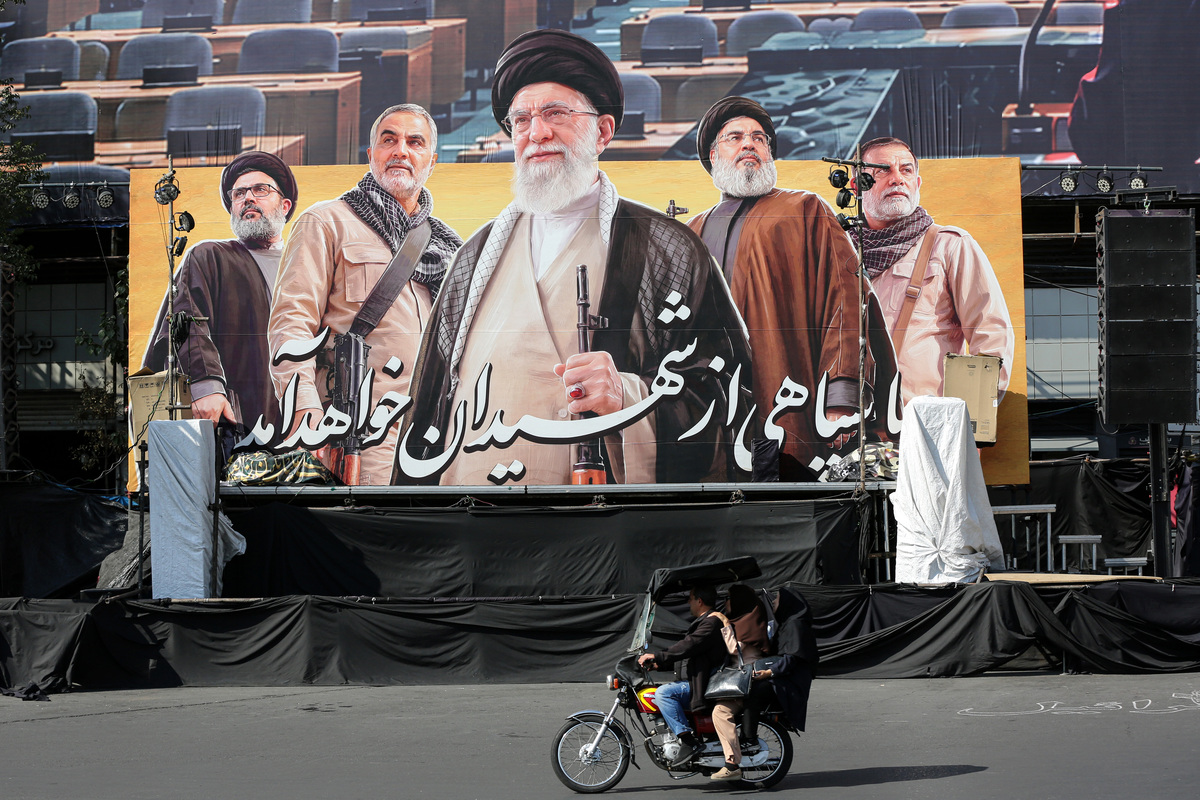
Daily life continues as normal in Tehran amid escalating US-Iran tensions. — Source: middleeastmonitor
Background of the Ongoing Conflict
The United States and Israel launched military attacks against Iran on 28 February 2026, beginning a conflict in which several senior Iranian figures were killed, including Supreme Leader Ali Khamenei. [2] The conflict between the US, Israel, and Iran began on 28 February 2026 with attacks that killed several senior Iranian figures including Supreme Leader Ali Khamenei. [2] The information comes at a time when the American president is under pressure to find an exit from a war that has lasted more than six months. [3] Republicans are concerned about the potential political repercussions ahead of the US midterm elections. [3] Although Trump has publicly stated that he does not plan new military actions before the electoral contest, his advisers have privately reported that they do not know whether that commitment is final. [3] Trump affirmed that Iran is waiting for events and warned that the United States will give it a hard lesson because patience has run out. [4] The president reiterated that Iran will not have nuclear weapons and assured that energy prices will fall drastically when the war ends. [4]
Effectiveness Doubts and MOAB Limitations
The MOAB is the largest non-nuclear bomb in the US arsenal and weighs about 9,800 kg. [3] It is guided by GPS and detonates before impacting the ground, causing a powerful shock wave and extensive surface destruction. [3] However, its size and power do not mean it is suitable for destroying deeply underground facilities. [3] Sources cited by the American network estimate that the bomb probably does not have the required penetration capability to effectively strike facilities such as those at Pickaxe Mountain, which are believed to be protected by multiple layers of granite. [3] The distinction is significant: the MOAB can cause extensive damage over large areas, but it is not designed as a deep-penetration munition. [3] As a source with knowledge of the military planning discussions told CNN, the weapon is suitable for destroying large areas but not for attacking targets located at great depth below the ground. [3] Therefore, its possible use against Iranian nuclear facilities does not guarantee that the intended military objective will be achieved. [3] American officials warn that its deployment would hardly force Tehran to capitulate or secure a decisive victory for the United States. [3] The sources expressed doubts about the capacity of this bomb to destroy fortified facilities deep underground, since it is designed to cause a high-power explosion over a wide area but not to penetrate deeply protected underground structures. [4] These limitations raise questions about its effectiveness in achieving the planned military objectives. [4]
Political and Psychological Dimensions
Beyond its purely military capabilities, the MOAB could be used as a means of psychological pressure on the Iranian leadership. [3] The enormous explosion and destructive power could aim to send a message of determination at a time when diplomatic efforts have not led to an agreement. [3] The MOAB was developed during the war in Iraq and was designed largely for psychological operations. [3] The expectation was that such a powerful explosion could shock opposing forces and influence their willingness to continue the fight. [3] Its first operational use took place in April 2017, when Trump, during his first presidential term, approved its drop against Islamic State positions in Afghanistan. [3] According to Afghan officials, 36 fighters were killed and three underground tunnels were destroyed, as well as weapons and ammunition. [3] American and Afghan officials had reported at the time that there were no civilian casualties. [3] If used in Iran, the MOAB could cause serious destruction and increase the risk of civilian casualties, especially if it hits infrastructure near populated areas. [3] CNN warned that the use of this bomb could cause considerable destruction in the attacked area and increase the risk of civilian casualties, especially if used against facilities near inhabited areas. [4] The US administration is studying different options to end the conflict without resorting to a large-scale ground operation, while Trump faces internal pressures to end the war amid a decline in popular support and uncertainty about the resumption of military operations. [4] Senior Trump administration officials and military planners have been examining options for weeks that could allow the United States to disengage from the conflict while giving the president the ability to present a positive result domestically. [3] One of the network's sources described some of the scenarios as a spectacular fireworks display, in the sense of an impressive military operation that could offer Trump a political exit, even if it did not achieve all the declared objectives of the war. [3] At the same time, the US military is reportedly preparing for the possibility of Iranian retaliation if a new attack is ordered. [3]
Diplomatic Context Involving Russia and China
Top Russian and Chinese diplomats discussed bilateral ties, wars in Ukraine and Iran during talks in Baku. [5] Lavrov and Wang met in Azerbaijan to discuss bilateral and international agenda on the sidelines of the 7th summit of the Conference on Interaction and Confidence Building Measures in Asia. [5]
What to watch next: The White House stated to CNN that it does not comment on sensitive military plans, which may or may not exist, while emphasizing that Trump keeps all options on the table to prevent Iran from acquiring a nuclear weapon. [3]