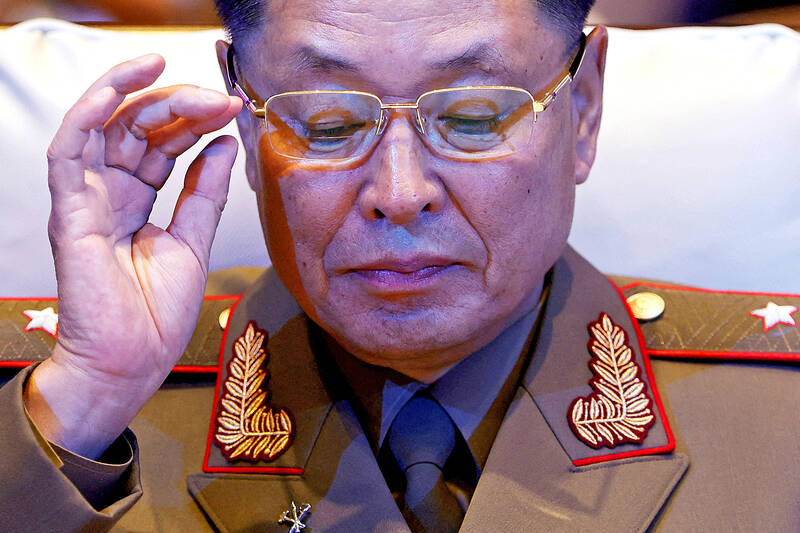

Most dangerous countries see North Korea expand nuclear deterrent at Beijing forum
In a development highlighting tensions among most dangerous countries, North Korea vowed to expand its nuclear arsenal at the Beijing Xiangshan Forum, citing a US-led military buildup and trilateral nuclear alliance with South Korea and Japan as justification, while other global flashpoints including Falklands oil development, Iran-Israel tensions, Palestinian Authority sanctions and new Western sanctions on Russia highlighted ongoing geopolitical risks.
North Korea Rejects Denuclearization
North Korean Vice Minister of Defense Kim Kang-il stated that Pyongyang’s nuclear-weapons status is irreversible and that it will ceaselessly strengthen its self-defensive nuclear deterrent in response to what it called the extreme nuclear threat from enemy states. [1] A growing US-led military buildup and an expanding nuclear alliance among Washington, Seoul and Tokyo justified Pyongyang’s efforts to strengthen and expand its nuclear forces, North Korean Vice Minister of Defense Kim Kang-il said at the Beijing Xiangshan Forum. [1] North Korea’s status as a nuclear weapons state is irreversible, Kim told China’s flagship international security conference, adding that the nation would continue to expand its nuclear arsenal. [1] “The ceaseless nuclear arms buildup of the enemy states fully justifies the building of a solid nuclear shield of the DPRK,” Kim said, using the acronym for North Korea’s formal name, the Democratic People’s Republic of Korea. [1] “As the enemy states’ nuclear threat reaches the extreme level ... the DPRK will firmly defend the peace and stability in the Korean Peninsula and the region by ceaselessly expanding and strengthening its self-defensive nuclear deterrent,” he said. [1] Kim blamed tensions on the Korean Peninsula on what he called Washington’s “invariable” hostile policy toward North Korea and accused the US of turning trilateral cooperation with South Korea and Japan into a nuclear alliance. [1] North Korea’s constitutional status as a nuclear weapons state was “the line of no retreat,” he said, urging other countries to abandon what he called the “daydream” of denuclearization. [1] Kim’s attendance at the Xiangshan Forum marked a rare high-profile showing by North Korea at an international security gathering in recent years and came as Pyongyang seeks closer ties with Beijing amid tensions with Washington and its allies. [1] His remarks followed a statement from Kim Yo-jong, the sister of Kim Jong-un, rejecting renewed international calls for North Korea’s denuclearization following discussions at the annual meeting of the International Atomic Energy Agency. [1] In a statement carried by state media, she said that North Korea’s status as a nuclear weapons state was “absolute” and could not be reversed, dismissing repeated denuclearization demands as annual “noise” and insisting Pyongyang’s nuclear position had been permanently established “physically and legally.” [1]
Falklands Oil Project Halted by Argentine Court
An Argentine federal judge ordered British and Israeli firms to halt the Sea Lion oil project off the Falkland Islands pending an environmental review, reopening legal aspects of the long-running sovereignty dispute. [2] An Argentine federal judge on Wednesday ordered British and Israeli companies to stop developing an oilfield off the Falkland Islands, opening a new legal front in the sovereignty dispute between Argentina and Britain. [2] The injunction by Judge Mariel Borruto targets the Sea Lion oil project 220km north of the British-controlled archipelago in the South Atlantic, barring drilling, offshore installations and port construction until Argentine authorities can conduct an environmental review and issue a decision. [2] In practice, Wednesday’s order is unlikely to halt progress on the project. [2] Borruto said that enforcement “depends on international cooperation and the conduct” of the two firms, Israel’s Navitas Petroleum and Britain’s Rockhopper Exploration, which have already vowed to press ahead with the project despite Argentine President Javier Milei’s threats of tougher sanctions. [2] With its commercial oil production expected to start in 2028, Sea Lion has raised the stakes of a territorial dispute that led Britain and Argentina to a short war in 1982. [2] For the territory’s roughly 3,500 residents, the oilfield promises to transform an economy long dependent on fishing. [2] For Argentina, which calls the islands the Malvinas, the project would allow foreign companies to extract oil riches it regards as its own. [2] Its claim to the archipelago, about 480km off its coast, is enshrined in the constitution and woven into national identity, drawing support across the country’s political divisions. [2]
Netanyahu Assesses Iran Threat
Israeli Prime Minister Benjamin Netanyahu said Iran’s desire to destroy Israel remains but its capability has been significantly diminished by Israeli actions, as the Israel-Hamas war has caused over 73,789 Palestinian deaths according to Gaza’s Health Ministry. [3] Israeli Prime Minister Benjamin Netanyahu said Thursday that Iran's "desire" to destroy Israel has not disappeared, though its capability to execute it has been "significantly diminished." [3] "In fact, it has been significantly diminished, and we have done most of the work, but there is still work to be completed," said Netanyahu during a ceremony at the President's office in Jerusalem honoring outstanding members of the Shin Bet. [3] He also addressed ongoing military operations, stating that Israel is "settling scores with those murderers who killed our people, our daughters, our wives, our children on October 7th, and we are simply settling accounts with those who are still left. And not many remain because we are dealing with them." [3] The war was sparked by the Hamas-led attack on October 7, 2023, in which militants stormed into southern Israel, killing about 1,200 people and taking 251 hostage. [3] Despite an October ceasefire that has reduced fighting in Gaza, Israel has continued to carry out strikes, killing at least 1,375 people since the agreement went into effect, according to local health officials. [3] The nearly three-year Israel-Hamas war has killed more than 73,789 Palestinians, according to Gaza’s Health Ministry. [3] The ministry, part of the Hamas-run government, maintains detailed records viewed as generally reliable by United Nations agencies and international organisations. [3] While it does not distinguish between civilians and militants, it reports that women and children make up around half of the total toll. [3]
US Sanctions Palestinian Leadership
The US imposed sanctions on Palestinian Authority and PLO officials for failing to meet commitments under US law, including payments to terrorists and pursuing unilateral actions at the ICC and ICJ, preventing President Mahmoud Abbas from attending the UN General Assembly in person. [4] The US State Department confirmed on Wednesday that the PLO and PA had failed to maintain their commitments under the PLO Commitments Compliance Act of 1989 (PLOCCA) and the Middle East Peace Commitments Act of 2002 (MEPCA), resulting in sanctions against Palestinian officials. [4] Beyond citing the PA’s continued stipends to Palestinian terrorists and failure to reform textbooks to remove the glorification of terrorism, the department said that the PA and PLO were initiating and supporting actions at international organizations that undermine or contradict prior commitments. [4] These included efforts to internationalize the Israeli-Palestinian conflict through the International Criminal Court (ICC) and International Court of Justice (ICJ), as well as attempts to bypass negotiations by seeking unilateral recognition. [4] As a result, the department announced that the US would deny visas to PLO members and PA officials. [4] The sanctions will prevent Abbas from attending the UN General Assembly in New York in person for the second consecutive year. [4] The Palestinian population, already critical of Palestinian Authority President Mahmoud Abbas, may view renewed US sanctions against the PA and Palestinian Liberation Organization as another sign that the current leadership’s approach to Washington has “not produced sufficient political results,” Dr. Nabil Kukali, president and founder of the Palestinian Center for Public Opinion (PCPO), told The Jerusalem Post on Thursday. [4]
New US Sanctions Target Russian War Machine
The US House passed the Lindsey O. Graham Sanctioning Russia and Iran Act of 2026, which would allow tariffs up to 100% on countries buying Russian oil and gas and target supply chains providing microelectronics to Russian weapons such as the Iskander-M missile. [5] The legislation, known as the Lindsey O. Graham Sanctioning Russia and Iran Act of 2026, would give President Trump authority to impose tariffs of up to 100% on countries that continue buying Russian oil and gas. [5] It would also expand sanctions against Russian officials and entities, foreign suppliers and companies involved in sanctions evasion, while tightening export controls and restricting new U.S. investment in Russia. [5] The bill gives the United States a stronger way to act on what years of sanctions-evasion investigations have already shown: export controls are only as effective as the supply chains around them. [5] Our new analysis illustrates the problem through one of Russia's most important ballistic missiles: the 9M723 Iskander-M. [5] We found that 78% of the identified microelectronic components in the missile's inertial navigation system were made in the United States. [5] The finding points to a contradiction at the heart of Russia's effort to build a self-sufficient defense industry. [5] Moscow has invested heavily in "import substitution" since its invasion of Ukraine, but the production of sophisticated weapons still depends on access to foreign electronics. [5] Of the identified components in the Iskander-M's inertial navigation system, 78.1% were of U.S. origin, compared with 9.4% from Japan, 6.3% from Taiwan, and 6.3% from Switzerland. [5] Among them are Analog Devices, accounting for 40% of the identified U.S.-origin components in the system, and Texas Instruments, which accounts for another 12%. [5]
Broader Global Implications
These separate developments from multiple regions underscore persistent international tensions without new synthesis. [1] [2] [3] [4] [5]
What to watch next: The effectiveness of the new US sanctions on Russia will depend on enforcement and how actively President Trump uses the authorities provided, while the Argentine court order on the Sea Lion project hinges on international cooperation with the involved firms.







