
Magnitude 7.2 Earthquake Hits Ayacucho Region in Peru
A magnitude 7.2 earthquake struck near Coracora in Peru's Ayacucho region on August 20, 2026, at a depth of 108 km, followed by continued seismic activity in Spain's Granada metropolitan area and reports of extensive damage to schools from an earlier magnitude 7.7 quake in Indonesia. [4] [3] [5]
Major Quake Strikes Peru
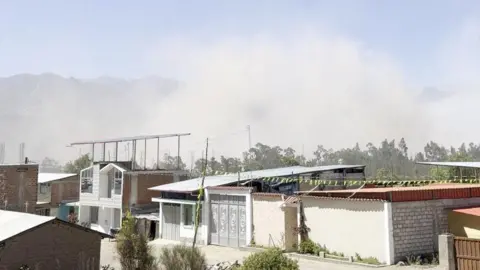
A strong earthquake of magnitude 7.2 on the Richter scale was recorded at 13:00 hours on Thursday with its epicenter near the locality of Coracora in Peru's Ayacucho region. [4] The Centro Sismológico Nacional of the Instituto Geofísico del Perú stated that the tremor reached a depth of 108 kilometers. [4] Its epicenter was located 35 kilometers north of Coracora. [4] The seismic movement attained an intensity of III-IV in Coracora on the Modified Mercalli scale. [4] The quake was felt in Ica and Arequipa, and no victims have been reported so far. [4] Peru maintains high seismic activity mainly due to the interaction of the Nazca and South American plates. [4] The Instituto Geofísico del Perú therefore recommends maintaining a culture of prevention and having a family emergency plan in place. [4] Magnitude and intensity represent different parameters, with magnitude quantifying the energy released by the earthquake while intensity describes the effects and perception of the movement at a given location. [4] This report on Thursday follows other movements recorded in recent hours in the country, including a magnitude 3.6 quake at 08:29:59 hours west of Ocoña in Camaná, Arequipa. [4]
Reduced Seismic Activity in Granada
The seismic activity affecting Granada capital and much of its metropolitan area experienced another day of reduced intensity. [3] During the early hours of Friday, seven seismic movements were counted according to records from the Instituto Geográfico Nacional, although only two were perceptible to the population. [3] The tremor of greatest magnitude reached 2.4 and originated in Gójar. [3] The second movement felt by residents occurred in Armilla with a magnitude of 2.2. [3] In this same municipality another earthquake was also recorded with a magnitude of 1.6. [3] The remaining movements detected during the early hours were of lesser intensity. [3] The Instituto Geográfico Nacional recorded quakes in Churriana de la Vega of 1.8, La Zubia of 1.7, and Alhendín of 1.9, in addition to those already mentioned in Armilla and Gójar. [3] The relative calm of the last hours contrasts with the succession of movements recorded during Thursday when around twenty earthquakes occurred at different points in the metropolitan Granada area. [3] One of the most notable episodes took place at 02:15 hours when an earthquake of 3.4 mbLg with its epicenter located in Dílar caused some residents of different municipalities to wake up as a result of the tremor. [3] Despite the alarm generated, that movement remained far from the two main episodes recorded in recent days, the earthquakes of 4.8 Mw that shook the area during the early hours of Saturday and the morning of Tuesday. [3]

A magnitude 7.2 earthquake struck near Coracora in Peru's Ayacucho region. — Source: gdelt
Comparison to 2021 Granada Swarm
The behavior of the seismic activity keeps open a scenario that specialists consider difficult to predict. [3] The succession of movements has reduced its intensity in the last hours but still does not allow establishing that the episode has reached its end. [3] Researchers cannot anticipate the duration of the episode. [3] Researcher Mercedes Feriche of the Instituto Andaluz de Geofísica has warned of the difficulty in determining the evolution of this seismic sequence. [3] Specialists still cannot know whether the movements will continue for a few days or whether the phenomenon could extend for weeks or even months. [3] The comparison with the episode recorded in Granada in 2021 proves especially relevant for the researchers. [3] The current situation shares some characteristics with that sequence, including the appearance of several earthquakes of significant magnitude. [3] In recent days five earthquakes of magnitude 4 or higher have already occurred, a figure that coincides with the one recorded five years ago in the area of Atarfe. [3] The temporal evolution also presents similarities. [3] In 2021 the first earthquake occurred on a Saturday and five days later three movements above magnitude 4 followed during a single night. [3] A dynamic that in the judgment of the researcher bears resemblances to the sequence experienced during this week. [3]
Geological Context of Recurrent Granada Tremors
Experts place the origin of this seismic recurrence in the geological characteristics of the Vega de Granada, an area in which a network of faults exists associated with the very configuration of the basin. [3] Under Granada there exists a set of tectonic structures due to the process of subsidence of the basin. [3] In certain episodes the movement of one of those faults can occur, generating a main earthquake followed by aftershocks. [3] On other occasions however the displacement of one fault can alter the equilibrium of nearby structures and cause other smaller faults to begin moving as well. [3] The result is a succession of earthquakes that can present characteristics different from a conventional mainshock-aftershock sequence. [3] This explanation allows understanding why the activity does not necessarily concentrate at a single point and why movements of different intensity can follow one another in distinct municipalities of the metropolitan area. [3] Granada coexists with recurrent seismic activity. [3] The very configuration of the depression of Granada, which comprises the capital and much of its metropolitan belt, explains why the presence of seismic activity does not constitute an extraordinary phenomenon for the area. [3] The question that remains open is determining the concrete nature of the current sequence. [3] It could not respond to a single seismic series but to the interaction of several faults and different associated sequences, a possibility that would find parallels with what occurred in Atarfe and Santa Fe in 2021. [3] The comparison does not imply however that the earlier episode will necessarily be repeated. [3] Seismology allows analyzing patterns and establishing probability scenarios but not anticipating with precision the moment, magnitude or duration of each movement. [3] The uncertainty also reaches the possibility that new more intense earthquakes appear than the two movements of 4.8 Mw recorded in recent days. [3] The possibility exists although it is considered improbable. [3] Specialists do not possess a tool that allows knowing in advance how long the phenomenon will remain active. [3] Therefore the decrease in activity during the early hours of Friday constitutes favorable data but does not yet permit certifying the end of the sequence. [3]
School Damage from Flores Island Quake
Indonesia’s National Disaster Mitigation Agency said 1,378 schools on Flores Island in East Nusa Tenggara were damaged in the magnitude 7.7 earthquake that struck the region on Aug. 15. [5] Field teams had assessed 92 percent of the damaged schools. [5] The overall assessment is 92 percent complete, covering 5,521 damaged classrooms and 502 school facility buildings classified as severely damaged. [5] The government was preparing emergency facilities so that 177,678 students could continue their education and 21,166 teachers and education staff could continue working. [5] A total of 923 schools had temporarily closed for safety reasons while 35 were holding classes in emergency facilities. [5] Another 171 schools had switched to remote learning while only 30 schools were still operating normally. [5] Official assessments had not yet been received for the remaining 219 schools. [5] The agency along with relevant ministries and agencies and local governments will accelerate final assessments and prepare education recovery measures to ensure students can continue their studies. [5]
Additional Global Earthquakes
A magnitude 3.0 earthquake occurred at a depth of 2.4 km located 10 km ENE of Coso Junction, CA. [1] A magnitude 4.5 earthquake occurred at a depth of 10.0 km in the Bonin Islands, Japan region. [2]
What to watch next: the possibility remains that movements will continue for days or extend for weeks or months with specialists unable to anticipate the precise duration of the Granada sequence.