Joseph Kabila Named Leader of New DR Congo Rebel Coalition FRN
Former President Joseph Kabila has been named leader of the new Front for the Refoundation of the Nation (FRN), a political-military coalition that succeeds the AFC/M23 rebel alliance and controls large parts of eastern Democratic Republic of Congo.
Announcement of the FRN Coalition
The FRN was announced on 12 October in Goma, North Kivu, with Kabila at its helm, supported by Corneille Nangaa, Bertrand Bisimwa, and M23 military chief Sultani Makenga as one of four vice presidents. [1] The coalition aims to coordinate resistance forces to end tyranny by all means, including force, and has ordered the dissolution of the AFC while raising questions about adherence to the November 2025 Doha peace framework signed by AFC/M23. [1] The announcement follows a July UN experts report noting closer AFC/M23 ties to Kabila and foreshadowing a reorganization; it comes amid ongoing clashes in eastern DRC despite the Doha process and a US-brokered Rwanda-DRC deal. [1] Coalition adviser Claude Ibalanky announced the group's leadership at a press conference at Kabila's residence in Goma. [2] Video released by the group showed Kabila signing documents at the group's declaration along with other leaders. [2] The FRN's mission is to restore the pillars of a functioning republic and unite and coordinate all resistance forces in order to put an end to tyranny by any means necessary, including the use of force. [3] The signatories have decided to pool their forces, resources, and means to create a framework for action through which all Congolese people, acting in unison, will undertake the task of liberating their country. [3] The Kabila-M23 tie-up was presented at a joint press conference at Kabila's residence in Goma, the major city in eastern Congo that the armed group has controlled since January 2025. [4]
Leadership Structure and Succession from AFC/M23
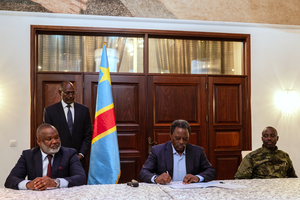
Joseph Kabila named leader of new DR Congo rebel coalition FRN in Goma. — Source: korea-herald
Kabila is supported by Corneille Nangaa, a former presidential candidate in the 2023 elections and coordinator of the AFC, and Bertrand Bisimwa, leader of the M23. [1] Emanuel Sultani Makenga retains his post as Chief of the General Staff of the armed forces, with the rank of Vice-President. [1] Freddy Kaniki has been appointed secretary-general, while Benjamin Mbonimpa, who is responsible for AFC/M23 negotiations within the framework of the Doha peace process, is deputy secretary-general. [1] M23 leader Sultani Makenga will serve as one of Kabila's four deputies in the new movement. [2] The other three also come from the AFC-M23 alliance which last year seized much of mineral-rich eastern DR Congo. [2] Kabila's new Front for the Refoundation of the Nation, or FRN, includes rebel groups formerly united under the Congo River Alliance, whose former leader Corneille Nangaa will serve as one of the new coalition's four vice presidents. [3] The declaration announcing its establishment states that the FRN succeeds the AFC and simultaneously orders the latter's dissolution. [1] The creation of the new political-military movement has caused dismay in the DRC. [1]
Impact on the Doha Peace Process
The AFC/M23 signed the Doha Framework for a Comprehensive Peace Agreement on 15 November 2025. [1] Questions are now being raised about how the new body, which has replaced the AFC/M23, intends to adhere to the agreement and honour the commitments already undertaken. [1] The framework agreement, reached between the DRC government and the AFC/M23 rebel movement through the mediation of Qatar, the United States, the African Union and Togolese President Faure Gnassingbé, does not establish a definitive peace. [1] It does, however, set out a roadmap and a method for shaping the framework for future negotiations, with the aim of resolving the crisis in the eastern part of the country. [1] Under pressure from the US, the Congolese government and the AFC/M23 rebels began direct negotiations in Doha to resolve the security crisis. [3] However, more than a year later, clashes continue in eastern Congo, and experts say that negotiations will become even more complicated with Kabila in a leadership position. [3] The AFC/M23 leaders have been integrated into a new formation, so it is hard to see even from a purely practical standpoint how the Doha process will work. [3] All of this risks jeopardizing the ongoing process. [3] The announcement of the new group comes days after Kabila delivered an address in which he said he would set out how Congolese people should act to rescue their country. [2]
Kabila's Recent Accusations and Political Return

Joseph Kabila named leader of new DR Congo rebel coalition FRN in Goma. — Source: france24
Kabila, who ruled from 2001 to 2019, was sentenced to death in absentia last year for treason and alleged collaboration with M23 and Rwanda; he has denied the charges and accused President Tshisekedi's government of undermining the constitution, mismanaging the economy, and failing to improve security. [2] On Friday, Kabila accused President Félix Tshisekedi's government of disregarding proposals he had put forward last year, including some aimed at ending the conflict in eastern DR Congo. [2] Kabila also accused the government of undermining constitutional rule, mismanaging the economy and failing to improve security. [2] He further alleged arbitrary arrests of political opponents and military officers. [2] The government has not publicly responded to those claims. [2] Kabila, 55, ruled DR Congo from 2001 until January 2019, when Tshisekedi took office following a disputed election. [2] The two were once political allies, forming an informal power-sharing arrangement after the transfer of power. [2] They later fell out and Kabila went into self-imposed exile in 2023 before returning to Goma last year. [2] Last year, a high military court in Congo sentenced Kabila to death in absentia after finding him guilty of treason, war crimes, and crimes against humanity. [3] The court said he collaborated with Rwanda and M23. [3] The former president denied the accusations and called the proceedings politically motivated. [3] Earlier this year, the US government imposed sanctions on Kabila for his alleged role in funding and providing political support to rebel groups operating in the east of his country. [3] Kabila led Congo from 2001 to 2019. [3] He took office at the age of 29 after his father and former President Laurent Kabila was assassinated and extended his mandate by delaying elections for two years after his term ended in 2017. [3] His candidate lost in December 2018 to Kabila's long-term political rival, Tshisekedi, who has ruled the country since 2019. [3] Kabila was condemned to death in absentia a year ago for complicity with the Rwanda-backed M23 armed group. [4] The 55-year-old Kabila, who ruled from 2001 to 2019, is accused by Congolese authorities of being one of the initiators of the Congo River Alliance (AFC), the now dissolved political wing of the M23. [4]
Broader Context of Conflict in Eastern DRC
The formation of the new coalition comes at an uncertain time in a country that has been wracked by violence for decades. [2] More than 100 militia groups are active in eastern DR Congo amid ethnic tensions and fighting for political power and control of lucrative natural resources. [2] The UN and Western governments accuse Rwanda of backing the M23 and controlling the rebels. [2] Rwanda denies supporting the M23 despite overwhelming evidence, and says its military presence in eastern DR Congo is a defensive measure against threats posed by Congolese armed groups. [2] M23 is one of about 100 armed groups that have been vying for a foothold in mineral-rich eastern Congo, along the border with Rwanda, in a decades-long conflict that has created one of the world’s largest humanitarian crises. [3] It took control of Goma, the capital of North Kivu province, as well as other key cities in eastern Congo in a lightning assault last year. [3] Congo, the US and the UN experts accuse Rwanda of backing the M23. [3] Eastern DRC has been plagued by violence for over 30 years with several attempts at mediation having failed so far. [4] A deal signed in December by Kinshasa and Kigali, under the auspices of Washington, has had no tangible effect on the ground. [4] Meanwhile, in July 2025, Kinshasa and the M23 committed, as part of a Qatari-mediated process, to a ceasefire that is not being respected. [4] For at least three years, these forces have controlled large areas of the provinces of North and South Kivu, including their respective capitals, Goma and Bukavu. [1]
Analyst Perspectives on Implications
Analysts say the move seeks to broaden the rebellion's support beyond M23's narrow base, attract army defectors, and reduce reliance on Rwandan backers while complicating peace efforts. [2] Richard Moncrieff, who monitors Africa's Great Lakes region for the International Crisis Group (ICG) says the new coalition is aimed at trying to enlarge the rebellion. [2] He argues that through his higher profile, Kabila hopes to get support from people dissatisfied with Tshisekedi beyond the very narrow political base that the M23 enjoys. [2] The analyst says this appears to be Kabila's objective, to draw more senior Congolese army officers to his side and lessen the reliance of the M23 on its Rwandan backers. [2] Moncrieff says Kabila is drawing on that past to proclaim the illegitimacy of Tshisekedi's government. [2] He however says it won't be easy to seize power like his father, partly because the US has imposed sanctions on Kabila, which he says presumes American support for DR Congo's government. [2] In May the US imposed sweeping sanctions on Kabila, accusing him of backing the M23, providing financial support, encouraging defections from the Congolese army. [2] Kabila said the measures were unjustified and politically motivated. [2] The US said they were part of a wider effort to support last year's peace deal between DR Congo and Rwanda that it brokered. [2] The latest events show peace negotiations are going nowhere and attempting to gain control on the ground is the priority for all parties, the ICG analyst says. [2] Yvon Muya, a researcher at the University of Ottawa in Canada, said Monday's announcement signals a direct confrontation between Kabila and Tshisekedi. [3] You don’t make an announcement like this without having prepared the actions that follow. [3] We will likely witness an escalation on the military front. [3]
What to watch next: The creation of the new political-military body had been foreshadowed in a report by United Nations experts published in July, which noted an increasingly close association between the AFC/M23 and Joseph Kabila and envisaged a reorganization of the movement, including a change of name and the possible assumption of a leading role by the former President. [1]