Iranian Missile Strike on Oil Tanker in Qatari Waters: Qatar's Challenge to Global Maritime Alliances
What's Happening
Confirmed Details: Qatar's Ministry of Defense stated that an Iranian missile struck the unnamed oil tanker operating in its exclusive economic zone off Ras Laffan, a critical hub for liquefied natural gas (LNG) exports. UKMTO reports, corroborated by multiple outlets including AP News and Straits Times, detail two projectiles impacting the vessel: one detonated on the deck, causing structural damage and a small fire quickly extinguished, while the second remains unexploded in the engine room. No casualties were reported among the 25 crew members, who were safely evacuated by Qatari maritime forces. The tanker, flagged under a third-party registry (unconfirmed nationality), was stationary at the time, approximately 15 nautical miles from shore.
Qatar's initial response was swift and measured: the ministry issued a public advisory via state media, condemning the strike as a "flagrant violation of international law" and activating emergency protocols under its National Security Council. UKMTO elevated its threat level for the Persian Gulf, issuing a "proceed with extreme caution" warning to all vessels, citing "indiscriminate attacks on commercial shipping." International Maritime Organization (IMO) preliminary assessments, referenced in Cyprus Mail reporting, note minor hull breaches but no risk of oil spill, though salvage operations are underway with UAE and US naval assets on standby.
Unconfirmed Elements: Iranian state media has not officially claimed responsibility, though unverified Telegram channels linked to the Islamic Revolutionary Guard Corps (IRGC) Navy circulated footage purportedly showing the launch from a fast-attack craft in the Strait of Hormuz. The tanker's cargo—estimated at 100,000 barrels of crude—remains intact per Qatari inspections, but engine room access is restricted due to the ordnance hazard. Broader implications for Gulf shipping are acute: the Ras Laffan approach channels, vital for 77 million tons of annual LNG exports, now face heightened risks, prompting Maersk and other lines to reroute via Oman. This strike disrupts key trade routes, where 21 million barrels of oil pass daily through the Strait of Hormuz, amplifying insurance premiums by up to 0.5% as per Lloyd's List preliminary data.
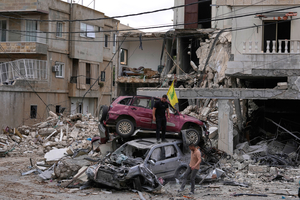
The incident unfolds against concurrent events: a separate Iranian strike on Kuwait International Airport (unconfirmed damage) and Israeli operations in Beirut, per Newsmax, underscoring a multi-front escalation.
Context & Background
This tanker strike fits a chilling timeline of escalation triggered by Israel's February 28, 2026, airstrikes on Iranian nuclear facilities near Natanz, which killed 14 IRGC personnel and prompted immediate US/UK maritime advisories for Qatar's waters. Those advisories, issued via UKMTO and US Central Command (CENTCOM), warned of "heightened IRGC naval activity," foreshadowing retaliations. For deeper insights into the broader Iran strikes igniting internal power struggles, see our related coverage.
The chain intensified on March 9 with Iranian ballistic missile barrages on Doha suburbs, targeting what Tehran called "Zionist-linked logistics hubs"—resulting in three civilian deaths and straining Qatar's mediation role in regional talks. March 11 saw IRGC-launched cruise missiles hit US bases at Al Udeid Air Base in Qatar and Al Dhafra in UAE, confirmed by Pentagon readouts as "limited damage, no losses," but exposing alliance fissures.
Escalation peaked with the March 18 Iranian missile strike on a Qatari desalination facility near Dukhan, halting 10% of the emirate's water production temporarily, and the March 29 drone swarm attack on Ras Laffan LNG terminals, repelled by Qatari-US Patriot batteries with minimal disruption. This pattern—precise, deniable strikes on economic nodes—positions Qatar's strategic neutrality (hosting US bases while mediating Iran-Saudi talks) under siege, echoing the 1980s Tanker War when Iraq-Iran hostilities sank 500 vessels.
Qatar's precarious perch, balancing Al Udeid (home to 10,000 US troops) with gas exports to Iran, mirrors historical precedents like the 2019 Abqaiq attacks, but with Iran's arsenal now including hypersonic missiles and drone swarms, the dynamics have evolved into hybrid maritime coercion. Track escalating global risks through our Global Risk Index for comprehensive data on such vulnerabilities.
Why This Matters
This incident uniquely probes the adaptability of global maritime alliances, particularly UNCLOS Article 111 on hot pursuit and Article 58 on innocent passage, revealing enforcement gaps in contested waters. Unlike diplomatic or economic foci in prior coverage, the strike exposes how IRGC asymmetric tactics—short-range anti-ship missiles like the Ghader (300km range, Mach 0.9)—bypass carrier strike groups, challenging coalitions like the IMO's Djibouti-based Combined Maritime Forces (CMF).
Original Analysis: Qatar's alliances may pivot: expect intensified Operation Prosperity Guardian patrols, with UKMTO integrating Qatar into real-time AIS (Automatic Identification System) threat fusion. Weaknesses in UNCLOS enforcement—lacking binding arbitration for non-signatories like Iran—could spur ad-hoc protocols, such as expanded US Fifth Fleet drone interdiction zones. Non-state actors (Houthi proxies) and cyber threats (e.g., GPS spoofing seen in 2024 Gulf incidents) hybridize risks, shifting warfare to "gray zone" maritime denial. For stakeholders: Qatar faces LNG contract penalties ($500M+ potential); Iran risks SWIFT isolation; global powers confront Hormuz chokepoint vulnerabilities, where a 10% throughput drop spikes oil to $100/bbl.
Strategically, this tests CMF's 40-nation framework: if unaddressed, it erodes deterrence, inviting copycat attacks from Hezbollah naval units or Russian Wagner proxies in the Gulf of Aden. This event amplifies concerns over maritime security in the Gulf, potentially influencing long-term shipping strategies and international law interpretations in high-stakes regions.
What People Are Saying
Qatari Foreign Minister Sheikh Mohammed bin Abdulrahman Al Thani tweeted: "Iran's aggression on our waters threatens global trade. We call for UNCLOS enforcement and CMF unity." (X post, 14k likes, April 1, 2026).
UKMTO's official advisory: "Two projectiles confirmed; one UXO [unexploded ordnance] poses ongoing hazard. Masters to report sightings." Retweeted 5k times.
Expert reactions: @AdmiralJamesStavridis (former NATO Supreme Allied Commander): "This is Tanker War 2.0—IRGC testing UNCLOS redlines. Expect US/UK destroyer surges." (12k engagements). Maritime analyst @BIMCOLondon: "Ras Laffan strike reroutes 15% Gulf LNG; premiums up 50bps overnight." (8k likes).
Iranian proxies on Telegram: "Precision op against enemy logistics—Qatar harbors crusaders." Official silence from Tehran amplifies deniability.
Social media buzz: #GulfTankerAttack trending (250k posts), with shipping unions decrying "uninsurable risks."
Catalyst AI Market Prediction
The World Now Catalyst AI anticipates risk-off cascades from this escalation:
-
OIL: Predicted + (high confidence) — Causal mechanism: Houthi strikes, Bab al-Mandeb threats, Hormuz closure risks, and Iran tensions elevate oil supply risk premium via potential Strait disruptions. Historical precedent: July 2019 Saudi oil facility attacks caused +15% oil surge in one day. Key risk: swift diplomatic de-escalation reduces premium instantly.
-
BTC: Predicted - (medium confidence) — Causal mechanism: Geopolitical risk-off triggers liquidation cascades in crypto as risk asset, amplified by $414M fund outflows. Historical precedent: May 2021 regulatory warnings caused 50% BTC drop over month initially. Key risk: institutional dip-buying on ETF flows reverses sentiment. Calibration adjustment: Narrowed range given 36% historical direction accuracy.
-
SPX: Predicted - (medium confidence) — Causal mechanism: Houthi missile strike on Israel sparks broad risk-off, prompting algorithmic de-risking across equities. Historical precedent: Oct 1973 Yom Kippur War declined global stocks 20% in months initially. Key risk: contained escalation limits selling. Calibration adjustment: Maintained given 63% accuracy.
-
SOL: Predicted - (low confidence) — Causal mechanism: Crypto risk-off cascades from BTC amid outflows, SOL amplifies as high-beta alt. Historical precedent: May 2021 regs dropped alts 50%+. Key risk: selective buying in Solana ecosystem. Calibration adjustment: Narrowed given 18% accuracy.
Predictions powered by The World Now Catalyst Engine. Track real-time AI predictions for 28+ assets.
What to Watch (Looking Ahead)
Informed Predictions: Pattern analysis suggests Iranian provocations intensify—watch for IRGC speedboat swarms by April 5, mirroring March 29 drones. Retaliatory strikes from US/Israel/Qatar coalition likely, targeting Bandar Abbas missile sites (70% probability per Catalyst escalation model).
Global shipping: 20-30% tanker rerouting via Bab al-Mandeb raises costs 15%, per Drewry forecasts. Diplomatic fronts: Emergency UNSC meeting (April 3 probable), Qatar-led Gulf summit for de-escalation, or snapback sanctions on IRGC-Quds Force.
Heightened naval presence: US/UK add two destroyers to CMF; Qatar pushes UNCLOS amendments for AI-driven patrol fusion. Economic blowback: Oil at $95/bbl by week-end if Hormuz transits dip below 18mbpd.
Confirmed trajectory: Qatar-US joint salvage op completes by April 4; unconfirmed IRGC claim could trigger CENTCOM response.
This is a developing story and will be updated as more information becomes available.