

Doomsday Clock Ticks Closer as US House Votes Third Time to End Iran War
The doomsday clock ticks closer as the US House of Representatives voted for a third time to end the US-Israeli war on Iran, which began on 28 February and has now dragged on for nearly seven months with on-and-off missile strikes, while the conflict has already cost the US more than $38 billion and is disrupting global oil flows through the Strait of Hormuz and alternative routes.
US-Israeli War on Iran Enters Seventh Month
The war that Trump launched with Israel on 28 February has dragged, with on-again, off-again deadly missile strikes being exchanged and causing havoc in the region for nearly seven months. [2] The conflict is now in its seventh month as of mid-September 2026. [1] Voters are confronting high prices, particularly for gas at the pumps, as the conflict disrupts the flow of oil resources through the vital Strait of Hormuz. [2]
House Votes Again to End Iran War
For a third time, the US House has voted to end the US-Israeli war on Iran, approving a war powers resolution that would halt President Donald Trump's ability to continue military action without congressional approval. [2] The roll call late Tuesday, 220-204, was similar to earlier efforts this summer, with a few more Republicans joining most Democrats voting to bring an end to the conflict. [2] None of the resolutions have made it to the president's desk, where Trump would almost certainly veto the measure. [2] "Remember when Donald Trump said that this war would last just a few weeks?" said Rep. Seth Moulton, D-Mass., who served as a Marine during the illegal US-UK invasion and occupation of Iraq and pushed the resolution forward. [2] He said it's time for Congress to “actually ask tough questions, as the Constitution directs us to do, rather than be subservient to another warmongering administration.” [2] Republican Rep. Brian Mast of Florida, the chairman of the House Foreign Affairs Committee, questioned which military resources Democrats would want to remove from the region where he said Iran remains a threat. [2] Mast said Trump is against "forever wars, and that is what he is ending"—the decades of hostilities from Iran. [2] "They are a continuous ongoing threat to the United States," Mast said. [2] "Enough is enough." [2] The House first approved a war powers resolution in June, and followed up with another one in July, all seeking to halt US action in Iran. [2] The Senate on its 10th try also approved a war powers resolution to end the conflict, but GOP senators quickly reversed course the next day after Trump berated them during a closed-door lunch. [2] While the Constitution gives Congress the authority to declare war, it also enables the president authority as the commander in chief to engage in some military actions. [2] The war powers act, created in the aftermath of the Vietnam conflict, sought to put a more specific time limit on the president's power, requiring congressional approval for sustained military actions after 60 or 90 days. [2]
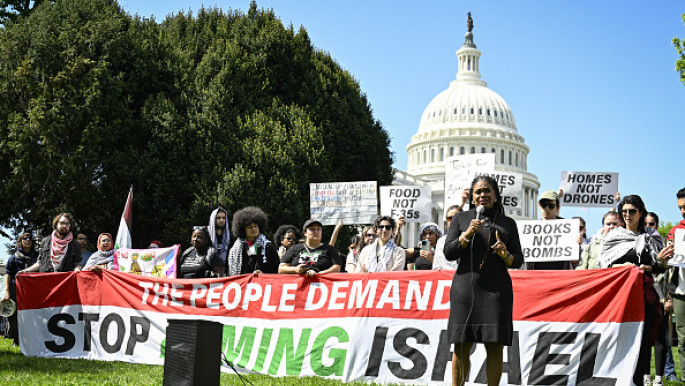
US House of Representatives votes for third time to end the war on Iran. — Source: thenewarab
Financial and Economic Toll on the US
The Congressional Budget Office said Tuesday that the war has cost more than $38 billion, as of 1 August, and is projected to be costing between $2 billion and $3 billion monthly, depending on the intensity of the fighting. [2] The budget office projected inflation will be 0.5 percentage points higher than expected heading into 2027 due to the war. [2] Six months of fighting with Iran have put pressure on U.S. ammunition stockpiles, energy prices and the federal budget, and raised concerns about the country’s ability to respond to other potential conflicts, according to the Congressional Budget Office. [4] The nonpartisan federal agency, which provides budget and economic analysis to Congress, estimates that the conflict has cost U.S. taxpayers $38 billion in direct expenses during the first five months of fighting and will push inflation up about 0.5 percentage points by early next year, a new congressional study has found. [5] The cost includes replacing expended munitions and equipment lost in battle, increased flying hours and increased fuel costs, the U.S. Congressional Budget Office said in a letter Tuesday to U.S. Rep. Brendan Boyle of Pennsylvania, the top Democrat on the House Budget Committee. [5] The CBO estimate is in line with U.S. Defense Secretary Pete Hegseth’s testimony to Congress in July that the war had cost $37.5 billion at that point. [5] Every additional month of conflict will cost at least $2 billion to $3 billion more. [5]
Global Energy Market Disruptions
The renewed confrontation between Washington and Tehran is increasingly being fought not only through military pressure but through the energy market, where disruptions to Gulf exports are pushing oil prices higher, testing the resilience of regional economies and creating a growing domestic challenge for the United States ahead of November’s midterm elections. [3] That pressure intensified Tuesday as Saudi Arabia’s principal route for exporting oil without passing through the Strait of Hormuz suffered another setback. [3] Oil loadings at the Red Sea port of Yanbu were suspended, shipping industry sources told Reuters, while Saudi Arabia’s East-West Pipeline remained offline following attacks on the kingdom’s energy infrastructure. [3] Brent crude futures were up $3.49, or 3.3%, at $109.20 a barrel by early Tuesday afternoon in New York, while US West Texas Intermediate crude rose $5.08, or 5%, to $106.46. [3] Both benchmarks were on course for their highest closes in nearly four months. [3] Preliminary data from Kpler cited by Reuters showed that just four commodity vessels transited Hormuz on Monday, down from 10 on Sunday. [3] Before the war, roughly 125 large commercial vessels passed through the strait each day. [3] Charl Le Roux of MENA Strategic Watch in Dubai said both components are now embedded in the price. [3] “Brent crude is trading at $103.78 per barrel, up from approximately $70–73 before the conflict and near a weekly peak of $108. Of the roughly $30 increase, an estimated $12–15 reflects confirmed supply losses, consistent with Goldman Sachs’ risk-premium framework. The remainder is an uncertainty premium linked to the conflict’s duration and expansion into the Red Sea, making a rapid decline unlikely,” he told The Media Line. [3] The kingdom’s 1,200-kilometer East-West Pipeline, also known as Petroline, carries crude from eastern Saudi Arabia to Yanbu on the Red Sea, allowing exports to bypass Hormuz. [3] The pipeline had become increasingly important during the war, moving roughly 4 million to 5 million barrels per day through the western route during parts of the conflict. [3] A drone attack forced the pipeline offline last week. [3] On Tuesday, shipping sources said oil loadings at Yanbu had also been suspended. [3] Saudi Arabia has informed some European customers that late-September crude cargoes will be canceled, while estimates for restoring the pipeline have ranged from days to several weeks. [3] US Energy Secretary Chris Wright said Tuesday that he expected oil to begin flowing through the pipeline again within days. [3] The disruption threatens a route that has recently handled the equivalent of roughly 4% of global oil supply. [3] Saudi output had already fallen sharply before the latest attack, with the International Energy Agency (IEA) putting August production at about 6 million barrels per day, its lowest level in more than three decades. [3]

US House votes to end the US-Israeli war on Iran as conflict disrupts global oil flows. — Source: jerusalempost
Regional Fighting and Diplomatic Moves
Iran's Foreign Minister Abbas Araghchi heads to China to meet his counterpart Wang Yi as Beijing is exceedingly trying to mediate an end to the US-Israeli war. [1] The Houthi Foreign Ministry says that navigation remains safe in the Bab al-Mandeb strait, and blames Saudi Arabia for trying to "mislead the international community". [1] Meanwhile, fighting continues with reports of a Houthi drone downed near Mecca, and Houthis claiming that they shot down a Saudi fighter jet. [1] US officials met representatives of Yemen's Houthis in Oman over the weekend, five sources familiar with the matter told Reuters, days after the Iran-backed militia seized a strategic stretch of the Red Sea coast in a sweeping offensive that routed Saudi-backed forces. [1] The Trump administration is preparing to approve a $2.8bn arms package for Israel that includes 40,000 heavy bombs. [1] At the same time, Israeli attacks are continuing on Gaza, occupied West Bank, southern Lebanon and south Syria despite any agreements or alleged ceasefires. [1]
Political Ramifications Ahead of Midterms
The action is likely the last House vote on the Iran war ahead of the midterm elections, where the conflict overseas is playing a substantial role in the political campaigns. [2] Lawmakers are heading home at the end of the week to campaign nearly full-time, with less than 50 days to go before the elections that will determine control of Congress as Democrats try to wrest power from Republicans. [2] Trump himself had promised not to involve the U.S. in foreign wars when he won a second term in the White House, and his actions against Iran are weighing on the Republican Party that controls the House and Senate. [2] Most Americans say the war in Iran has not been worth fighting, according to an AP-NORC poll in July. [2] House Speaker Mike Johnson acknowledged at a press conference Tuesday the need to bring gas prices down. [2] But the Republican speaker said he believes the Iran conflict is entering a “new phase” as allies step up to help stabilize the region. [2] When that happens, he said, “you’re going to see, as the president said, anytime gas prices will go down again, the cost of groceries will as well.” [2] Johnson said Trump expects the shift after the election, and the speaker added, "I'd love it to happen today." [2]
What to watch next: Iran's Foreign Minister is traveling to China for mediation talks as Beijing seeks to end the conflict; separately, US officials met Houthi representatives in Oman amid ongoing Houthi actions and Israeli strikes across Gaza, the West Bank, Lebanon and Syria.







