Doomsday Clock for Middle East Peace Ticks Forward as Israelis Mark Three Years Since October 7 Attacks
As the doomsday clock for Middle East peace ticks forward, Israelis marked three years since the October 7, 2023 Hamas attacks that killed 1,200 people and took 251 hostages, as Palestinians in Gaza mourned the destruction from the ensuing war that has killed more than 74,000. [3]
Anniversary Vigils in Israel
In Kfar Aza kibbutz, residents held a vigil with a roll call of the dead and a bugle call. [3] A resident read out a roll call of the dead while a trumpet played a solemn bugle call. [3] Zion Regev, a community leader in the kibbutz, said most residents remain displaced and have yet to return, the trauma of October 7 continuing to shape their lives. [3] "This is the first time we are doing all the things here in the kibbutz," Regev said. [3] "It's a very emotional day, it's a very difficult day for our community, three years after October 7th." [3] The attacks of October 7, 2023, were the deadliest day in Israel's history. [3] Militants led by Hamas killed 1,200 people and took 251 hostages. [3]
Protests Demand Accountability
Protesters gathered outside Israel's parliament demanding accountability and an independent inquiry into the security failures, blaming Netanyahu ahead of elections. [3] Protesters against what they view as a lack of accountability for the security failure gathered outside parliament in Jerusalem, blaming Prime Minister Benjamin Netanyahu for refusing an independent inquiry into the attack. [3] Some protesters held signs reading: "The people will remember October 7 on October 27," a reference to an Israeli general election 20 days away that is being viewed as a referendum on Netanyahu's long tenure in power. [3] "We need the change and we need hope and we need to know that we have a government that cares about the public and doesn't work also only for themselves," said protester Shaked Arrad. [3]
Netanyahu's Response and Election Outlook
Netanyahu has rejected blame for the security breach and resisted calls for an independent investigation. [3] On the eve of the anniversary, he told a cabinet meeting that Israelis "remember with grief and pain our heroes who fell in the War of Redemption and our brothers and sisters who fell in the terrible massacre in the Gaza border communities". [3] Election polls show neither Netanyahu nor his main competitors would muster enough seats in parliament to form a coalition if a vote were held today. [3] That has frustrated many in Israel, including families of those killed in the attacks, some of whom have joined the election race. [3]
Gaza's Devastation and Daily Life
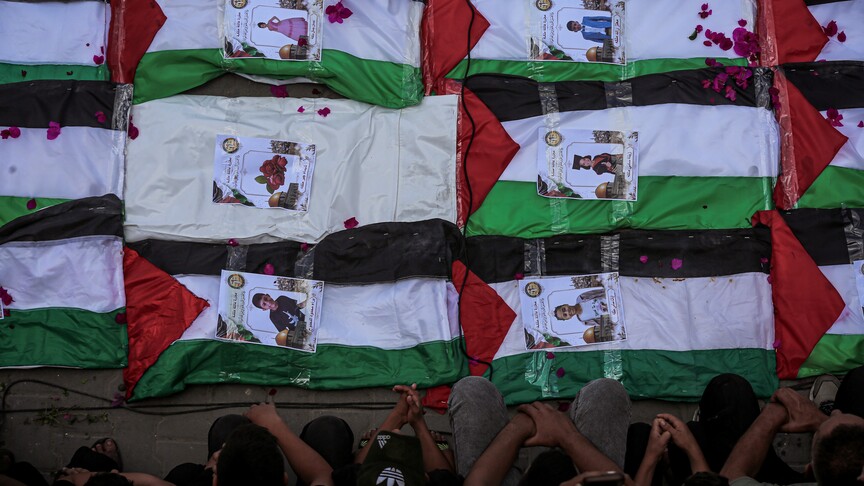
In Gaza, three years of bombardment have displaced nearly the entire population, destroyed much of the enclave, and left survivors in tents and ruins recalling pre-war life. [2][3] Three years ago, the war between Israel and Hamas began. [2] In Gaza, it has meant three years of bombardment that have dramatically transformed the Palestinian territory. [2] Residents of the enclave try to survive the best they can, caught between hope for a better future and resignation. [2] The anniversary is the first since the October 10, 2025, ceasefire deal, which has left Israel in control of around two-thirds of Gaza, where it has demolished remaining buildings and ordered residents out. [3] Hamas controls the remaining third of the territory, a narrow strip on the coast where the 2 million population mostly live in makeshift tents and bombed-out buildings. [3] Umm Mohammad, a mother of five displaced from Gaza City and now living with her husband and children in a tent encampment in Deir Al-Balah, said the war had ripped her family apart. [3] "We were one happy family. The war displaced us. My son left Gaza, the other went to a separate tent, my daughters left with their husbands to other parts of the Strip and we rarely meet," she said. [3] On this day, she said, "we recall how happy, despite all problems, we were before the war broke out, destroying everything we loved." [3]
Ongoing Violence Post-Ceasefire as Doomsday Clock Ticks Forward
Israeli strikes continued after the October 2025 ceasefire, killing at least two Palestinians in Beit Lahia and Khan Younis. [3] In the latest violence, Gaza medics said on Wednesday Israel's military had carried out air strikes in Beit Lahia in northern Gaza and in Khan Younis in the south, killing at least two Palestinians and wounding others. [3] The Israeli military said it had struck a militant target in Beit Lahia, without providing details. [3] It did not immediately provide comment on the strike in Khan Younis. [3] Israel's subsequent bombardment and ground operations in Gaza have killed more than 74,000 people, including at least 1,400 killed in the past year since a US-brokered ceasefire, which halted major fighting but has failed to stop Israeli attacks or secure the disarmament of Hamas. [3]
Human Toll on Gaza's Health System
More than 1,700 health workers have been killed in 920 attacks on Gaza's health facilities, leaving the health system in ruins. [4] Reported death toll exceeds 74,200, equivalent to about 3.4% of Gaza’s estimated prewar population. [5] More than 1,700 health workers killed in 920 attacks on health facilities and staff. [4] Three years of Gaza genocide have left the health system in ruins through the Israeli assault. [4]
What to watch next: Election polls show neither Netanyahu nor his main competitors would muster enough seats in parliament to form a coalition if a vote were held today, while Israeli strikes continue in areas such as Beit Lahia and Khan Younis. [3]