
Doomsday Clock for Palestinian Statehood Ticks Closer to Midnight as Death Toll Tops 74,200
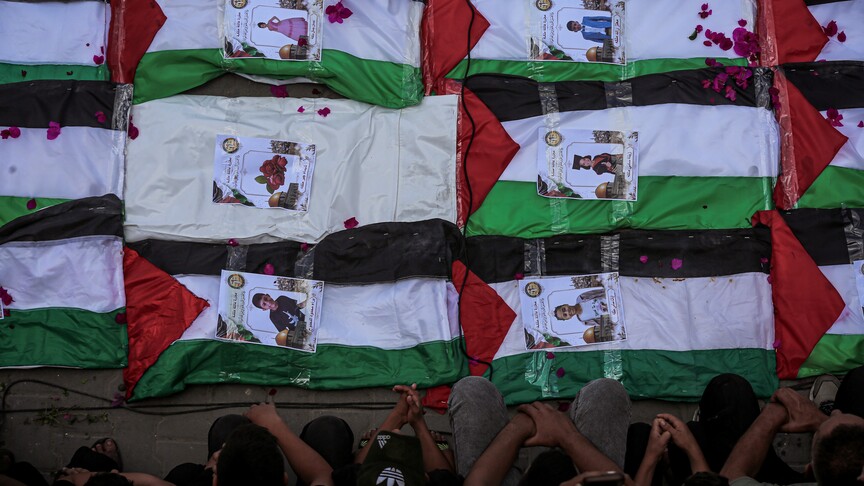
Three years after the 7 October 2023 Hamas attacks that triggered Israel's war on Gaza, the reported Palestinian death toll exceeds 74,200 while Israeli forces control around two-thirds of the enclave and settlement expansion accelerates across the occupied West Bank and East Jerusalem, advancing the doomsday clock for any viable Palestinian statehood.
Human Cost After Three Years
The death toll of more than 74,200 Palestinians is equivalent to about 3.4 percent of Gaza’s estimated prewar population. [1] Destruction continues despite a ceasefire according to a UN rapporteur. [2] Francesca Albanese says the situation in Gaza is beyond what words can say. [2] More than 1,000 Palestinians have been killed in the West Bank since 7 October 2023. [4] Around 40,000 people have been forcibly displaced there according to UN figures. [4] Palestinian Authority President Mahmoud Abbas told the United Nations on 24 September that what is unfolding in Gaza, the West Bank and East Jerusalem are not isolated incidents but rather a malicious colonial project aimed at making life more difficult for Palestinians in their homeland and forcing them to leave. [4]
Destruction of Gaza’s Healthcare and Medical Records
Hassan Shobir, a 54-year-old with colon cancer, lost his biopsy report, CT scan results, tumour marker tests and treatment protocol when facilities including Al-Shifa Medical Complex and the Turkish Hospital for Oncology were affected. [3] The World Health Organisation says the destruction of Gaza’s healthcare infrastructure has damaged health information systems and medical records including paper files and electronic servers. [3] Walaa Abu al-Omrain, 28 and displaced in Al-Zawayda, had medical records documenting previous deliveries and complications at Al-Huda Centre before it was bombed. [3] Ghada Masoud lost her three-year-old son’s vaccination card while fleeing Jabalia, leaving her unable to confirm doses of the DTaP vaccine at a new facility. [3] Tawfiq al-Maghribi, 67, knows he is allergic to certain painkillers and antibiotics but does not know their names because he cannot read or write and lost access to records. [3]

UN rapporteur Francesca Albanese speaks during an interview three years into the Gaza war. — Source: anadolu
Territorial Fragmentation in Gaza
More than 90 percent of Gaza’s housing stock has been damaged or destroyed. [4] By May 2026 Israeli forces controlled around 60 percent of the enclave. [4] Prime Minister Benjamin Netanyahu said in May that Israel controlled 60 percent of the Gaza Strip and that he wanted that figure increased to 70 percent. [4] Israeli forces now control around two-thirds of the territory. [5] Once one of the world’s most densely populated areas, most of Gaza's inhabitants are now concentrated in roughly a third of the enclave. [4] Calls to re-establish Israeli settlements in Gaza have moved from marginal to mainstream, with Finance Minister Bezalel Smotrich stating in 2025 that Gaza is an inseparable part of the Land of Israel. [4] Around a third of Israelis now support renewed settlement in Gaza. [4]
Settlement Expansion and Displacement in West Bank and East Jerusalem
Settlement construction reached a record level in 2025, the highest since the UN began systematically monitoring it in 2017. [4] According to Israeli anti-settlement organisation Peace Now, 146 settlements in the West Bank and 15 in East Jerusalem have been established over the past two years. [4] Some 750,000 Israelis now live in settlements across the occupied territories. [4] In July the Israeli army issued at least 15 land confiscation orders in the Jenin governorate. [4] The International Court of Justice found in an advisory opinion in July 2024 that Israeli settlement policies, forced evictions and extensive house demolitions violated international law. [4] Human Rights Watch said in June that Israeli measures aimed at altering the demographics of Jerusalem constitute war crimes. [4]

Destroyed medical records lie scattered in Gaza after three years of conflict. — Source: thenewarab
Battle Over Post-War Governance
A Palestinian technocratic committee appointed to govern post-war Gaza under a US-brokered framework remains unable to enter the territory. [5] The National Committee for the Administration of Gaza, chaired by Ali Shaath, was formed in January under UN Security Council Resolution 2803. [5] Hamas dissolved its governing body in July to make way for the committee. [5] Israeli Prime Minister Benjamin Netanyahu rejected Trump’s plan in August, saying Israel would not withdraw until Hamas was fully disarmed. [5] Israeli Foreign Minister Gideon Sa'ar dismissed the committee as a ploy to copy Hezbollah's arrangement in Lebanon. [5] The Board of Peace said it would judge Hamas by its actions, insisting on one authority, one law, and one weapon. [5]
Broader Palestinian Political and Humanitarian Outlook
Palestinian analysts describe the delay in allowing the committee to enter as a symptom of a deeper problem over Gaza’s future. [5] Writer and political analyst Iyad al-Qarra expects the status quo with Israel holding 70 percent of the Strip and the committee stuck outside it to last at least until the end of the year. [5] An estimated 1.98 million people, 94 percent of Gaza's population, need shelter and basic household assistance according to a Shelter Cluster survey. [5] The global hunger monitor IPC says more than 1.2 million people face acute hunger. [5] UNRWA laid off 600 staff and cut Gaza salaries by 20 percent in January to cover a $220 million shortfall. [5] The Board of Peace unveiled a $2.45 billion plan in September to start rebuilding, a fraction of the $71.4 billion needed. [5]
What to watch next: Palestinian legislative elections set for 28 November by PA President Mahmoud Abbas face likely postponement given Israel’s own general election on 27 October leaves almost no time for a new Israeli government to set its policy.