
Doomsday Clock for Gaza Survival Ticks Closer to Midnight as Israel Eliminates 4,000 October 7 Attackers
Reporting based primarily on bankier.pl.
The doomsday clock for Gaza survival ticks closer to midnight three years after the October 7 2023 Hamas attack on Israel, as Israeli Defense Minister Israel Katz stated that 4000 of the roughly 6000 Palestinian assailants who crossed the border have been killed while Gaza remains in ruins with over 2 million residents dependent on humanitarian aid under severely restricted conditions despite a ceasefire in October 2025. [1]
Three Years After the October 7 Attack
Israeli Defense Minister Israel Katz announced that around 4000 direct participants in the Palestinian attack on Israel from October 7 2023 have been killed so far. [1] Katz said that 6000 terrorists crossed the border with Israel on October 7 and committed cruel acts, of whom 4000 have been eliminated and 2000 remain. [1] The figures on attack participants given by Katz were presented by military intelligence. [1] According to earlier army estimates around 5600 attackers from Hamas and associated terrorist organizations from the Gaza Strip carried out the invasion of Israel on October 7 2023. [1] In the fighting on Israeli territory at that time between 1200 and 1600 of them were killed while the rest were pushed back into the Strip. [1] Many of them died during the conflict that has continued since then. [1] Actions aimed at tracking down and eliminating all people who took part in the attack carried out by Hamas are being conducted by the Nili unit of the Shin Bet security agency. [1] Israeli forces and Shin Bet have intensified efforts in recent months to eliminate all assailants. [1] The directive from Prime Minister Benjamin Netanyahu to the army and security agencies is firm and clear that beyond the overarching goal of eliminating Hamas and demilitarizing the Gaza Strip all participants in the attack must be tracked and eliminated without limits from top commanders to rank-and-file soldiers. [1]
Scale of Destruction and Displacement in Gaza
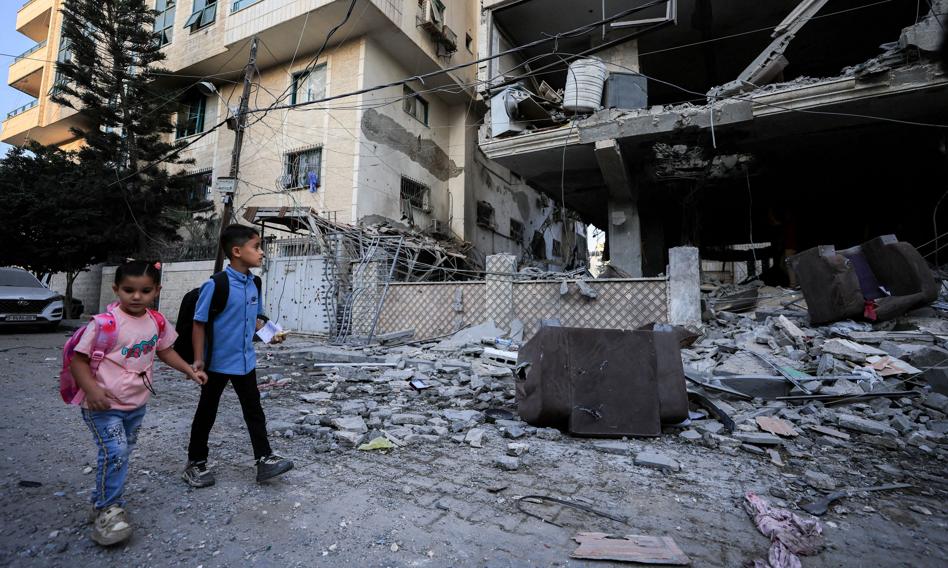
Israeli bombardments destroyed or damaged more than 80 percent of buildings in the Gaza Strip. [1] Around 1.9 million of the 2.1 million residents were forced to leave their homes many of them repeatedly. [1] Currently two-thirds of Gaza Strip residents live in tents or makeshift camps according to the UN Office for the Coordination of Humanitarian Affairs in September. [1] Nearly a year after the truce was announced reconstruction has practically not yet begun. [1] Israeli troops still control nearly two-thirds of Palestinian territory. [1]
{IMAGE_2}
Humanitarian Conditions and Access to Aid
Three years after the start of the war most of the more than 2 million residents of the Gaza Strip remain dependent on humanitarian aid. [1] Since the truce was concluded in October 2025 food availability has improved but hundreds of thousands of people still live in tents without access to electricity water or medical care. [1] The resumption of humanitarian aid after the truce was announced brought some relief but living conditions remain unbearable and the scale of human suffering still exceeds all imagination UN Secretary-General Antonio Guterres said on September 24. [1] One of the biggest changes after the ceasefire is the improvement in the food situation. [1] A greater inflow of aid reduced the threat of famine but assistance still does not meet needs. [1] According to OCHA families receive a monthly food package and a 25-kilogram bag of flour which covers about half of the minimum caloric requirement. [1] Aid organizations distribute around 650000 hot meals daily. [1] Food is more easily available on the market but prices remain on average twice as high as before the war. [1]
Collapse of Essential Services
Access to basic services is improving much more slowly. [1] For three years no electricity has been supplied to the Gaza Strip from the Israeli grid. [1] Hospitals and some households use generators but Israeli restrictions on the import of fuel engine oil and spare parts hinder their operation. [1] The price of generator oil rose from around 3 dollars before the war to as much as 1300 dollars per liter making the energy produced this way unavailable to most families Reuters reported on September 10. [1] Infrastructure destruction also limits access to water. [1] In the September report of the UN Special Coordinator for the Middle East Peace Process around 77 percent of households rely on water deliveries by tanker. [1] None of the wastewater treatment plants are operating and two-thirds of pumping stations are out of service so sewage flows directly into the Mediterranean Sea among other places. [1] UNICEF reported in July that up to 70 percent of residents did not have access to even six liters of water per person per day. [1] Water problems also affect sanitary conditions. [1] According to UNSCO 73 percent of tested water samples did not meet chlorination standards and 18 percent were microbiologically contaminated. [1] The health threat is also posed by around 68 million tons of rubble containing sewage medical waste and unexploded ordnance. [1] Destruction and fuel shortages also affect health care. [1] Rotating power outages limit the use of respirators and inhalers in hospitals and there is also a shortage of medicines including anticancer drugs dialysis materials and insulin. [1] Poor sanitary conditions mean that infectious diseases account for about 18 percent of medical consultations. [1] At least 41800 residents have serious war injuries requiring long-term rehabilitation of which about one-quarter are children according to a joint assessment by the EU UN and World Bank. [1]
{IMAGE_3}
Doomsday Clock for Gaza Survival Ticks Closer to Midnight in Broader Impacts on Education, Economy, and Recovery
Despite the start of the new school year on September 19 around 200000 children still have no access to organized education OCHA reports. [1] Nearly 495000 are learning in temporary points run by the UN and partner organizations. [1] The plan was supposed to bring relief Adam Coogle of Human Rights Watch said in May referring to the plan to end the conflict in the Gaza Strip overseen by the Peace Council established under a UN Security Council resolution. [1] Yet Palestinians in the Gaza Strip continue to go hungry still lack access to medical care and civilians continue to die he added. [1] According to the United Nations Conference on Trade and Development the war destroyed all major sectors of the Gaza Strip economy and more than 90 percent of working-age residents remain without work. [1] The cost of reconstruction is estimated at around 71.5 billion dollars. [1] Médecins Sans Frontières warns that Israel is progressively asphyxiating Gaza and continuing its genocide as the space in which people can live is vanishing while the conditions people need to survive are being systematically destroyed through continued violence the deliberate blockade of essential supplies and the destruction of healthcare and vital infrastructure. [2] It will take generations to recover from the harm that has already been done over the past three years MSF says. [3]
Casualties and Ceasefire Context
The war in the Gaza Strip broke out after the attack by Hamas and other Palestinian groups on Israel on October 7 2023. [1] The truce ended the heaviest fighting although Israeli attacks have not ceased entirely since then. [1] MSF states that Israel is progressively asphyxiating Gaza by destroying means of survival through continued violence blockade of supplies and dismantling of healthcare and infrastructure with recovery expected to take generations. [2]
What to watch next is whether the intensified efforts by Israeli forces and Shin Bet to track and eliminate remaining participants in the October 7 attack will continue alongside any further changes in aid inflows or restrictions that affect the pace of recovery in the Gaza Strip.