
Doomsday Clock Edges Closer as Russia and China Veto Iran Sanctions Monitoring at UN
As the doomsday clock edges closer amid rising global frictions, Russia and China vetoed a UN resolution to extend monitoring of sanctions on Iran as the 81st UN General Assembly opens amid heightened global tensions over the Iran war, Israel-Gaza conflict, and related geopolitical disputes.
Russia and China Block Iran Sanctions Monitoring
Russia and China have vetoed a United Nations resolution that sought to extend the monitoring of sanctions on Iran. The resolution that would have authorised UN experts to continue monitoring sanctions reimposed on Iran last year over its nuclear programme was shut down on Thursday. On Thursday, 11 of the 15 members voted to extend sanctions monitoring. Russia and China vetoed the resolution while Pakistan and Somalia abstained. “We strongly urge Western colleagues to stop their very dangerous actions on the Iran front, which threaten further complication in settling the crisis in the Persian Gulf,” Russia’s UN Ambassador Vassily Nebenzia told the Security Council after the vote. Iran, in a post on X, thanked China and Russia for vetoing the US resolution. “Iran deeply appreciates Russia and China for their consistent and principled positions and decisive actions today,” Iran said. The two countries “prevented yet another cynical attempt by the United States and its allies to abuse the Security Council for their political purposes.” [2]
Background on Reimposed Sanctions
UN sanctions were officially reimposed against Iran in September 2025 when France, Germany and the United Kingdom triggered the “snapback” mechanism under UN Security Council Resolution 2231. It cites six previous UNSC resolutions which had imposed sanctions targeting Iran’s nuclear and military programmes, including nuclear enrichment, ballistic missiles, and arms trade. Iran was accused of violating the 2015 nuclear pact, which limited Iran’s nuclear activities. But Iran has repeatedly denied the allegation that it is seeking to produce nuclear weapons or that it violated the agreement. After the sanctions were imposed last year, the UN tried to form an independent panel of experts to monitor and report on Iran’s sanctions violations, including recommending further action. However, the experts were never appointed because the 15-member Security Council could not reach consensus. [2]
UNGA High-Level Week Agenda
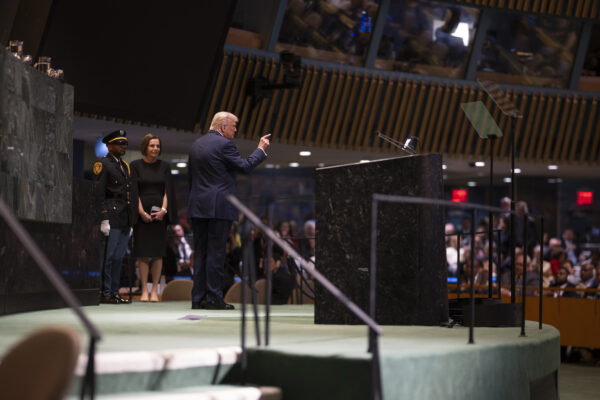
US president Donald Trump’s Iran war and Israel’s US-backed genocide in Gaza are set to dominate the 81st UN General Assembly in New York, with Russian and Ukrainian, as well as Israeli and Iranian delegations, to also take the floor. The UNGA’s “high-level week” will kick off with a political row between Trump and Brazil. Brazilian prime minister Luiz Inácio Lula da Silva will give the opening speech on Tuesday morning, in which he has promised to “personally” warn Trump not to interfere in Brazilian elections on 4 October by supporting his populist, far-right rival Flavio Bolsonaro. Trump will speak immediately afterward to deliver what diplomats expect to be a pugilistic rebuke. Ukrainian president Volodomyr Zelensky, whose speech is yet to be scheduled, will focus his attention on bilateral meetings, with a potential Trump-Zelensky meeting, as well as already scheduled meetings with European Commission president Ursula von der Leyen and French president Emmanuel Macron, to secure more EU funding. The Trump-friendly Russia will be represented by foreign minister Sergei Lavrov, speaking on Saturday, even though he is under US and EU sanctions. Israel and Iran set out their cases, with Israeli prime minister Benjamin Netanyahu speaking on Thursday and Iranian president Masoud Pezeshkian also addressing the assembly. [1]
US Arms Deal with Saudi Arabia
The United States has approved a $24.3 billion sale of 48 F-35 stealth warplanes to Saudi Arabia, the State Department said Thursday, the kingdom's latest major arms purchase since the start of the Iran war. Saudi Arabia has been repeatedly targeted with drone and missile strikes by Tehran's forces since the United States and Israel launched their war against Iran in February, and has also been hit by Yemen's Iran-backed Houthi rebels. [4]
Related Tensions with Russia
Switzerland said Vladimir Putin’s seizure of Russian assets belonging to Nestle SA is a worrying development and it’s working with the company to get the actions reversed. The Russian president on Thursday ordered stakes in businesses of Nestle and French supermarket chain Auchan to be placed under temporary administration by a local company. The Kremlin linked the actions to European military support for Ukraine. For Switzerland, it comes at a particularly sensitive time. The country is less than two weeks away from a national vote on its neutrality, where the result could affect Swiss sanctions on Russia. Switzerland’s State Secretariat for Economic Affairs, speaking on behalf of the government, said in a statement that it’s “worried” about the seizure of Nestle’s assets. It’s working with Nestle “toward the reversal of the compulsory administration.” Eric Nussbaumer, a former senior lawmaker of the Social Democrats, called Russia’s move “unjustified.” “Apparently there’s resentment against Switzerland in high places in Russia,” he said. “I advise extreme caution when dealing with this regime.” [5]
Broader Geopolitical Context
The development comes as the Trump administration began its campaign to isolate Tehran from its economic partners as the more than six-month-old war in Iran has hit a stalemate. PREMIUM TIMES earlier reported the new round of economic sanctions imposed on Tehran and its partners in August. Treasury Secretary Scott Bessent stated that the US would sever economic ties with the countries conducting business with Iran. Multinational Maritime Defense Coalition holds its 4th planning meeting in Saudi Arabia as part of the coalition's ongoing transition from founding stage to actual operational stage. As the doomsday clock edges closer, US president Donald Trump’s Iran war and Israel’s US-backed genocide in Gaza are set to dominate the 81st UN General Assembly in New York. [2] [3] [1]
What to watch next: Ukrainian president Volodomyr Zelensky will focus on bilateral meetings including a potential Trump-Zelensky meeting as well as already scheduled meetings with European Commission president Ursula von der Leyen and French president Emmanuel Macron to secure more EU funding, while Israeli prime minister Benjamin Netanyahu speaks on Thursday and Iranian president Masoud Pezeshkian also addresses the assembly.