
China Severe Weather: Typhoon Noul Makes Landfall in Guangdong with 162 kph Winds
China severe weather unfolded as Typhoon Noul, the strongest typhoon to strike China this year, made landfall in Guangdong province on July 26 with maximum sustained winds of 162 kph, prompting the highest alert for flash floods, evacuation of more than 801,000 people, and emergency relief efforts as it weakened into a tropical storm while lashing southern China with heavy rain and strong winds. [3]
Typhoon Noul Landfall and Immediate Impact
China declared its highest alert for flash floods in several areas as Typhoon Noul brought heavy rain and gale-force winds across Guangdong province and neighboring Hong Kong. [2] The center of the typhoon crossed over land at about 3:50 a.m. near Guangdong’s Pinghai, state broadcaster China Central Television reported. [3] Maximum sustained winds near the eye of the storm at the time of landfall were 162 kph, it said. [3] That made Noul the strongest typhoon to strike the country so far this year, it added. [3] Chinese weather authorities expected parts of southern Guangdong and southeastern Fujian provinces to experience heavy rain. [3] The typhoon weakened to a tropical storm on Sunday as it moved inland after lashing a stretch of southern China with strong winds and rain, prompting emergency relief in the fiercest storm to hit the country this year, state media reported. [3]
Evacuations, Disruptions, and Casualties
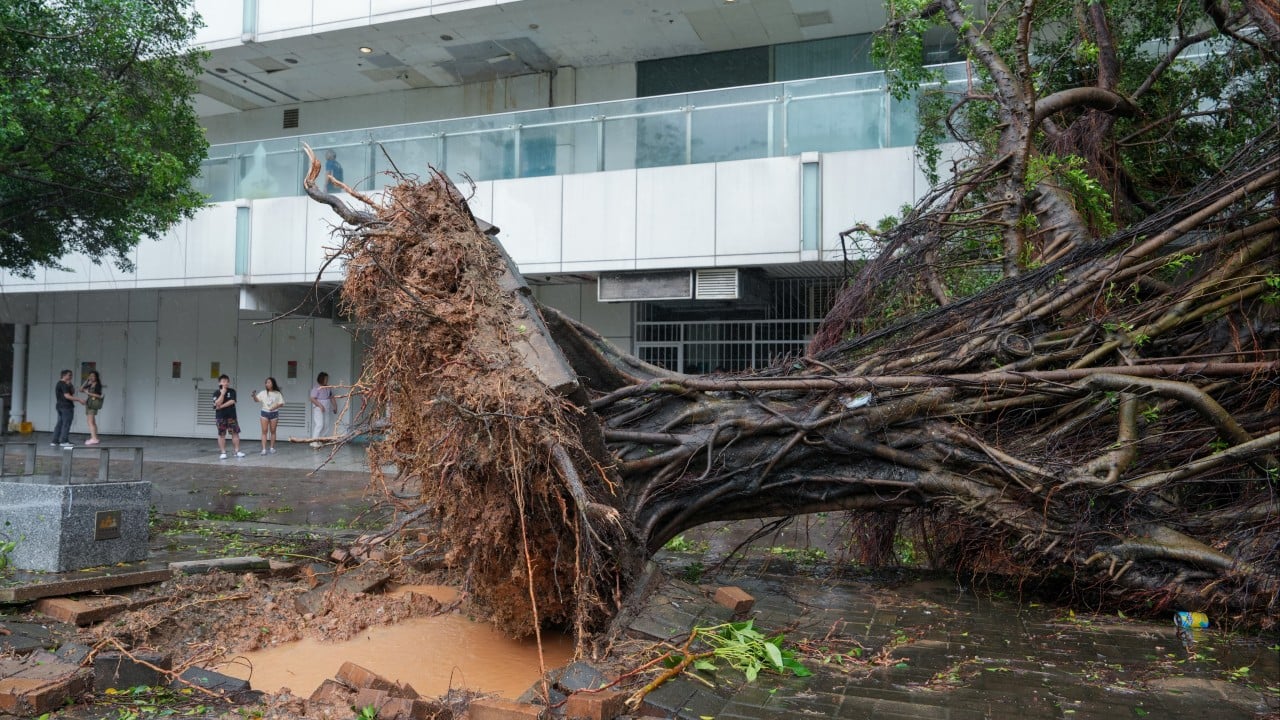
More than 801,000 people had been relocated for safety in Guangdong as of yesterday, the state-run Xinhua news agency said. [3] Prior to the storm’s landfall, severe weather forecasts had spurred authorities to evacuate more than 340,000 people and suspend work and rail services, with major flight disruptions continuing throughout yesterday morning. [3] The Hong Kong Airport Authority said that about 350 flights were canceled and about 2,000 passengers were stranded at the airport over the weekend. [3] At least 21 people were injured across the territory during the typhoon, Hong Kong authorities said. [3] Workers move a fallen tree in the aftermath of Typhoon Noul in Pinghai in China’s Guangdong Province yesterday. [3]

Fallen trees lie across a road in southern China after Typhoon Noul made landfall in Guangdong. — Source: bangkokpost
Flood Alerts and Government Response
China declared its highest alert for flash floods in several areas as the year's strongest typhoon made landfall early on Sunday (July 26) in the country's south, bringing heavy rain and gale-force winds across Guangdong province and neighboring Hong Kong. [2] The Chinese Ministry of Water Resources upgraded its flood-control emergency response, including for Guangdong, over high risks of mountain floods, Xinhua said. [3] China’s National Development and Reform Commission said it allocated 100 million yuan (US$14.8 million) to support recovery efforts in Guangdong. [3] Chinese authorities upgraded flood-control responses for risks of mountain floods in Guangdong and Fujian, with the National Development and Reform Commission allocating 100 million yuan for recovery efforts. [3]
Broader Weather Context and El Nino Influence
Hong Kong should prepare for stronger storms and a warmer, wetter winter this year as the current El Nino phenomenon is likely to intensify into a super event, a local green group and a leading meteorologist have said. [1] Typhoons heading for Hong Kong this year were set to grow more powerful, as El Nino raised sea temperatures and provided storms with more moisture and energy, Friends of the Earth (HK) said on Monday. [1] The forecast, which is based on international and local data, came after the Observatory predicted in May that El Nino could turn the four to seven tropical cyclones expected to come within 500km (311 miles) of the city this year into super typhoons. [1] Local temperatures have been rising, with the annual mean increasing by 0.14 degrees Celsius (0.25 Fahrenheit) per decade since 1885. [1] Friends of the Earth warned that scorching days and hot nights in the months ahead would significantly increase the risk of heatstroke and other health problems associated with higher temperatures, while intense downpours could overwhelm the city’s drainage systems. [1] Higher sea levels would also worsen the threat of seawater backflow and flooding in coastal and low-lying areas, and persistent rain would weaken slope stability, raising the risk of landslides, it predicted. [1]
{IMAGE_3}
Separate Flash Flood Disaster in Gansu
Separately, in northwestern China, at least 10 people died and 23 were injured in a flash flood in Gansu Province, Xinhua reported. [3] The flash flood, triggered by a period of sudden heavy rainfall, hit a scenic area in the province’s Weiyuan County in the afternoon and trapped some tourists who were camping. [3] Search-and-rescue operations were still under way, Xinhua said. [3] A flash flood in northwestern China's Gansu Province killed at least 10 people and injured 23 after sudden heavy rainfall trapped campers in a scenic area. [3]
Regional Preceding Damage from the Typhoon
Before gaining intensity on Saturday over the South China Sea, Noul had already left a path of damage, clipping the extreme northern islands of the Philippines. [3] Three people were killed and one was missing due to the typhoon, the Philippine National Disaster Risk Reduction and Management Council said yesterday. [3] The typhoon's center crossed land near Guangdong’s Pinghai at about 3:50 a.m. with winds of 162 kph, injuring at least 21 people in Hong Kong where around 350 flights were canceled and 2,000 passengers stranded. [3]
What to watch next: Hong Kong should prepare for stronger storms and a warmer, wetter winter this year as the current El Nino phenomenon is likely to intensify into a super event.