
Bolivia Protests Prompt President to Declare State of Emergency
Bolivian President Rodrigo Paz declared a state of emergency on Saturday amid Bolivia protests to enable security forces to clear protesters' roadblocks that have paralyzed the economy for 50 days, caused shortages of food, fuel and medicine, and left at least 14 people dead. [1]
Emergency Declaration
President Rodrigo Paz stated in an early morning address that the blockades are no longer a social protest but an organized attempt to destabilize Bolivia's democracy. [1] He said the emergency measure aims to restore freedom of movement, protect citizens and ensure essential supplies. [1] Paz warned that those continuing disruptions would face legal consequences. [1] The decree prohibits blocking streets, avenues, roads and highways in ways that affect transportation and supplies. [2] It orders the armed forces to temporarily support the police in restoring order, reopening roads and protecting the population. [2] The measure enables wider military deployment. [1] Paz said the state of emergency is not to restrict people's lives but to give freedom back to the people and free Bolivia from those who use political conflict to block roads and harm the population. [1] The decree is set to last 90 days but could be lifted earlier if violence and threats against the population come to an end. [2]
Impact of 50 Days of Blockades
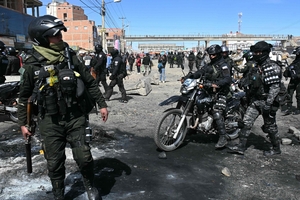
The blockades have cut off key roads and stranded trucks, choking supplies of food, fuel and medicines to many areas, particularly hurting Bolivia's administrative capital La Paz and the neighboring city of El Alto. [1] Businesses closed, supermarket shelves were emptied, and hospitals ran out of oxygen. [2] Over the last five weeks, violent confrontations between demonstrators and riot police led to 365 arrests and 37 injuries, according to authorities. [2] At least 14 people have died, with most linked to a lack of medical care due to transportation disruptions. [1] Neighbors clashed when government tractors began clearing some roadblocks on highways in and around El Alto. [1] Some residents expressed support for clearing the debris, while others lined highways shouting support for the protests and stating they have the right to fight for their livelihoods. [1]
Government Actions and Union Deal
Paz reached a deal on Friday with the main union, the Bolivian Workers’ Confederation, to lift blockades and form working groups on demands. [1] The agreement provides for working groups bringing together ministers and union leaders to discuss the protest movement’s demands, and the government promised not to privatize public companies. [4] Paz had taken prior steps such as reversing land reforms and making cabinet changes. [3] He addressed the nation hours after unveiling the deal, but proceeded with the emergency declaration after dialogue failed with other groups. [1] The president said he had exhausted all avenues of dialogue, reaching agreements with those whose demands were legitimate. [4]
Protesters' Response and Divisions
Rural and indigenous groups aligned with former President Evo Morales were not included in the union deal and continue protesting, mainly around Cochabamba. [1] These groups have hardened roadblocks and accused the government of neglecting their needs. [4] Protesters demand fuel subsidy restoration, an end to shortages and Paz's resignation. [3] In areas home to migrants from peasant highland communities, dozens shouted support for the protests through tears. [1] Some opposition lawmakers warned a state of emergency could further ratchet up tensions. [1]
Political Context and Next Steps
Paz has been in power for seven months after nearly two decades of governments under the leftist Movement Toward Socialism headed by Morales. [1] The president has blamed Morales for stoking the unrest, while Morales has backed the protest movement, called for early elections and denied any role in instigating dissent. [1] Congress cleared a path for the declaration in May when it repealed a law that had set limits on the executive branch's use of emergency orders. [1] The president must notify Congress of the state of emergency within 24 hours, and Congress has up to 72 hours to approve or reject it. [1] The opposition Alianza Libre party indicated it would support the measure. [1] The US strongly supports Paz's decision to restore order and ensure the free flow of food, medicine and essential supplies. [1]
Current Situation on the Ground
Police and armed forces cleared several roadblocks by Saturday afternoon with normality returning in some areas. [1] Some protesters allied with former President Evo Morales continue blocking roads especially around Cochabamba. [1] Bolivia's mines were operating normally. [1] Public reactions remained mixed in affected neighborhoods, with some residents welcoming the clearing of debris and others expressing support for continued protests. [1]
What to watch next: Congress is expected to vote on the emergency decree on Saturday evening, and the government has 90 days to make progress on union demands under the Friday agreement while some roadblocks remain in place. [1]