

1,005 Palestinians Killed by Israeli Fire in Gaza Since Ceasefire
The Israel conflict continues to produce severe humanitarian consequences across multiple fronts, with Israeli operations in Gaza having killed more than 1,000 Palestinians since a ceasefire with Hamas took effect. [3] Settlers in the West Bank have destroyed internationally funded schools and torched a mosque, and Amnesty International has accused Israel of committing war crimes through forced displacement in southern Lebanon. [1] [2] [5]
Overview of the Israel Conflict
Israeli operations in Gaza have killed 1,005 Palestinians and injured 3,157 since the ceasefire, pushing the overall death toll above 73,000 according to the Gaza Health Ministry. [3] [4] This escalation forms part of the broader Israel conflict that spans Gaza, the West Bank, and southern Lebanon, where additional incidents of settler violence and large-scale displacement have been documented. [1] [2] [5] The figures reflect ongoing military activity even after the ceasefire agreement with Hamas. [3]
Gaza Death Toll Since Ceasefire
Israeli operations in Gaza have killed 1,005 Palestinians and injured 3,157 since the ceasefire, pushing the overall death toll above 73,000 according to the Gaza Health Ministry. [3] [4] The Gaza Health Ministry's latest toll released Wednesday recorded these post-ceasefire casualties from Israeli fire. [3] Earlier reports confirmed that at least 1,005 Palestinians were killed and 3,157 injured in the eight months following the ceasefire. [4] These numbers contribute directly to the cumulative death toll that has now surpassed 73,000. [4]
Settler Attacks on West Bank Infrastructure
Israeli settlers have destroyed schools and other community infrastructure in the occupied West Bank that received support from Finland and other international donors. [1] The Finnish public broadcaster Yle reported that a significant number of Palestinian facilities funded through international aid programmes have been demolished or damaged in recent years, including projects supported through Finnish development cooperation. [1] These actions have targeted infrastructure backed by multiple international donors beyond Finland alone. [1]
Palestinians gather at a site of Israeli strike aftermath in Gaza since the ceasefire. — Source: newsmax
Mosque Torched in West Bank Village
Israeli settlers set fire to a mosque in the West Bank village of Jiljilya, with videos showing the building ablaze and Hebrew graffiti reading "revenge". [2] Local officials and witnesses confirmed the arson attack on a Wednesday. [2] Videos on social media showed the mosque in the town of Jiljilya ablaze while walls were marked with the Hebrew graffiti. [2] The incident adds to reports of settler violence against Palestinian sites in the West Bank. [2]
Amnesty Accusation of War Crimes in Lebanon
Amnesty International determined that Israel's mass evacuation orders and "no-return" zones in southern Lebanon constitute unlawful transfer, a war crime under the Fourth Geneva Convention. [5] The rights group found that the Israeli military had dramatically expanded its use of mass "evacuation" and "no-return" orders since 2024, displacing hundreds of thousands of people across Lebanon and preventing tens of thousands from returning to their homes in the south. [5] Amnesty's investigation, which analysed Israeli military orders published on X, interviews with displaced residents and satellite imagery, concluded that Israel used evacuation orders as a deliberate tool to depopulate large areas of southern Lebanon while continuing to destroy homes and civilian infrastructure. [5] Kristine Beckerle, Amnesty International's deputy regional director for the Middle East and North Africa, stated that Israel's forced displacement and prevention of return of tens of thousands of civilians from southern Lebanon amounts to unlawful transfer, which is a grave breach of the Fourth Geneva Convention and thus a war crime. [5]
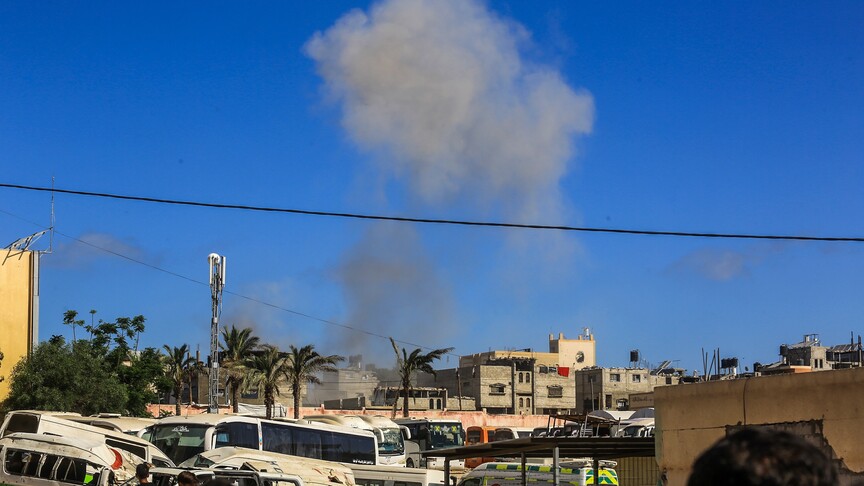
Israeli forces operations in Gaza have killed over 1,000 Palestinians since the ceasefire. — Source: anadolu
Scale of Displacement and Israeli Response
Israel ordered residents to leave areas south of the Litani River and later the Zahrani River, affecting territory home to roughly 800,000 people, and established a "Forward Defence" zone covering about 6% of Lebanon where return is barred. [5] Within the first 48 hours of the escalation, the Israeli military ordered residents to leave all areas south of the Litani River, covering around 8.5% of Lebanon. [5] Days later, it expanded the order to areas south of the Zahrani River, affecting territory home to roughly 800,000 people. [5] Three days after the 17 April ceasefire, the Israeli military designated a "Forward Defence" zone extending eight to 12 kilometres into Lebanese territory and covering around 600 square kilometres, equivalent to about 6% of Lebanon's land area. [5] Satellite imagery showed widespread destruction inside the zone, with entire municipalities along the border largely levelled and demolition extending deeper into Lebanese territory. [5] The Israeli military rejected Amnesty's findings, saying it issues advance warnings rather than mandatory evacuation orders and claiming there is no prohibition on Lebanese civilians returning to their homes. [5] Amnesty pointed to recent statements by Israeli Defence Minister Israel Katz that Israeli forces would remain indefinitely in security zones in Lebanon, Syria and Gaza, and that those areas would be cleared of residents. [5]
What to watch next: Amnesty International called for a permanent ceasefire, Israel's withdrawal from Lebanese territory, accountability for violations of international law and the suspension of arms transfers that could facilitate further abuses. [5]






