Palestine War Ends as Hamas Agrees to Full Disarmament Under Palestinian Oversight
Hamas has agreed to a deal to completely disarm in Gaza, inventorying and storing its remaining heavy weapons under Palestinian supervision in exchange for a phased Israeli withdrawal, marking a potential first step toward ending the nearly three-year Palestine war that has killed more than 73,000 Palestinians. [3] The agreement follows months of talks and was driven by devastating humanitarian conditions facing over two million Palestinians in Gaza. [3] Hamas insisted on wording that involves inventorying and storing weapons under Palestinian oversight rather than handing them directly to Israel. [3]
Hamas Accepts Disarmament Framework
After months of marathon talks, Hamas has for the first time accepted a framework of the Board of Peace's plan to completely disarm in Gaza. [3] The plan provides for the inventorying and storage of its remaining heavy weapons under Palestinian supervision, potentially removing the most significant obstacle to advancing the Trump-backed peace initiative for Gaza. [3] Palestinian officials involved in the talks believe the new leadership was prepared to take what they describe as the most consequential political decision in Hamas's history, driven by the devastating humanitarian conditions facing more than two million Palestinians in Gaza. [3] A senior Hamas official and member of the movement's negotiating team told the BBC that the talks were "long and extremely difficult," with Hamas insisting on the wording "inventorying and storing weapons" under Palestinian oversight rather than handing them over to Israel. [3] It remains too early to judge whether the agreement will be fully implemented or whether all parties will honour their commitments. [3] But if it holds, it could mark the first credible step towards ending a war that has lasted for nearly three years and opening the way for a broader political process. [3]
Reactions Among Gazans
In Gaza, the announcement was met with little public enthusiasm. [3] After years of failed ceasefires and collapsed agreements, many Palestinians have grown deeply sceptical of new political breakthroughs. [3] For displaced teacher Mohammed Hamdouna, the conflict ushered in an era of horror that he hopes can finally draw to a close. [2] “Finally, the world’s longest nightmare will end,” the 35-year-old told AFP. [2] “I’m afraid to dream or believe it until the crossings are opened and aid and temporary shelters begin to enter Gaza,” said Hamdouna. [2] He is one of thousands of Gazans originally from the northern part of the enclave who remain displaced with their families. [2] “Finally, Hamas has agreed to hand over its weapons after Gaza was destroyed. The people paid the price in blood. Hamas should have absolutely no role in Gaza,” he said. [2] Ahmed Aal, a 37-year-old taxi driver living in a makeshift tent, said he does not trust Israel. [2] “I’m not optimistic… Israel doesn’t honour agreements — they’ll invent something” to go back to fighting, he said. [2] “Israel and Hamas negotiate from the comfort of hotels. Time doesn’t matter to them, but for us time is everything. Every minute, people die in Gaza,” Aal said. [2]
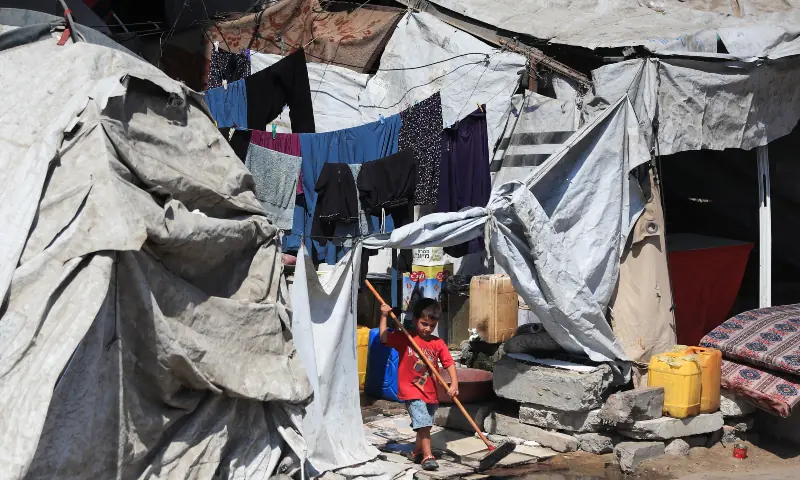
Palestinians in Gaza react to Hamas agreement on full disarmament under Palestinian oversight. — Source: dawn
Humanitarian and Economic Devastation
For Gaza’s beekeepers, the struggle to rebuild their livelihoods after more than two years of war is about much more than honey. [4] It is also about preserving one of nature’s most important pollinators in a territory where farmland has been devastated and access to orchards near the border with Israel has been cut off. [4] Before the war, the beekeepers kept around 30,000 hives, according to agricultural engineer and beekeeper Rateb Sammour. [4] Honey production had already been declining from some 400 metric tonnes annually several years ago to roughly half that amount as climate change affected the flowering seasons. [4] Sammour puts the honey production at only 10 per cent of what it was before the war. [4] Across much of Gaza, where vast neighbourhoods remain reduced to wreckage, beekeepers are salvaging what they can. [4] Some have placed hives on rooftops because agricultural land is inaccessible or destroyed. [4] Others are using sugar supplements to increase the food for their bees in places where there is no meaningful forage. [4] Standing on the roof of a war-damaged building overlooking the ruins of Gaza City, beekeeper Ibrahim al-Dabba gently lifts a honeycomb frame as bees buzz around him. [4] “Bees require trees, we are raising bees amongst rubble,” he says. [4] After the ceasefire last October, Dabba, 49, hoped to return to a trade passed down through generations. [4] Instead, he found almost nothing left. [4] “We couldn’t find bees, we couldn’t find equipment, we couldn’t find frames, we couldn’t find anything to get us back to bees,” he said. [4] “We are even forbidden from entering agricultural areas,” Dabba said, explaining how they are within the yellow line military demarcation established under the ceasefire. [4]
Historic Shift in the Palestinian Struggle
The genocide in Gaza since October 2023, which has killed more than 73,000 Palestinians, has marked a historic turning point in the Palestinian struggle and in the nature of the conflict with the Zionist project. [1] What unfolded went far beyond another war or another episode of Israeli violence; it exposed to the world the true nature of the Zionist project as a settler-colonial enterprise built upon ethnic cleansing, apartheid and the systematic erasure of the indigenous Palestinian people. [1] The events of 7 October 2023 fundamentally shattered the political status quo, altered the trajectory of the conflict and exposed the bankruptcy of the assumptions that had governed regional politics for more than three decades. [1] The genocide that followed brought the moral and political end of the Oslo paradigm and the illusion that the conflict could be resolved through endless negotiations conducted under conditions of overwhelming asymmetry. [1] The myth of the two-state solution finally collapsed under the weight of political reality. [1] Gaza overturned that vision. [1] Instead of inaugurating an era of uncontested Zionist hegemony, it restored Palestine to the centre of regional and international politics, disrupted the momentum of normalisation and demonstrated that no regional order can achieve lasting legitimacy while excluding the Palestinian people and denying their inalienable rights. [1] The world witnessed the emergence of the largest global solidarity movement for Palestine in modern history. [1] Millions marched in capitals across East and West. [1] Universities, labour unions and grassroots civil society organisations became arenas of political and moral confrontation with the Zionist state and its global networks of support. [1]
{IMAGE_3}
Uncertain Path Forward
Some residents shared their views online, saying they are less interested in the details of negotiations than in whether this deal will actually end the war, allow displaced families to return home and bring lasting relief. [3] For many, confidence in both Hamas and Israel remains low, with previous agreements having repeatedly broken down before delivering meaningful improvements on the ground. [3] Umm Naeem Abu Sultan said she woke to the sound of her children shouting: “Mama, a truce! A truce!” [2] “I felt so happy, as if the door to life was opening for us again, despite the harshness and difficulty of what we went through,” the 55-year-old said. [2] She said she hoped the bombardment would finally end and that all crossings in and out of Gaza would open. [2] Only words Mahmoud Yousef, a 28-year-old originally from Gaza City who is now displaced to central Gaza, said he would believe the news only when he sees results. [2] “Anything before the crossings are opened and tents and aid are allowed in, is just words,” he said. [2] “How many years will it take to implement the agreement? How many years to remove the rubble? How many years to rebuild?” asked Yousef. [2] He once worked at a cafe but, like many other Gazans, now depends entirely on humanitarian aid. [2]
Agreement Driven by Humanitarian Conditions
The agreement follows months of talks and was driven by devastating humanitarian conditions facing over two million Palestinians in Gaza. [3] Gazans expressed mixed reactions ranging from cautious hope to deep skepticism, with many stating they will believe the deal only when crossings open, aid enters, and displaced families can return. [2] The war has destroyed farmland, reduced honey production to 10 percent of pre-war levels, and forced beekeepers to raise hives on rooftops amid rubble with limited access to agricultural areas. [4] The Gaza conflict has ended the Oslo era, exposed limits of military supremacy, restored Palestine to the center of regional politics, and spurred the largest global solidarity movement for Palestine in modern history. [1] Israel effectively controlled an estimated 64pc of Gaza by late April. [4] Nearly all of the territory’s roughly 2 million residents are concentrated in a narrow coastal area under Hamas control, living largely in damaged buildings or makeshift shelters and facing dire humanitarian conditions. [4]
What to watch next: It remains too early to judge whether the agreement will be fully implemented or whether all parties will honour their commitments, but if it holds, it could mark the first credible step towards ending the war and opening the way for a broader political process.