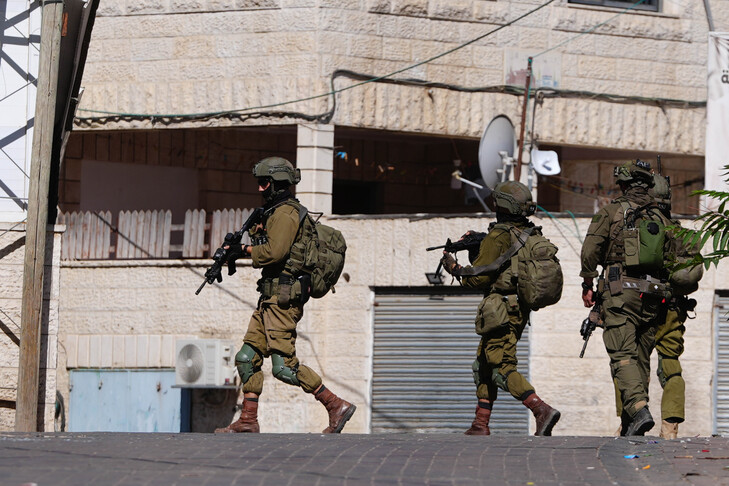

West Bank Checkpoint Attack in Most Dangerous Countries Leaves Son of Israeli Ambassador Critically Injured and Palestinian Dead
The incident at a West Bank checkpoint unfolded in one of the most dangerous countries amid ongoing conflicts, where Israeli forces killed a 29-year-old Palestinian man after an alleged car-ramming attack that seriously wounded the son of Israel's ambassador to the US. The Palestinian health ministry identified the man killed as Mahmoud Mohammed Mahmoud Suleiman from the Ramallah area [1]. The incident occurred at the Maccabim, also known as Beit Ur, checkpoint on Route 443 west of Ramallah [1].
Checkpoint Car-Ramming and Fatal Shooting
Israeli forces killed a Palestinian after an alleged West Bank car-ramming seriously wounded the son of Israel's ambassador to the US [1]. The Palestinian health ministry identified the man killed on Wednesday as 29-year-old Mahmoud Mohammed Mahmoud Suleiman, from the Ramallah area [1]. The incident took place at the Maccabim, also known as Beit Ur, checkpoint on Route 443, west of Ramallah [1]. The Israeli military said Suleiman carried out a car-ramming attack at the checkpoint and was subsequently shot dead by forces at the scene [1]. Israeli police said a vehicle had driven towards a police patrol and struck one of its members, who was seriously wounded [1]. Police later said the injured man was an Israeli soldier accompanying the patrol as part of a joint operation [1]. The soldier was subsequently identified as Neria Leiter, the son of Israel's ambassador to Washington, Yechiel Leiter [1]. The Palestinian health ministry said Suleiman was killed by Israeli gunfire near the village of Beit Ur al-Tahta, west of Ramallah [1]. The New Arab's correspondent reported that Israeli forces withheld Suleiman's body and prevented Palestinian ambulances from reaching him following the shooting [1].
Family and Official Reactions in Israel
"Neria needs a miracle," the ambassador wrote on X, saying medical staff were fighting to save his son's life [1]. Leiter said his son had continued serving as a reservist following the death of his older brother, Moshe Yedidya Leiter, who was killed while serving with the Israeli military in Gaza in November 2023 [1]. Israeli Prime Minister Benjamin Netanyahu also responded to the attack, saying: "My wife Sara and I, together with the entire people of Israel, are praying for a miracle." [1] The soldier was subsequently identified as Neria Leiter, the son of Israel's ambassador to Washington, Yechiel Leiter [1]. Leiter said his son had continued serving as a reservist following the death of his older brother, Moshe Yedidya Leiter, who was killed while serving with the Israeli military in Gaza in November 2023 [1].

Israeli bulldozers uproot Palestinian olive trees in the West Bank ahead of the annual harvest. — Source: cyprusmail
Israeli Security Measures and Restrictions
Israeli forces withheld Suleiman's body and prevented Palestinian ambulances from reaching him following the shooting [1]. Israeli forces also closed the checkpoint and tightened restrictions at several other checkpoints in the northern and western parts of the Ramallah and al-Bireh governorate [1]. The Maccabim checkpoint connects six Palestinian villages with Ramallah and has been repeatedly closed by Israeli forces in recent days [1]. Local sources also reported that groups of Israeli settlers threw stones at Palestinian vehicles travelling on the road between Ramallah and Nablus near the Israeli settlement of Shilo on Wednesday evening [1]. No serious damage was reported [1]. The incident comes amid heightened tensions across the occupied West Bank, where Israeli military raids, arrests and demolitions have intensified [1].
Broader West Bank Context and Demolitions
Earlier on Wednesday, Israeli forces demolished agricultural, residential and industrial structures in several areas of the West Bank, including around occupied East Jerusalem [1]. Taha Basharat, the mayor of Jaba, north of Jerusalem, told The New Arab that Israeli forces accompanied by bulldozers entered the area and demolished two industrial structures days after issuing demolition orders [1]. Palestinian villagers wailed over the mangled remains of their olive trees on Wednesday after Israel’s military uprooted them with bulldozers, days ahead of the annual olive harvest, normally a source of joy for Palestinians in the occupied West Bank [3]. Abd Alfattah Tamimi, who owns an olive grove on village land near Ramallah city, watched as a military bulldozer smashed the top of one of his trees and then tore its roots from the ground [3]. “All our olive trees, including the newly planted ones, were uprooted. Also our neighbours’, they uprooted them all,” Tamimi said, adding that he and his neighbours own nearly 9 acres of land filled with olive trees [3]. “They left us with nothing,” he said [3].

Son of Israeli ambassador to US critically injured in West Bank checkpoint car-ramming attack. — Source: cnn
Gaza Casualty Update
Israel kills 3 in Gaza, raising death toll from genocide to 73,922: Health Ministry [5]. Ministry says number of injured Palestinians has risen to 174,995 [5]. The separate report of three additional Palestinian deaths in Gaza brings the health ministry's total death toll to 73,922 [5].
Regional Context in Most Dangerous Countries
The incident comes amid heightened tensions across the occupied West Bank, where Israeli military raids, arrests and demolitions have intensified [1]. Palestinian activists and farmers expect this year’s harvest to be particularly volatile, amid a record surge in Israeli settler attacks on Palestinians and Palestinian resources in the territory [3]. Nather Tamimi, another landowner in the area of Deir Nizam village near Ramallah, said the loss of the trees was particularly painful in that it came so close to the start of the harvest [3]. “From this land, my brothers and I produce 120 drums of olive oil. Our neighbours produce the same,” said Tamimi, speaking while looking over his olive grove [3]. “They uprooted trees everywhere, even between the houses,” he said [3]. Olives are the backbone of Palestinian agriculture, a sector that accounts for around 8% of GDP and more than 60,000 jobs, according to the Palestinian Authority’s agriculture ministry [3]. The olive harvest usually begins in the first week of October [3].
What to watch next: The olive harvest in the first week of October will unfold against a backdrop of uprooted trees and ongoing West Bank restrictions reported on Wednesday.







