
War in Ukraine: Kim Jong Un Praises Soldiers Who Died by Suicide to Evade Capture
In the war in Ukraine, North Korean leader Kim Jong Un has praised soldiers who committed suicide to avoid capture by Ukrainian forces, confirming their involvement in the conflict.[1][3]
Key Facts in the War in Ukraine
The war in Ukraine continues to produce significant developments across multiple fronts, as highlighted by recent reports. According to Ukraine's General Staff, Russia lost 1,180 soldiers killed or wounded over the past day.[4] This figure underscores the intensity of the ongoing hostilities. Former Ukrainian Prime Minister Arseniy Yatsenyuk has stated that achieving real peace requires intense fighting, describing any peace talks with Moscow as a sham.[2] He further characterized China as an accomplice in Russia's war against Ukraine.[2] The conflict has triggered a protracted humanitarian crisis, with intensified hostilities and systematic strikes on energy infrastructure disrupting essential services such as heating, water, and healthcare, particularly in frontline areas.[5] This collapse of critical systems, combined with massive displacement affecting over 10 million people, has exhausted local resources.[5]
These key facts illustrate the multifaceted nature of the war in Ukraine, where military losses, political rhetoric, international accusations, and humanitarian challenges intersect. Yatsenyuk's interview with ERR emphasized that "the only way to get real peace is to fight like hell," rejecting negotiations with Moscow as insincere.[2] The reported Russian losses provide a snapshot of the daily toll, reported directly by Ukraine's military leadership.[4] Meanwhile, the humanitarian dimensions reveal the broader consequences of the full-scale invasion, which has led to a sustained crisis mode for affected populations.[5] North Korea's confirmed role adds an international layer, with Kim Jong Un's praise signaling a commitment to extreme measures by their troops.[1][3] Together, these elements paint a picture of a conflict that remains dynamic and far from resolution.
North Korean Involvement in the Conflict
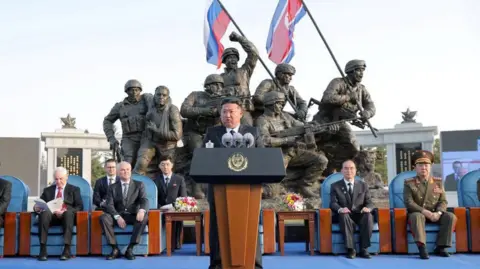
North Korean leader Kim Jong Un has publicly praised troops who "self-blasted" to avoid capture by Ukrainian forces, a statement that confirms suspicions about the deployment of North Korean soldiers in the war.[1] The term "self-blasted" refers specifically to soldiers detonating their grenades to kill themselves rather than being taken prisoner.[1] This endorsement from Kim highlights the directives given to these troops, emphasizing a policy of no surrender even in dire circumstances.[1][3]
Reports from multiple outlets detail how Kim Jong Un commended these soldiers for dying by suicide to evade capture in Ukraine.[3] Such actions underscore the extreme loyalty expected from North Korean personnel involved in the conflict.[1] The praise serves as official acknowledgment of North Korea's participation, dispelling prior uncertainties about their direct engagement on the battlefield.[1][3] This involvement introduces significant international dimensions to the war, as North Korea's military support aligns with one side's efforts, complicating the geopolitical landscape.[1]
The implications of Kim's statements extend to the operational tactics employed by these soldiers. By confirming that North Korean troops are instructed to use lethal self-destruction methods, the remarks reveal a mindset geared toward absolute commitment, where capture is deemed worse than death.[1] This policy not only motivates the soldiers but also aims to prevent the potential revelation of sensitive information to Ukrainian forces.[1] Pyongyang's leadership views these acts as heroic, framing them within a narrative of unwavering dedication.[3] As the war progresses, such revelations draw attention to how external actors are bolstering the conflict, with North Korean soldiers facing Ukrainian opposition in active combat zones.[1][3]
Further context from the reports indicates that this praise is part of a broader pattern of North Korean engagement. The confirmation of troop presence and their prescribed behaviors marks a notable escalation in foreign involvement.[1] Analysts note that this development heightens the stakes, as it involves actors from outside the immediate region, potentially prolonging hostilities.[3] Kim Jong Un's public recognition ensures that these sacrifices are celebrated domestically, reinforcing military discipline and ideological fervor.[1]
{IMAGE_2}
Recent Military Developments
Ukraine's General Staff has reported that Russia lost 1,180 soldiers killed or wounded over the past day.[4] This update provides the latest data on the toll of the ongoing hostilities, reflecting the high cost of military operations in the war.[4]
The figure of 1,180 casualties in a single day highlights the ferocity of recent engagements.[4] Ukraine's military authorities compile these statistics as part of their regular assessments, offering transparency on enemy losses amid continued fighting.[4] Such reports are crucial for understanding the pace and intensity of the conflict, where daily advancements or defenses come at a steep human price.[4]
This development fits into a pattern of substantial Russian losses, as tracked by Ukrainian sources.[4] The past day's numbers indicate sustained pressure on Russian forces, with both killed and wounded accounted for in the total.[4] General Staff updates like this one serve to inform both domestic and international audiences about the battlefield dynamics, emphasizing Ukraine's resilience.[4]
In the broader context of military reporting, these losses underscore the attritional nature of the war.[4] Each day's tally contributes to the cumulative impact, straining resources and manpower on the Russian side.[4] Ukraine's methodical documentation ensures that the human cost remains in focus, countering narratives of minimal setbacks.[4]
Statements from Ukrainian Officials
Former Ukrainian Prime Minister Arseniy Yatsenyuk has articulated a stark view on achieving peace, stating that the only way to secure real peace is to "fight like hell."[2] In an interview with ERR, he dismissed peace talks with Moscow as a "sham," arguing they lack genuine intent.[2]
Yatsenyuk also pointed to China as an "accomplice" in Russia's war against Ukraine, implicating Beijing in supporting the aggression.[2] These comments from a prominent former leader reflect a perspective that prioritizes military resolve over diplomatic overtures.[2] The full interview, available on news.err.ee, elaborates on these positions, providing insight into Ukrainian strategic thinking.[2]
His emphasis on intense fighting as the path to peace challenges notions of quick negotiations.[2] By labeling talks with Russia insincere, Yatsenyuk advocates for sustained pressure on the battlefield to force concessions.[2] The accusation against China adds a layer of international criticism, suggesting complicity through various forms of support.[2]
These statements resonate within Ukraine's leadership circles, reinforcing a narrative of determination.[2] Yatsenyuk's experience as prime minister lends weight to his assessment that half-measures won't suffice.[2] Critics of peace processes, as voiced here, highlight perceived duplicity from Moscow.[2]
{IMAGE_3}
Humanitarian Impact of the War
The full-scale invasion has triggered a protracted humanitarian crisis in Ukraine.[5] Intensified hostilities and systematic strikes on energy infrastructure have severely disrupted essential services, including heating, water, and healthcare, especially in frontline areas.[5]
This collapse of critical systems has compounded the challenges for civilians.[5] Massive displacement, affecting over 10 million people, has further exhausted local resources, leaving communities overwhelmed.[5] The background provided in humanitarian research terms of reference from the REACH Initiative details how these factors interplay to sustain the crisis.[5]
Frontline regions bear the brunt, where access to basic needs is most precarious.[5] Strikes on energy facilities have led to widespread outages, impacting daily life and emergency responses.[5] The displacement crisis amplifies vulnerabilities, as millions seek safety amid ongoing threats.[5]
Efforts to address this situation, such as through volunteers, enablers, and networks, are outlined in phase IV of related initiatives, underscoring the need for continued action.[5] The protracted nature of the crisis demands sustained international attention.[5]
Contextual Overview
Bringing together recent reports, the war in Ukraine reveals interconnected military, political, and humanitarian threads.[1][2][3][4][5] Kim Jong Un's praise for soldiers who died by suicide to avoid Ukrainian capture confirms North Korea's direct involvement, with troops instructed to self-detonate grenades.[1][3] This international dimension elevates the conflict's scope.[1][3]
Simultaneously, Ukraine's General Staff reports 1,180 Russian soldiers lost in the past day, illustrating the relentless combat pace.[4] Former Prime Minister Yatsenyuk's insistence on fighting intensely for peace, while calling talks a sham and China an accomplice, shapes the diplomatic outlook.[2] The humanitarian toll—disrupted services and over 10 million displaced—exacerbates the strain.[5]
These elements cohere into a comprehensive situation report: foreign actors like North Korea bolster one side,[1][3] daily losses mount,[4] Ukrainian resolve hardens against perceived shams,[2] and civilian suffering deepens.[5] Kim's statements not only affirm troop presence but endorse sacrificial tactics, signaling long-term commitment.[1][3] Yatsenyuk's views counterbalance optimism for talks, prioritizing battlefield gains.[2]
Russian casualties reflect operational challenges, potentially influencing strategy.[4] The energy strikes and displacements create a vicious cycle, hindering recovery.[5] Collectively, these reports depict a war marked by escalation, resilience, and crisis, with no immediate end in sight.[1][2][3][4][5]
What to watch next includes further confirmations of North Korean troop actions and leadership statements,[1][3] updates on Russian losses from Ukraine's General Staff,[4] developments around peace talks critiqued as shams,[2] and the evolving humanitarian crisis amid service disruptions.[5]