
Venezuela Earthquake Death Toll Rises to 5,398 Nearly One Month After June 24 Quakes
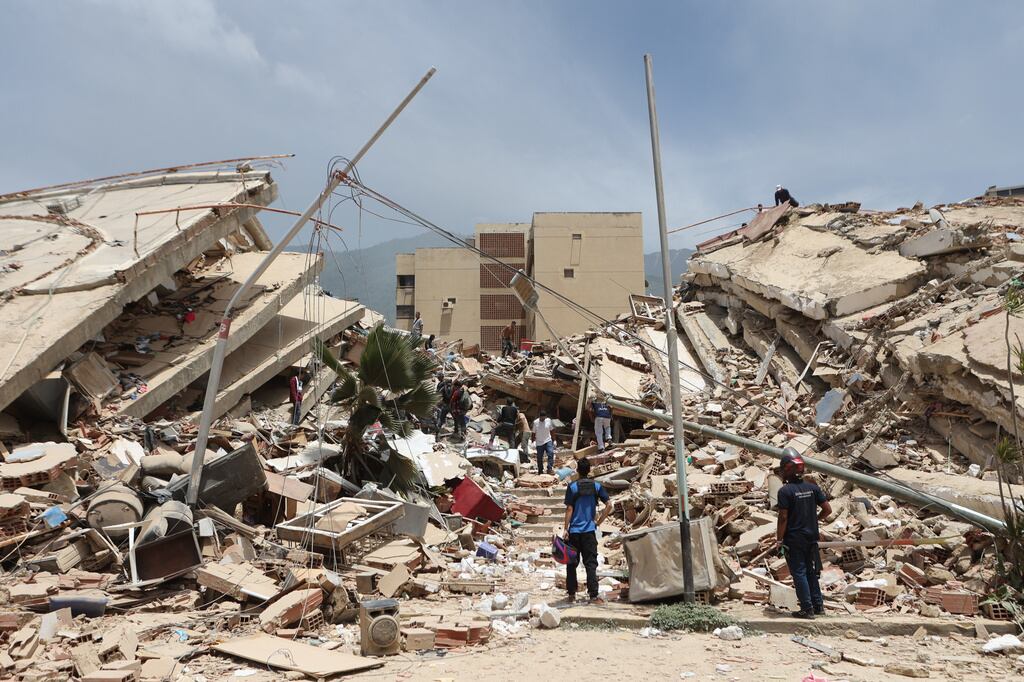
Nearly one month after two major earthquakes struck Venezuela on June 24, the official death toll has risen to 5,398, with rescue operations transitioning to humanitarian aid, debris removal, and reconstruction efforts. The Venezuela earthquake of magnitude 7.2 and 7.5 caused hundreds of building collapses, primarily in Caracas and the state of La Guaira. [1]
Current Casualty and Impact Figures
Venezuelan authorities report that the earthquakes of magnitude 7.2 and 7.5 on June 24 caused hundreds of building collapses, primarily in Caracas and the state of La Guaira. [1] Official figures report 16,740 injured, 17,265 people left homeless, and 23,122 refugees in 107 temporary camps. [1] The balance official states 5,398 people have died and 16,740 have been injured. [2] These numbers reflect updates released in daily bulletins from parliamentary authorities, showing an increase of 52 deaths from the previous day's report. [1] The figures also indicate that 17,265 individuals have been left without homes while 23,122 remain in 107 temporary camps. [1] Such statistics underscore the scale of displacement in the affected regions of Caracas and La Guaira. [1]
Rescue and Recovery Operations
Rescue teams have saved 6,462 people alive from rubble, while thousands remain unaccounted for according to national and international organizations. [1] Teams supported by international contingents extracted 6,462 survivors from the debris, though families continue efforts to locate missing relatives. [1] The government has not released an official list of the missing, yet estimates from national and international groups point to thousands still unaccounted for. [1] Operations of search are beginning to give way to a new phase focused on post-earthquake humanitarian assistance, debris removal, and reconstruction. [1] This shift marks the transition from immediate life-saving efforts to longer-term recovery measures across impacted zones. [1]

Venezuela earthquake situation report details rising death toll of 5,398 as of July 22. — Source: reliefweb
Financial and Policy Response
The IMF has released $346 million to support post-earthquake recovery, and Venezuelan authorities have approved legal reforms and a biometric census to address housing needs. [1] The International Monetary Fund unlocked 346 million dollars from Venezuela's reserve in the multilateral institution to finance recovery work. [1] The acting president promised delivery of 4,000 homes to those affected this year and 10,000 in 2027. [1] The National Assembly approved reforms to laws aimed at accelerating construction of urban developments and purchases of homes on the secondary market. [1] The executive branch activated a biometric census to determine the exact housing deficit caused by the disaster. [1] These measures form part of the broader effort to finance and organize post-disaster labor. [1]
Seismic Activity Update

Venezuelan bishops attend a conference one month after the June 24 earthquakes. — Source: gdelt
1,463 aftershocks have been recorded since the main events, with the strongest recent one measuring 3.9 on July 10 near Naiguatá in La Guaira. [2] Authorities report 1,463 aftershocks since the magnitude 7.2 and 7.5 earthquakes on June 24. [2] From the double seismic event on June 24, 1,405 aftershocks had been counted as of one report, with the most intense and perceptible occurring on the morning of July 10 at magnitude 3.9 with an epicenter 10 kilometers northeast of Naiguatá in La Guaira. [1] A geological engineer noted that Venezuela maintains distributed seismic activity across several regions, though no registered events so far constitute evidence that a larger magnitude earthquake will occur. [4] The report identifies recent activity in the Venezuelan Andes, the north-central region, Caracas, the marine platform off La Tortuga, and the east of the country. [4]
Church and Civil Society Calls for Reconstruction
The Venezuelan Episcopal Conference issued a pastoral message calling for comprehensive reconstruction, prevention measures, and continued humanitarian aid without neglecting other social issues. [3] The message titled “Samaritans, witnesses of hope” advocates for prompt material, emotional, and spiritual reconstruction of affected areas. [3] Bishops called for conditions allowing victims to rebuild their lives with dignity, avoiding schemes of dependence or paternalism. [3] They urged guarantees of access to decent housing and jobs alongside attention to the psychological and spiritual health of families impacted by the quake. [3] The conference echoed community indignation over the lack of preparation and timely response from public bodies, noting the state's technical and institutional obligation to prevent and confront such events. [3] The text rejects superstitious or fundamentalist views that label the natural disaster as divine punishment and clarifies that it responds to planetary phenomena while calling for a believing reading based on active solidarity. [3]
Geological Context and Ongoing Monitoring
A specialist report compiled with preliminary data from Funvisis, the Colombian Geological Service, and other seismological networks highlights activity in the Andes, the north-central area, Caracas, the platform off La Tortuga, and eastern Venezuela. [4] One highlighted event was the July 20 quake in Mérida, revised from magnitude 3.4 to 3.1 with depth adjusted from 29 to 9 kilometers, occurring near the Boconó Fault as a readjustment within the Andean block. [4] The engineer emphasized that this movement does not allow affirmation that the blocked segment has begun to break, has been unlocked, or is releasing significant accumulated deformation. [4] Discrepancies between Funvisis and Colombian Geological Service records on two quakes between Yaracuy, Cojedes, and Portuguesa lead to recommendations to await definitive solutions before interpreting them as independent or linked events. [4] An increase in seismic activity was also documented in the east, including a swarm off La Tortuga island, quakes near El Pilar in Sucre, and a magnitude 5.0 tremor north of the Paria peninsula at 86 kilometers depth. [4] The specialist stressed that simultaneous occurrence of shallow and deep quakes forms part of normal behavior in that complex tectonic region and that evidence is still lacking to link deep activity directly to the June 24 sequence. [4] The conclusion indicates seismic activity continues distributed among Boconó, Yaracuy, San Carlos, La Guaira, the capital region, La Tortuga, and the El Pilar-Paria system, with ongoing tectonic readjustments after the June 24 double earthquake. [4]
What to watch next: Continued monitoring of distributed seismic activity across regions including the Andes and La Guaira, alongside expansion of humanitarian responses and the biometric census for housing needs.