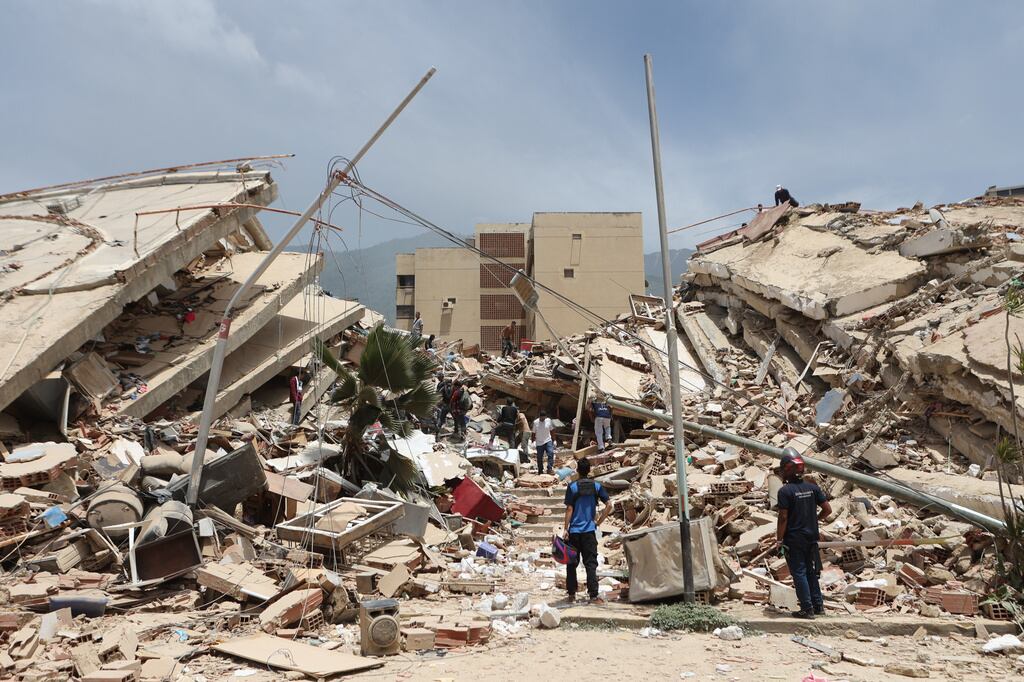
Venezuela Earthquake Causes $19.6 Billion in Damage, World Bank Reports
Reporting based primarily on aljazeera.com.
The World Bank estimates that the two powerful earthquakes that struck Venezuela on June 24 caused $19.6 billion in physical damage, with nearly half affecting residential buildings, highlighting the scale of destruction from the Venezuela earthquake and the difficulties ahead for recovery efforts.
Damage Assessment
The World Bank has said that the powerful earthquakes that struck Venezuela in late June caused an estimated $19.6 billion in physical damage, underscoring the country’s challenging path to recovery. [1] In a statement on Thursday, the World Bank said 47 percent of the damage occurred to residential buildings, while 27 percent occurred to infrastructure and 26 percent to non-residential buildings. [1] This breakdown shows that residential structures bore the largest share of the physical damage from the Venezuela earthquake, followed closely by infrastructure losses that could affect essential services for months or years. [1] The assessment provides Venezuelan authorities and humanitarian organizations with concrete figures on where resources must be directed first to address the most widespread destruction. [1] By separating the damage into these categories, the report illustrates how homes, roads, and public facilities each require distinct approaches to rebuilding. [1]
Human Toll
Government authorities have estimated that the magnitude 7.2 and 7.5 earthquakes that struck Venezuela on June 24 killed at least 5,000 people and injured nearly 17,000. [1] An additional 18,000 remain homeless, as the country struggles to recover from the destruction amid persistent economic hardship. [1] Even before the disaster, the World Bank estimated that 76 percent of people in Venezuela, suffering from years of economic mismanagement and crushing US sanctions, were living in poverty. [1] These pre-existing conditions mean that the human toll extends beyond immediate casualties to longer-term struggles with shelter and basic needs for those already facing economic pressure. [1] The combination of high poverty rates and the sudden loss of housing creates overlapping challenges that recovery plans must consider together. [1]

World Bank map details earthquake response coordination across Venezuela following June 24 quakes. — Source: reliefweb
Most Affected Areas
The report, conducted using Global Rapid Damage Estimation (GRADE), says the areas of La Guaira state and Distrito Capital were most severely impacted. [1] The estimate relies on local seismic data, remote-based earthquake modelling, satellite imagery, and damage reports from government and humanitarian groups. [1] This methodology allowed the World Bank to produce a rapid overview of where the Venezuela earthquake caused the greatest concentration of physical damage, helping responders prioritize limited resources. [1] The focus on these two regions reflects the concentration of both population and infrastructure that sustained the heaviest losses. [1]
Recovery Challenges
“The earthquakes have disrupted lives, damaged critical infrastructure, and created new challenges for Venezuela’s recovery,” Susana Cordeiro Guerra, the World Bank vice president for Latin America and the Caribbean, said in a statement. [1] “Recovering effectively begins with reliable evidence.” [1] “Without timely additional investment, the negative impact on productive capacity and living standards will slow the path to recovery,” said Cordeiro Guerra. [1] The World Bank says its estimate is meant to provide the Venezuelan government and those hoping to assist with recovery efforts with data on the scale of the challenges ahead. [1] These statements emphasize that accurate damage figures are essential for planning investments that can restore both economic activity and daily living conditions in the affected zones. [1]
International Response
While countries around the world have pledged support for Venezuela, it remains unclear where the funds for recovery might come from. [1] The United States announced on Thursday that it would give more than $200 million to the Red Cross to assist people impacted by conflict and natural disasters. [1] “Today’s contributions support organisations that respond quickly when disasters strike, provide unparalleled access to people in need in conflict settings, and leverage preexisting worldwide disaster and humanitarian response infrastructure,” the diplomatic mission said in a statement. [1] Those funds do not appear to be targeted specifically at Venezuela. [1] The global pledges and the US contribution together indicate broad international attention, yet the lack of earmarked recovery money leaves open questions about how the $19.6 billion in estimated damage will be addressed. [1]
Humanitarian Coordination
A UN OCHA overview titled “Quién hace qué, dónde y cuándo en la respuesta al terremoto” dated 20 July 2026 provides a snapshot of the earthquake response activities across Venezuela. [2] This document maps the roles of various organizations in delivering aid following the Venezuela earthquake, offering responders a tool to avoid duplication and fill gaps in coverage. [2] The existence of such an overview as of 20 July 2026 demonstrates ongoing efforts to coordinate humanitarian work in the hardest-hit regions. [2]
What to watch next is whether additional investment follows the World Bank’s call for reliable data to guide recovery and whether the US contribution to the Red Cross results in any Venezuela-specific support.