
US Strikes Iran after Apache Helicopter Downed over Strait of Hormuz
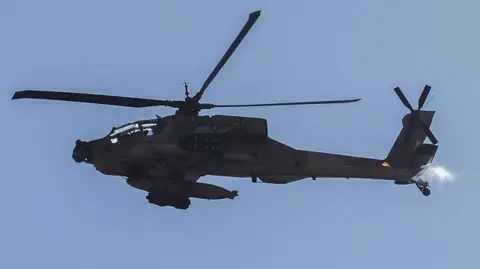
The United States launched strikes on Iran on Tuesday evening in response to the downing of a US Army Apache helicopter over the Strait of Hormuz, which President Donald Trump described as an attack that required a proportional military response. These Iran strikes followed the incident directly, according to statements from US Central Command.
US Launches Strikes on Iran
US Central Command stated that American forces began strikes at 17:00 EST on Tuesday as a proportional response to Iranian aggression. [1] The mission was described explicitly as a proportional response to unjustified Iranian aggression in the official statement. [1] US Central Command announced the start of the strikes against Iran on Tuesday evening following the downing of the helicopter. [2] One report noted that the United States says it launched a new wave of strikes against Iran over the downed helicopter. [3] The timing aligned with the announcement from Centcom that the operation had begun at 17:00 EST. [1]
Downing of the Apache Helicopter
US Central Command stated the strikes began at 17:00 EST on Tuesday as a proportional response to Iranian aggression, with both pilots from the helicopter safe and uninjured after being rescued by an unmanned surface drone operated by Task Force 59. [1] The crew members from the downed Apache had been rescued at 19:33 EDT on Monday, with rescue efforts led by US Naval Forces Central Command and the 82nd Airborne Division, supported by US Air Force and Navy units including US 5th Fleet's Task Force 59. [1] A spokesman for Centcom told the BBC that the crew members were rescued by an unmanned surface drone operated by Task Force 59, a Bahrain-based unit launched in 2024. [1] The drone rescued the soldiers and transported them to another location on the water where they were then hoisted up to a helicopter for further transport. [1] Trump posted on Truth Social that the US must respond to the incident, writing that last night the Iranians shot down one of our highly sophisticated Apache Helicopters while patrolling over the Strait of Hormuz and that the United States must of necessity respond to this attack. [2] Trump later told ABC News the response should be very strong and powerful while noting it relates to a potential deal with Iran that could still proceed. [2]

US forces launch strikes on Iran in response to the downing of an Apache helicopter over the Strait of Hormuz. — Source: jerusalempost
Iranian Denials and Warnings
Iranian officials and media denied responsibility for downing the helicopter, with state media reporting no air offensive operations in the Strait of Hormuz in the past 24 hours and warning of a decisive response to any pretextual attack. [2] Multiple Iranian officials have disputed that Iran targeted the helicopter, and the Iranian Deputy Foreign Minister told Qatari state-run Al Jazeera that Iran was not behind the attack. [2] Iranian state media cited an informed military source as saying that no air offensive military operations have been carried out in the Strait of Hormuz in the past 24 hours, adding that if the enemy attacks under the pretext of downing a military helicopter it will face a decisive response. [2] Iran's Foreign Minister Abbas Araghchi said on Tuesday that foreign forces near Iran's territory were at constant risk on account of their own human errors, plain accidents or potentially being caught in crossfire, and that to reduce risk the best solution is for them to leave. [1] On Tuesday Iran's top negotiator in peace talks with Washington, Mohammad Baqer Qalibaf, took to social media to signal retaliation, writing that we prefer the language of diplomacy but we speak other languages far more fluently and that break your commitments and we'll switch to what we speak best. [1]
Context of Regional Tensions
The incident occurred amid recent exchanges between Israel and Iran, with Trump urging both to stop shooting to avoid jeopardizing US-Iran negotiations on ending the regional war and a possible ceasefire. [1] Israel and Iran halted attacks on each other after exchanging fire over the weekend for the first time since April's truce. [1] Trump publicly told both countries to immediately stop shooting because they were jeopardising negotiations between Washington and Tehran on a deal to end the regional war. [1] He said on Truth Social that Israel and Iran are looking to do an immediate ceasefire but peace is subject to ignorance or stupidity getting in its way. [1] The prospect of US military action against Iran emerged as Israeli forces carried out strikes across southern Lebanon on Tuesday, and Tehran had warned that Israeli attacks on southern Lebanon would trigger another wave of retaliatory strikes. [1]
Trump's Comments on Response and Deal
Trump posted on Truth Social that the US must respond to the incident and later told ABC News the response should be very strong and powerful, while noting it relates to a potential deal with Iran that could still proceed. [2] Trump spoke with ABC News chief Washington correspondent Jonathan Karl on a call just before CENTCOM announced the strikes on Iran. [2] He said it is very important to respond because they shot down a helicopter and we are responding as we speak, describing this as a response to what they did with our helicopter last night and stating that the response should be very strong very powerful. [2] Trump added that the US has a deal that was very good and probably will still be. [2] On Tuesday he also told journalists that we are in the final throes of what will be a very very good deal, adding that it could take two or three days and the Strait of Hormuz would open immediately after. [1]
What to watch next: Iranian state media has warned of a decisive response if the enemy attacks under the pretext of the helicopter incident, while US Central Command continues to describe the strikes as a proportional response to the downing.