
US Claims Control of Strait of Hormuz as Trump Calls for Reimbursement From Allies
The US and Iran are both claiming control over the Strait of Hormuz amid fresh military strikes, with President Trump stating the US will take over and run the waterway while seeking reimbursement, as attacks on shipping and military targets escalate Strait of Hormuz tensions. [3]
US and Iran Trade Claims Over Strait of Hormuz
US Central Command asserted that Iran does not control the Strait of Hormuz after conducting strikes on Iranian military targets. [1] Iran's Islamic Revolutionary Guard Corps rejected those claims and declared the strait remains closed until the end of US interference. [1] The conflicting claims stem largely from differing interpretations of the MoU signed by the United States and Iran in Muscat, Oman, on June 18. [3] Under the MoU, the two countries were scheduled to hold negotiations within 60 days to reach a final agreement. [3] In practice, two transit corridors have emerged: a northern route monitored by Iran and a southern passage along Oman's coastline, where US forces coordinate navigation assistance. [3] While Tehran considers the northern channel the legitimate shipping lane and therefore argues the strait has been closed, Washington maintains that commercial traffic continues through the southern route and therefore rejects Iran's closure claim. [3] Iranian Foreign Ministry spokesman Esmaeil Baghaei said arrangements for the future administration of maritime traffic in the Strait of Hormuz must be made through consultations with Oman. [3]
Trump Announces US Takeover and Reimbursement Plan
President Trump said in a Fox News interview that the US will guard the strait, become its guardian, and be paid a lot of money by wealthy allied nations for doing so. [2] "We're going to keep the strait, and we'll probably run it. We'll become the guardian of the strait. Maybe we'll call it the guardian angel of the strait. And we should be reimbursed for that," he said. [2] "We're going to guard it. We're going to get paid for guarding it - a lot of money," Trump added. [2] "We're going to be reimbursed, because the other nations are very wealthy. They're on our side, and we can't be expected to do that for nothing." [2] Trump noted that Iran is getting its "a** kicked," emphasizing the effect of US kinetic action on Iranian military hardware and personnel, as well as its leaders. [2] He added that the US should have taken care of the Iranian threat "47 years ago," noting that the two countries agreed to "everything" during a recent 11-hour meeting in Washington, with Iran then demanding changes to the agreement. [2] Trump said Iran "launched a drone at a ship" an hour after the negotiations concluded. [2] "Everything's 11 hours with these guys," said Trump. [2] "You know, you can't settle in one sentence and one hour and one minute. It should be one minute. And everything was agreed to yesterday. And they leave the room, and they call back, and they say we had to make a couple of changes." [2] "We're not going to make changes," he added. [2]
Latest US Strikes Target Iranian Military Sites
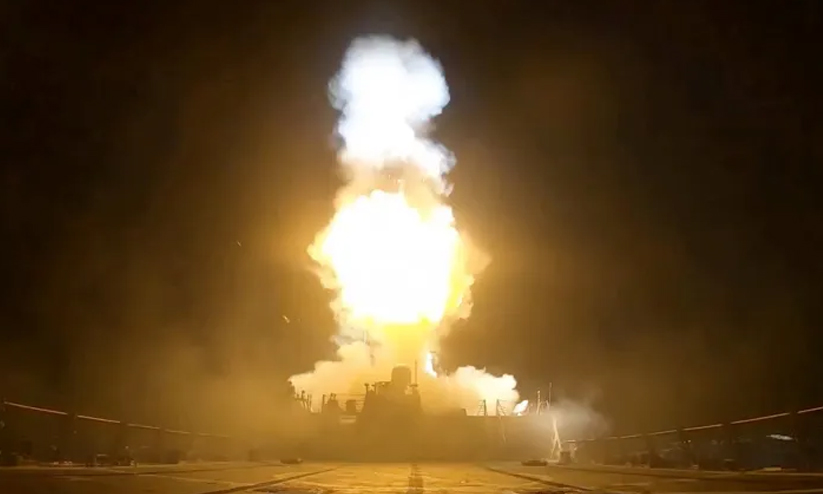
US Central Command conducted strikes on Iranian military targets including air defense systems, radar centers, missile and drone facilities, and small boats. [1] CENTCOM said it "completed a new wave of offensive strikes against Iran," hitting multiple targets with precision munitions "to degrade Iran's ability to continue attacking international shipping flowing through the Strait of Hormuz." [3] CENTCOM spokesperson Tim Hawkins said earlier that US forces had intercepted an Iranian cruise missile and a one-way attack drone. [3] Iranian media said US strikes were concentrated in southern Iran overnight, particularly around the Strait of Hormuz, including the provinces of Hormozgan, Khuzestan and Sistan-Baluchestan. [3] According to Iran's state-run Press TV, explosions were heard in the key port cities of Sirik, Bandar Abbas and Jask, while a telecommunication tower near Sirik was reportedly hit. [3] Qatar's Al Jazeera television, citing local reports, said fresh explosions were also heard on Qeshm Island. [3] The official IRNA news agency said one person was killed and four others were injured after a projectile struck an agricultural water pumping station in Mahshahr, Khuzestan Province. [3] The semi-official Tasnim news agency separately reported that US attacks killed one person and wounded two others on Farur Island. [3] Earlier, the US struck about 140 targets in Iran, including missile and drone launch centers, weapons depots, and communication systems. [1]
Iranian Retaliation Hits US Bases Across Gulf
Iran's Islamic Revolutionary Guard Corps launched retaliatory missile and drone strikes on US bases in Jordan, Bahrain, Kuwait, and Oman. [1] In statements carried by its official Sepah News outlet, the IRGC said it had launched missile and drone strikes against US bases in Jordan, Bahrain, Kuwait and Oman. [3] The IRGC claimed it had set fire to missile silos and fuel tanks at Prince Hassan Air Base in Jordan, hit helicopter maintenance facilities, a P-8 surveillance aircraft hangar and a command center at Sheikh Isa Air Base in Bahrain, and destroyed a fuel depot, a Patriot air defense system and an FPS radar installation at US bases in Kuwait. [3] Jordan's military said its air defense systems intercepted and shot down four missiles that entered the kingdom's airspace from Iran early Monday, according to the state-run Petra news agency. [3] In Bahrain, multiple air raid sirens sounded on Monday, with the Interior Ministry urging residents to seek shelter. [3] The Bahrain headquarters of a US commercial company was hit and caught fire, Iran's semi-official Mehr news agency reported. [3] Explosions were reported in Iranian provinces near the strait including Hormozgan, Khuzestan, and Sistan-Baluchestan, with at least one person killed and others injured. [1]
Impact on Shipping, Oil Prices, and Civilian Areas
Roughly 20 commercial vessels transited the southern route along Oman's coast in coordination with US forces despite Iranian closure claims. [1] The U.S.-led Joint Maritime Information Center and the U.S. Naval Forces Central Command said the southern route remains operational despite Iranian claims, adding that "U.S. forces are prepared to maintain freedom of navigation and safeguard lawful commerce." [3] Around 20 commercial vessels transited the Strait of Hormuz in coordination with the US military over the previous 24 hours, reported Axios, citing a US official. [3] Oil prices rose over 4 percent on heightened risks. [1] Brent crude, the main international benchmark, rose more than 4 percent to 79.17 U.S. dollars a barrel by 0300 GMT on Monday, the highest since June 22, Al Jazeera reported. [3] Air raid sirens sounded in Bahrain and Kuwait. [1] Iran's Revolutionary Guards said in a statement that the only way to restore regular shipping traffic through the strait was to end US military interventions in the waterway and warned that "continued interference could lead to greater incidents in the global oil and gas sector." [5]
International Diplomacy and Warnings
Diplomatic efforts continue with Oman summoning an Iranian representative to protest. [1] Pakistan's foreign minister urged de-escalation in a call with his Iranian counterpart. [1] UN Secretary-General Antonio Guterres warned of severe consequences if full war erupts. [1] Qatar, Pakistan, and Egypt have continued mediation attempts. [1] Pakistan's foreign minister spoke by telephone with his Iranian counterpart and requested that tensions be reduced. [1] Guterres warned that if war erupts again in full scale, its consequences would be extremely serious. [1]
What to watch next: Continued exchanges of strikes between US and Iranian forces, further diplomatic outreach by Oman and other mediators, and developments along the southern transit route in the Strait of Hormuz.