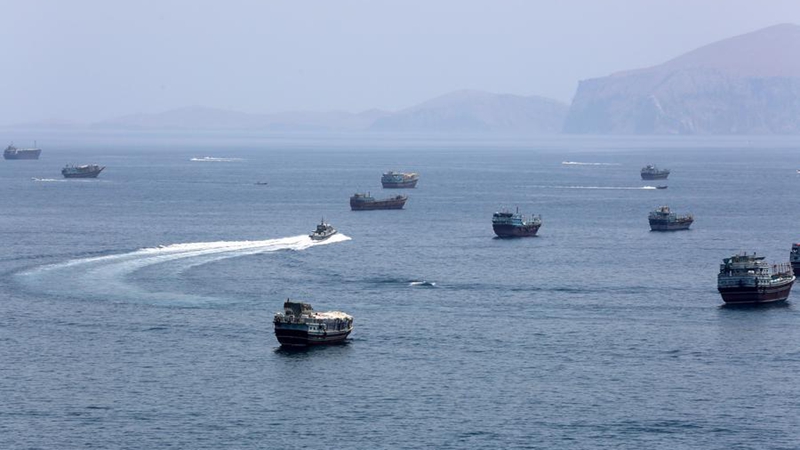

US and Iran exchange strikes over Strait of Hormuz, drawing regional condemnation
The United States and Iran exchanged strikes on Sunday, with the US conducting attacks in the Strait of Hormuz and Iran targeting US bases in Kuwait, Bahrain and Qatar, prompting widespread regional condemnation and oil prices jumping more than 3%. [1] [2]
US and Iran Exchange Strikes in Hormuz Dispute
The U.S. Central Command stated its forces completed a third round of strikes this week against Iran for attacking a commercial ship in the Strait of Hormuz, despite a June memorandum of understanding between the countries. [1] Iran retaliated by striking US military facilities in Kuwait, Bahrain and Qatar, with its Foreign Ministry declaring launch points for US attacks as legitimate targets and accusing Washington of violating nearly every provision of the memorandum signed 25 days earlier. [3] The U.S. Central Command said in a post on X early Sunday that its forces had completed a third round of strikes this week against Iran, "holding Iranian forces accountable for attacking another commercial ship in the Strait of Hormuz." [1] Iran retaliated later by targeting U.S. bases and facilities across the Gulf, with Iranian media saying the strikes targeted U.S. military facilities in Kuwait, Bahrain and Qatar. [1] The fresh round of attacks occurred over navigation in the Strait of Hormuz on Sunday, despite a memorandum of understanding signed by the two countries in June. [1] This exchange raised concerns over renewed regional escalation. [1]
Regional Condemnation from Egypt
Egypt condemned the Iranian attacks as a flagrant violation of sovereignty, a dangerous escalation threatening Gulf security and stability, and called for an immediate halt to escalatory actions and adherence to international law. [1] Egypt on Sunday condemned the Iranian attacks, calling them "a flagrant violation" of the sovereignty of the countries affected, the Egyptian Foreign Ministry said in a statement. [1] The attacks represent "a dangerous escalation that threatens the security and stability of the Gulf region and undermines efforts aimed at reducing tensions and consolidating regional security," the ministry said. [1] Egypt stressed that no pretexts or justifications could be accepted for such attacks, calling for an immediate halt to all escalatory actions and adherence to international law to prevent further tension and instability in the region. [1]
UAE, Qatar and Oman Responses
The UAE, Qatar, Oman and Iraq also condemned the Iranian actions, with Oman summoning Iran's ambassador to protest drone attacks on its territory, while regional statements emphasized risks to maritime security, international trade and the need for de-escalation through dialogue. [1] The United Arab Emirates (UAE) also condemned the Iranian missile and drone attacks. [1] In a statement, the UAE Ministry of Foreign Affairs reaffirmed the UAE's solidarity with the countries targeted and reiterated its support for measures to safeguard their security and stability. [1] The UAE Ministry of Defense said on social media that its forces were intercepting incoming missiles and drones, while its National Emergency Crisis and Disasters Management Authority said the situation remained stable, and that missile threats detected earlier were outside the country's borders. [1] Qatar's Foreign Ministry, in a statement, strongly condemned the Iranian attacks targeting its territory and several neighboring countries, describing them as a flagrant violation of sovereignty, territorial integrity and international law. [1] Oman on Sunday summoned Iran's ambassador to deliver a formal note of protest over drone attacks targeting sites in the governorates of Musandam and Al Wusta, Oman's Foreign Ministry said. [1] In a statement, the ministry said Oman expressed profound dismay over what it described as irresponsible acts, stressing the need to respect state sovereignty, the principles of good neighborliness, non-interference in internal affairs, and the norms governing relations between the two neighboring countries. [1]
Iraq Calls for Dialogue
Iraq expressed concern over the continuing tensions and developments affecting maritime security in the region. [1] A ministry statement said that these developments could have potential repercussions for regional security and stability, as well as for international trade. [1] While calling for dialogue and diplomatic means to address differences, the ministry reaffirmed Iraq's support for all efforts aimed at de-escalation, preserving the security and stability of the region, and safeguarding the shared interests of its peoples. [1]
Oil Prices Surge on Tensions
Oil prices rose more than 3% following the exchange of strikes and the dispute over Hormuz navigation status. [2] Oil jumped more than 3% after the US and Iran exchanged strikes and disputed the Hormuz status. [2]
What to watch next: Further statements from the U.S. Central Command and Iranian Foreign Ministry on accountability for commercial ship attacks and memorandum provisions, alongside continued regional calls for adherence to international law and diplomatic de-escalation.





/file/attachments/orphans/Resurfacing4_119455.jpg)