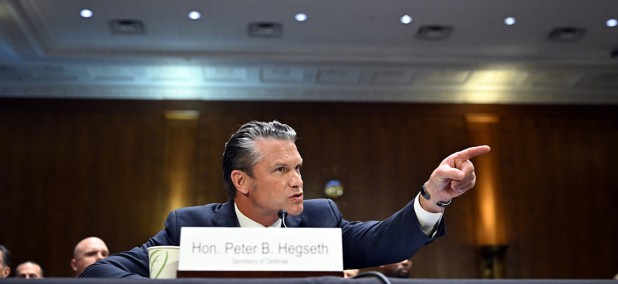

United States Tensions Rise as Senators Demand Straight Answers From Hegseth on Iran War
Defense Secretary Pete Hegseth faced sharp questioning from senators of both parties over his conflicting statements on the U.S. war with Iran known as Operation Epic Fury, as lawmakers expressed frustration with the Trump administration's shifting rationales and growing public opposition to the conflict amid United States tensions.
Senate Hearing Exposes Frustration With Hegseth
Senators pressed Hegseth to defend past claims that Operation Epic Fury was a "historic and overwhelming victory" that rendered Iran's military "combat-ineffective" and achieved all objectives, but he acknowledged Iran continues to develop and launch drones and missiles. [1] Sen. Jon Ossoff read Hegseth’s previous statements back to him and sought a yes-or-no confirmation on whether those descriptions remained accurate. [1] Hegseth stated that U.S. strikes had decimated Iran’s Air Force, Navy, and industrial base while noting the country was still developing and launching drones and missiles. [1] He added that the objective remains preventing Iran from obtaining a nuclear weapon to threaten the United States. [1] Sen. Kirsten Gillibrand highlighted inconsistencies between earlier claims that Iran’s nuclear ability had been obliterated and later assertions that Iran was within two weeks of a weapon. [1] Sen. John Kennedy, a Trump ally, demanded straight answers on whether Iran could restart its nuclear program if operations ended too soon. [1] Lawmakers from both parties criticized the administration for failing to consult Congress and the public or provide a clear strategy. [1]
Declining Public and Political Support
Public support for the war has declined sharply, with 68 percent of Americans saying it is “not worth fighting” and only one-third of MAGA voters approving, down 13 points in two months. [1] Sen. Chris Coons noted that the drops reflect disapproval of how the White House has pursued the effort rather than differences over preventing an Iranian nuclear arsenal. [1] Some 37 percent of self-identified MAGA voters now say they would support the war only if it does not increase costs, according to a recent poll. [1] Lawmakers expressed concern that economic pressures on voters, including health care, food, and housing costs, are heightening frustration with inconsistent messaging about the war’s progress. [1]
Budget Battles Tied to War Costs
The hearing highlighted resistance to the administration's $1.5 trillion defense budget request amid questions over management of previously appropriated funds and the costs of wars including Operation Southern Spear and Operation Epic Fury. [1] Lawmakers noted $75 billion in appropriated but unobligated funds and questioned whether critical shortfalls could be avoided without additional supplemental funding now at $67 billion. [1] Hegseth responded that previously allocated funds under the Big Beautiful Bill would be spent by September and that the military was receiving everything it required. [1] Gen. Dan Caine compared the budget request to investments made ahead of World War II and described it as a future investment to buy down risk. [1] The House approved a $95 billion Republican budget plan for the Iran war. [3]
Trump's Latest Threats on Iran
President Trump threatened to bomb Iranian bridges or power plants, including in Tehran, in response to any Iranian attacks on ships in the Strait of Hormuz. [2] In a social media post, Trump stated that any time Iran shoots at a ship in the Strait of Hormuz by missile, rocket, drone, or other device, the United States will bomb and destroy one bridge or power plant, including those in or next to Tehran. [2] Trump also said Iran desperately wants to meet with U.S. negotiators and warned that the U.S. military will conduct strikes on Pickaxe Mountain soon and very heavily. [2]
House Approves Expanded U.S.-Israel Military Ties
The House approved a $1.15 trillion NDAA with provisions for closer U.S.-Israel military integration. [4] The measure passed 219-206 largely along party lines, with Republicans voting 213-1 in favor and Democrats voting 205-5 against. [4] Section 219 would integrate American and Israeli research and development, while Section 622 would expand and enhance intelligence sharing with Israel. [4] Democratic opponents cited concerns over sovereignty and described the provisions as an existential threat to American sovereignty and democracy. [4] Rep. Ilhan Omar stated that Americans want no part in Netanyahu’s genocidal regime. [4] The bill now moves to the Senate. [4]
What to watch next: The $1.15 trillion NDAA heads to the Senate for consideration of its own version, while supplemental funding requests tied to ongoing operations face further scrutiny in appropriations hearings.






