
Ukraine Strike Targets Russian Oil Facilities, Causing Environmental Damage
Ukraine has conducted strikes on Russian oil targets, including the Tuapse facility, as part of ongoing military actions in the war.[1] These operations have not only targeted key economic infrastructure but have also sparked significant reactions within Russia, including calls for extreme responses and concerns over environmental fallout.[2][4] In a recent strike Ukraine forces focused on one of Russia's largest oil sites, leading to immediate impacts such as oil spills and unusual weather phenomena like black rain.[4] The incidents highlight the intensifying nature of the conflict, now on day 1,526 of battlefield updates, where economic pressures from the war are mounting.[1][2]
Amid these developments, discussions among Russian exiles reveal divisions over the Kremlin's handling of the situation, while broader technological trends from the Ukraine war are influencing other global conflicts.[2][5] Environmental and humanitarian repercussions extend to other events in the war, such as the destruction of infrastructure critical to water supplies.[3] This report draws on verified sources to outline the strikes, their contexts, and ripple effects.
Overview of Recent Strikes
The recent strikes by Ukraine on Russian oil targets represent a strategic escalation in the ongoing war, directly impacting Russia's economic backbone.[1] As the conflict enters its extended phase—marked as day 1,526 in battlefield updates—these attacks underscore how military actions are increasingly intertwined with economic warfare.[2] Ukraine's operations have zeroed in on oil facilities, which are vital to Russia's revenue streams, demonstrating a calculated approach to disrupt fuel production and exports amid the prolonged hostilities.[1]
Reports indicate that Ukrainian forces have systematically hammered key sites, contributing to fears of broader economic strain on Russia.[4] The war's toll on the economy is evident, as these strikes coincide with heightened pressures on Russia's energy sector, a cornerstone of its wartime financing.[1] This context is crucial, as oil refineries and related infrastructure have become focal points, reflecting Ukraine's capability to project power deep into Russian territory despite the grueling nature of the conflict.[4] The immediacy of these events ties into the larger pattern of reciprocal strikes, where both sides target assets that sustain their war efforts.
Furthermore, the strikes align with Ukraine's broader military doctrine, leveraging precision capabilities to hit high-value targets.[1] Economically, the disruptions from these attacks compound existing challenges for Russia, where oil revenues fund much of the military apparatus.[1] Observers note that such operations not only degrade operational capacity but also signal resolve in the face of territorial stalemates.[2] As the war progresses, these incidents provide a snapshot of how infrastructure vulnerabilities are exploited, with immediate contexts including prior exchanges of fire and ongoing positional battles.[4] The strategic choice of oil targets amplifies the psychological and material impact, pressuring Moscow's war machine while highlighting the resilience of Ukraine's offensive posture.[1]
In summary, the overview of these strikes reveals a deliberate focus on economic chokepoints, set against the backdrop of a war that has reshaped regional dynamics and global energy markets.[1][4]

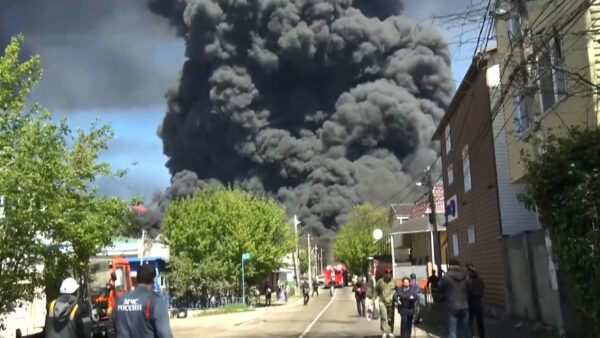
Ukrainian strike damages Russian oil facility, causing oil spill and environmental harm. — Source: cyprusmail
Specific Targets and Incidents
Details of the strikes reveal a concentration on the Tuapse oil facility, one of Russia's largest sites, where Ukrainian forces delivered significant blows.[4] The town of Tuapse, a strategic hub for oil processing, was bombed in operations that caused visible and tangible damage, including oil spills that have raised alarms across the region.[2][4] These spills have led to environmental concerns, with reports of black rain—a phenomenon linked to the combustion and dispersal of petroleum products—affecting local areas.[4]
The nature of the incidents points to precision strikes capable of penetrating defenses around critical infrastructure.[2] Tuapse's role as a key oil town makes it a prime target, and the resulting spills have prompted fears of a larger environmental disaster gripping Russia.[4] Black rain, characterized by oil-laden precipitation, underscores the immediate fallout, contaminating soil, water sources, and air quality in the vicinity.[4] These effects are not isolated; they stem directly from the hammering of refinery operations, where fires and leaks have exacerbated the damage.[4]
Incidents like these illustrate the dual military and ecological dimensions of modern warfare.[2] The Tuapse strikes, in particular, have been detailed in updates as pivotal, with the facility's strategic importance amplifying the repercussions.[2] Oil spills from such attacks pose long-term risks to ecosystems, while the black rain event signals acute atmospheric pollution from the strikes.[4] Ukrainian actions here fit into a pattern of targeting energy nodes, with each incident compounding cumulative environmental stress on Russian territory.[4]
Analysis of the strikes shows how the choice of Tuapse maximizes both tactical disruption and secondary effects, such as the spills that challenge local response capabilities.[2][4] The environmental impacts are immediate and visible, serving as a stark reminder of the unintended consequences of infrastructure warfare.[4]
Russian Reactions and Divisions
Russian responses to the Tuapse oil strikes have been marked by intense rhetoric, including calls for a nuclear-armed response from Kremlin figures.[2] A Kremlin oligarch reportedly demanded a "trinitrotoluene" or nuclear-armed retaliation following Ukraine's bombing of the strategic oil town, reflecting the fury within official circles.[2] This nuclear saber-rattling highlights the provocative nature of the strikes on core economic assets.[2]
At the same time, Russian exiles are divided over the Kremlin's stance and the broader implications of the attacks.[2] Discussions among exiles reveal splits in opinion, with some criticizing the aggressive posturing while others grapple with the war's escalating costs.[2] The Kremlin's nuclear fury, as framed in battlefield updates on day 1,526, underscores internal pressures to respond forcefully to perceived humiliations like the Tuapse incident.[2]
These reactions expose fractures within Russian elites and diaspora communities, where the strikes have fueled debates on strategy and escalation risks.[2] The oligarch's call for extreme measures points to a hawkish element pushing for disproportionate countermeasures, potentially heightening tensions.[2] Exile divisions further complicate the narrative, as voices outside Russia question the sustainability of Moscow's approach amid repeated infrastructure hits.[2]
Overall, the responses paint a picture of a regime under strain, balancing aggressive rhetoric with the realities of environmental and economic damage from the strikes.[2]
Broader War and Technological Context
The strikes on Russian oil targets occur within the expansive context of the Ukraine war, where innovations like drones play a central role.[5] Drones similar to those used widely in the Ukraine conflict are now being adopted by other groups, such as Hezbollah, which has deployed fiber-optic drones against northern Israel.[5] These small, hard-to-track devices, controlled via thin fiber-optic cables that evade electronic detection, exemplify technology transfer from the Ukrainian battlefield.[5]
This adoption highlights the Ukraine war's influence on global conflicts, as fiber-optic drones—proven effective in evading defenses—proliferate.[5] In Ukraine, such drones have been instrumental in strikes, reconnaissance, and attrition warfare, shaping tactical evolutions that other actors now emulate.[5] The broader war context thus extends beyond bilateral engagements, with Ukrainian experiences exporting lessons in asymmetric warfare.[5]
Technological proliferation underscores how the conflict serves as a testing ground for next-generation weaponry, influencing distant theaters.[5] Hezbollah's use mirrors Ukraine's widespread application, where these drones' stealth features have tipped balances in prolonged fights.[5]

A fire rages at a Russian oil refinery following a Ukrainian strike. — Source: aljazeera
Related Humanitarian and Environmental Effects
Indirect impacts of the war include severe humanitarian and environmental challenges, exemplified by the destruction of the Nova Kakhovka Dam.[3] On June 6, 2023, the dam on Ukraine’s Dnipro River was destroyed, cutting primary freshwater supplies for upstream communities while flooding downstream areas with contaminated water and unexploded ordnance.[3] Active warfare persisted around the disaster zone, complicating response efforts.[3]
Within hours, organizations like Chemonics International coordinated with local and international partners to address the crisis in this complex conflict environment.[3] The explosion's effects disrupted water access critical for daily life and agriculture, while floods carried hazards that endangered populations.[3] This event ties into the war's pattern of infrastructure sabotage, mirroring environmental concerns from oil strikes elsewhere.[3]
Humanitarian coordination in such zones requires navigating ongoing combat, as seen in the rapid mobilization post-dam breach.[3] The dual threats of water scarcity upstream and contamination downstream amplified vulnerabilities, with unexploded ordnance adding lethal risks to flooded regions.[3]
These effects highlight the war's far-reaching toll on civilian infrastructure and ecosystems.[3]
Key Developments Summary
To deepen understanding, the interplay of strikes, reactions, and side effects forms a multifaceted crisis, with economic hits[1], nuclear threats[2], and tech spread[5] converging alongside disasters like Kakhovka[3].
What to watch next
Monitor Russian responses to Tuapse strikes for potential escalations, ongoing environmental monitoring in affected areas, and further adoption of Ukraine-war drones by non-state actors, as these elements continue to shape the conflict's trajectory.[2][4][5]