
Ukraine Launches Largest Drone Attack on Moscow Refinery Since War Began
Ukraine launched its largest drone attack on Moscow since the start of the war, striking the Kapotnya oil refinery and causing significant damage that knocked out a major refining unit for days amid Russia strikes on Ukrainian religious sites.
Overview of the Drone Assault on Moscow
Ukraine carried out its largest drone assault on Moscow since Russia’s full-scale invasion, targeting the Kapotnya oil refinery and disrupting flights across the Russian capital. [2] The strike triggered a major fire, with residents reporting black smoke, fuel smells and oily residue falling across the city. [2] Ukrainian drones also approached the Russian capital from different directions in a massive attack. [1] The very fact that for the second day in a row Ukrainian drones were flying over Moscow did nothing to improve Russians’ mood. [1] Authorities suspended temporarily the activities in all four airports that serve the area of Moscow – Vnukovo, Domodedovo, Sheremetyevo and Zhukovsky – provoking heavy disruptions to air traffic. [4] Videos of the day showed a new attack on Moscow and the aftermath of the previous attack from multiple angles. [1]
Damage Assessment at the Refinery
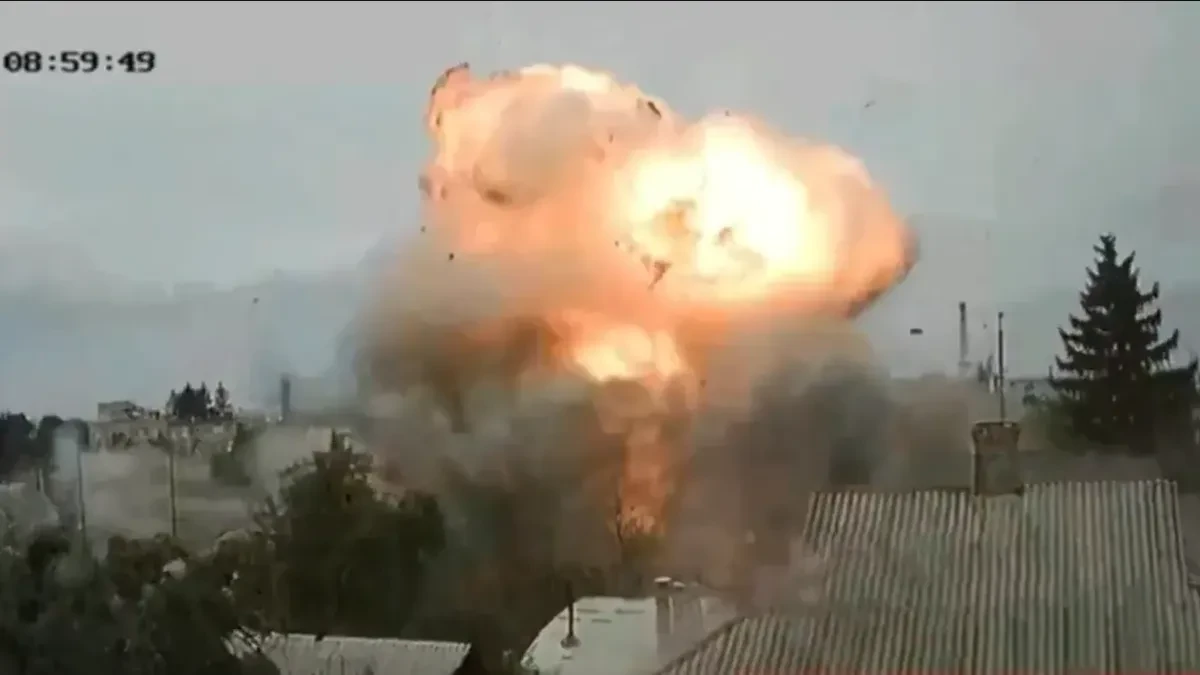
The Moscow refinery has been knocked out of operation for at least several days. [1] Drones hit one of the two refining units, having damaged the first one in the air raid on 16 June. [1] The AVT-6 refining unit that was hit has a capacity of 140,000 barrels of oil per day, which it processes in such a way that commercial fuels can subsequently be produced from it. [1] Less important service facilities, oil tanks, pipelines and the like were also damaged. [1] The most photogenic part of the attack on Moscow was caused by an inaccurate Russian missile. [1] Videos and photographs circled the world showing, after a large explosion, a massive cover being blown off the top of an oil storage tank in the Russian capital. [1] A video emerged that shows the large tank was hit and destroyed by a malfunctioning Russian surface-to-air missile, likely from a Pantsir air-defence system. [1] In footage an incoming drone approaches the already smoking refinery when a missile launches towards it, passes harmlessly under the unmanned aircraft and immediately afterwards hits the tank. [1]
Ukraine drone attack strikes Moscow's Kapotnya oil refinery causing major fire and flight disruptions. — Source: timesofindia
Russian Claims of Interceptions
Moscow Mayor Sergei Sobyanin claimed that Russian air defences shot down 25 drones that were heading towards the Russian capital. [5] Sobyanin initially reported that six drones heading towards the city had been destroyed before updating the number to 25. [5] The mayor added that emergency services are working at the sites where debris fell. [5] In Russian-occupied Sevastopol the Kremlin-appointed governor Mikhail Razvozhayev said the city is being attacked by Ukrainian drones. [3] An air-raid warning was issued in the city at 13:30. [3] Two UAVs have been shot down in the Northern Side district. [3]
Broader Ukrainian Strikes
The offensive Ukraine launched did not remain limited to the capital. [4] The State General Staff of Kyiv announced that Ukrainian forces had also hit the oil depot of Gukovo in the oblast of Rostov, provoking a vast fire. [4] According to Ukrainian authorities the site is used to store and distribute fuels and lubricants destined for Russian military and industrial activities. [4] The governor of the region Yuriy Slyusar confirmed the attack and the subsequent blaze. [4] Geolocalised footage disseminated online shows flames and dense columns of smoke near the plant. [4] President Volodymyr Zelensky linked directly the operation to the Russian bombardments against the monastic complex of the Kyiv-Pechersk Lavra that occurred on 14 and 15 June. [4]

Russian forces in occupied Sevastopol report repelling a Ukrainian drone attack. — Source: ukrainskapravda
Reactions from Russian War Commentators
Pro-war Russians have succumbed to madness according to observers of the reactions. [1] Konstantin Malofeyev claimed that war meant victory at any cost and openly called for nuclear apocalypse, asking why Russia does not use the nuclear weapons that forefathers produced and stockpiled. [1] Vladimir Solovyov began calling on Russians to prepare for hard times and self-sacrifice. [1] Aleksandr Kots offered a recipe for how to destroy Kyiv by blowing up the dam above the city so the water would wash away that filth as well as the bridges across the Dnipro. [1] Yuriy Kotenok called for a nuclear strike and proposed that the regime should be radicalised against its own citizens by introducing a strict counterintelligence regime and tightening punishments for treason. [1] Dmitry Rogozin stated that the enemy has opted for a sharp escalation and that the suffering of the civilian population and the blood of the people only excites the vampires even more. [1] The first thing to note is the use of the word war which is now becoming the norm. [1]
Implications for Russian Air Defenses
Many of the criticisms focused on the media system controlled by the Kremlin. [4] Commentators accused state televisions and newspapers of minimising the impact of the attacks and of presenting a distorted version of reality. [4] The main television channels did not dedicate specific services to the attacks against Moscow. [4] Analysts believe that the growing frequency of Ukrainian incursions is highlighting the vulnerabilities of the Russian defensive system. [4] Kyiv has increased the range of its long-range operations striking not only targets in the border regions but also strategic infrastructure in the vicinity of Moscow and Saint Petersburg. [4] This evolution forces the Kremlin to distribute its defensive resources over an immense territory reducing the effectiveness of protection of single objectives. [4] Moscow would be facing a shortage of S-300 missiles and essential components for their production. [4] The army has used S-300 missiles as attack weapons against ground targets in Ukraine reducing further the stocks available for air defence. [4] The employment of increasingly sophisticated Ukrainian drones forces Moscow to use advanced and costly systems to counter relatively cheap threats increasing the pressure on strategic reserves. [4]
What to watch next: Russian authorities may continue reporting interceptions while pro-war commentators press for further escalation and state media face ongoing criticism for downplaying the strikes.