
Ukraine conflict reports Russian territorial losses of 116 square kilometres in April 2026.
In the ongoing conflict Ukraine has seen a notable shift on the battlefield, where Russia has lost territory for the first time since Ukraine’s August 2024 incursion into Russia’s Kursk oblast. These losses amount to approximately 116 square kilometres across multiple front-line areas, according to recent analysis.[5]
Recent Territorial Developments
The latest battlefield analysis reveals a significant change in the territorial dynamics of the conflict Ukraine. Russia, which had maintained control over captured areas since Ukraine's unexpected August 2024 incursion into its Kursk oblast, has now experienced net territorial losses. This marks the first instance of such setbacks for Moscow in April 2026.[5]
Details from the analysis indicate that the lost ground totals around 116 square kilometres. This figure encompasses several distinct areas along the extensive front line, suggesting that the retreats are not confined to a single sector but are distributed across multiple zones of active combat. The August 2024 incursion into Kursk, described as bold by observers, had previously disrupted Russian advances by drawing forces away from other fronts and highlighting vulnerabilities in Moscow's border defenses.[5]
While these losses represent a reversal after a period of relative stagnation or gains for Russian forces, the analysis emphasizes that they do not equate to an overall defeat in the war. Russia's position remains robust in many areas, and the 116 square kilometres, though measurable, constitute a fraction of the vast territories involved in the broader conflict. The timing in April 2026 underscores the protracted nature of the fighting, where incremental changes can signal tactical adjustments rather than strategic collapse.[5]
This development comes from an analysis published this week, providing fresh data on front-line movements. Such reports are crucial for understanding the ebb and flow of territorial control, as they rely on geospatial tracking and verified observations to quantify changes accurately. The losses highlight Ukraine's ability to contest ground effectively in select regions, potentially through counteroffensives or defensive stands that forced Russian withdrawals.[5]
Further context from the same source frames these events against the backdrop of the Kursk operation, where Ukrainian forces penetrated deep into Russian territory. That incursion shifted momentum temporarily and may have informed subsequent Ukrainian tactics leading to the April 2026 gains. Nonetheless, the front line remains fluid, with both sides continuing to maneuver for advantage.[5]
Ongoing Military Exchanges
Russia and Ukraine have engaged in a series of attacks as the Kremlin prepares for its World War II victory celebrations. These exchanges reflect the persistent intensity of military operations, with both sides launching strikes amid heightened tensions.[2]
In Kyiv, residents have grown accustomed to the threat of Russian attacks, viewing them as part of a grim routine. One resident captured this sentiment, stating, “I'm worried, but it's become routine, unfortunately,” following warnings of possible strikes. This underscores the psychological toll on civilians in the Ukrainian capital, where air raid alerts and potential bombardments have become normalized aspects of daily life.[2]
Complementing these offensive actions, Ukraine maintains robust defensive postures, particularly along key maritime fronts. Efforts to protect the Black Sea coast from Russian drones and mines form a critical component of these measures. Ukrainian forces employ various strategies to counter these threats, ensuring the security of coastal areas vital for logistics and naval operations.[4]
The combination of aerial and naval threats illustrates the multifaceted nature of the exchanges. Russian attacks, often timed around significant dates like the WWII commemorations, aim to assert pressure, while Ukraine responds with both retaliation and fortified defenses. The resident's comment in Kyiv highlights how such patterns affect urban populations, fostering resilience amid ongoing uncertainty.[2][4]
These military interactions ahead of the celebrations suggest a deliberate escalation, with Russia leveraging symbolic occasions to demonstrate resolve. Ukraine, in turn, focuses on mitigation, particularly against drone incursions and minefields that endanger shipping and coastal infrastructure.[2][4]
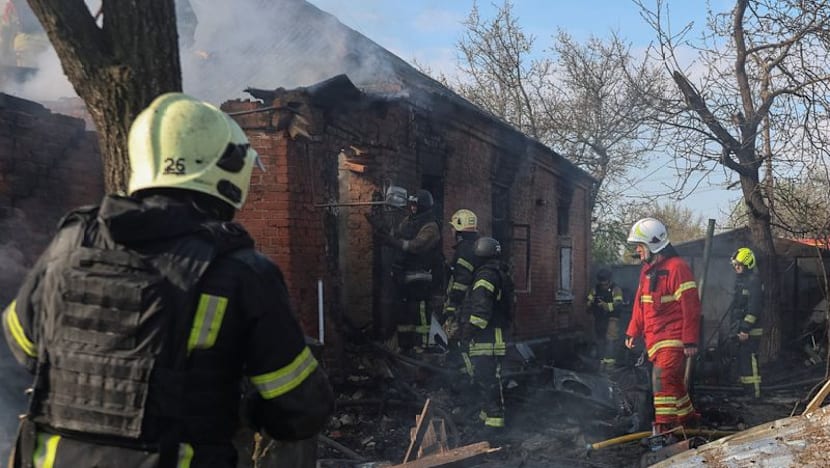
Ukrainian and Russian forces exchange attacks in the ongoing conflict. — Source: channelnewsasia
International Incidents Linked to the Conflict
Greek authorities are actively examining a mysterious naval drone discovered in the Ionian Sea, raising questions about its origins and potential ties to the Russia-Ukraine war. The device, reportedly containing explosives, has drawn attention from Greek media, who speculate it could be Ukrainian in origin or otherwise connected to the ongoing conflict.[1]
The discovery in the Ionian Sea, a strategically important body of water in the Mediterranean, points to the broadening geographic scope of conflict-related activities. Naval drones represent an evolving tool in modern warfare, capable of covert operations, reconnaissance, or direct attacks. The presence of explosives suggests it was armed, amplifying concerns about its intended use.[1]
Greek officials' investigation aims to determine the drone's provenance, whether it drifted from operations in the Black Sea region or was deployed independently. Media reports emphasize the possible link to the Russia-Ukraine war, noting that both sides have utilized uncrewed surface vessels extensively. This incident highlights how the conflict's ripples extend beyond Eastern Europe, potentially affecting NATO members like Greece.[1]
The examination process involves technical analysis to identify manufacturing marks, navigation data, or explosive composition that could trace it back to a specific actor. Such findings could inform international responses, including enhanced maritime patrols in the area. The Ionian Sea's proximity to conflict zones via sea routes makes it a plausible transit path for such devices.[1]
Foreign Involvement in the Fighting
A Yemeni man has become the latest foreign national to lose his life while fighting alongside Russian forces in Ukraine. Hamza Mahmoud Al-Habashi was killed after reportedly being misled into joining the Russian side, illustrating the deceptive recruitment practices drawing fighters from distant regions.[3]
This case points to a pattern, as Al-Habashi is described as the most recent Yemeni casualty in the conflict. Yemen, embroiled in its own civil war, serves as a recruitment pool for Russia, where promises of pay or citizenship may lure individuals under false pretenses. The term "misled" implies misinformation about the nature of the combat or risks involved, leading to tragic outcomes.[3]
Foreign fighters on the Russian side add complexity to the battlefield composition, supplementing regular troops with international recruits. Al-Habashi's death underscores the human cost for these participants, who may lack full awareness of the intense fighting in Ukraine. Reports of such involvement suggest organized efforts to bolster Russian manpower amid high casualties.[3]
The involvement of Yemenis, in particular, connects Middle Eastern instability to the European theater. Previous instances of Yemeni deaths indicate this is not an isolated event, pointing to sustained recruitment channels. Russian forces benefit numerically, but the reliance on foreign elements may affect unit cohesion and morale.[3]

A Yemeni man killed while fighting with Russian forces in Ukraine. — Source: thenewarab
Ukraine's Defenses Along the Black Sea Coast
Ukraine continues to prioritize the defense of its Black Sea coast against persistent Russian threats, including drones and mines. These defensive operations are essential for maintaining control over maritime approaches and protecting economic lifelines.[4]
The methods employed by Ukrainian forces target the specific challenges posed by uncrewed aerial and naval systems. Drones, often launched from Russian positions, conduct surveillance or strikes, while mines create hazardous navigation zones. Countermeasures likely include electronic warfare, patrol vessels, and demining operations to neutralize these dangers.[4]
The Black Sea remains a contested domain, where control influences grain exports, naval mobility, and supply lines. Ukraine's active defense reflects adaptations learned over years of conflict, emphasizing layered protection from shore-based assets to offshore patrols. This front complements land battles, ensuring a holistic strategy.[4]
Ongoing efforts demonstrate resilience, as Russian attempts to dominate the sea through asymmetric tools are met with determined resistance. The focus on drones and mines highlights their role as force multipliers, cost-effective for attrition warfare.[4]
Contextual Overview of the Situation
The current state of the conflict Ukraine integrates territorial shifts, military engagements, international spillover, and foreign participation into a complex picture. Russia's April 2026 territorial losses of 116 square kilometres across front-line areas mark the first such reversal since the Kursk incursion, yet do not signal an end to the war.[5]
Military exchanges persist, with attacks traded ahead of Kremlin WWII victory celebrations and Kyiv residents adapting to routine threats. Defensive measures, especially along the Black Sea against drones and mines, sustain Ukraine's posture.[2][4]
External events, like the naval drone in Greece's Ionian Sea potentially carrying explosives and linked to the war, illustrate global reach. Foreign fighters, such as the misled Yemeni combatant Hamza Mahmoud Al-Habashi killed alongside Russians, reveal recruitment dynamics.[1][3]
Together, these elements—from battlefield analysis to maritime defenses—frame a conflict marked by attrition, innovation, and international dimensions. The analysis underscores incremental changes amid stalemates, with both sides entrenched.[1][2][3][4][5]
What to watch next: Monitor potential escalations around the Kremlin's WWII victory celebrations, where further attacks could occur, alongside Ukraine's continued Black Sea defenses against drones and mines, and investigations into foreign-linked incidents like the Ionian Sea drone.[2][1][4]