US strike on Iranian tankers leads to accusations of reckless adventure.
The US conducted a fighter jet attack on Iranian tankers in the Strait of Hormuz, prompting sharp backlash from Tehran.[1] Iran accused the US of a 'reckless military adventure' following the strike on empty oil tankers, while an oil spill was spotted near Iran's Kharg Island export terminal, as reported by the Associated Press.[2][3] Oil prices, including Brent crude futures, increased due to the renewed fighting between the US and Iran, with the US military claiming the strikes occurred after the tankers attempted to breach a blockade on Iranian ports.[4][2] Iranian officials stated that the US attack violated a ceasefire and hindered diplomatic efforts.[5]
Overview of the US Strike
The recent US strike Iran conducted via fighter jets targeted Iranian tankers in a strategically vital area, the Strait of Hormuz, escalating tensions in an already volatile region.[1][2] According to reports, the attack involved US fighter jets striking empty oil tankers, an action that has drawn significant international attention due to its location in one of the world's most critical chokepoints for global oil shipments.[1] The Strait of Hormuz serves as a primary conduit for oil exports from the Middle East, making any military activity there particularly sensitive to global energy markets and maritime security.[2]
Details from available accounts indicate that the strikes took place amid ongoing confrontations, with the US military positioning the action as a response to specific provocations by the tankers.[2] The event unfolded in the context of broader hostilities, where US forces engaged Iranian vessels that were reportedly empty, heading possibly toward Iranian ports under blockade.[2] This strike Iran faced marked a direct military engagement, explained in various reports as part of a pattern of aerial operations against Iranian maritime assets.[1] The timing of the attack aligns with a series of exchanges, including prior US strikes on Iranian vessels and coastal targets noted in satellite observations.[3]
Further context reveals that the US fighter jet involvement was not isolated but part of a sequence of events that included strikes on Thursday and early Friday, heightening concerns over the stability of shipping lanes.[3][1] Iranian officials have framed this as an unprovoked escalation, but US explanations point to defensive measures against attempts to challenge established blockades.[2] The precision of fighter jet operations in such confined waters underscores the tactical nature of the engagement, where empty tankers became focal points amid efforts to enforce restrictions on Iranian port access.[2] This overview highlights how the strike fits into immediate military dynamics, with both sides presenting narratives that justify their positions based on the tankers' movements and the blockade's enforcement.[1][2]
Iranian Reactions and Accusations
Iranian officials swiftly condemned the US strike on the tankers, labeling it a 'reckless military adventure' that disregarded established norms of engagement in the region.[2] This accusation came directly in response to the attack on empty oil tankers in the Strait of Hormuz, with Tehran portraying the action as an unnecessary provocation that endangered regional stability.[2] The rhetoric from Iranian voices emphasized the recklessness of targeting vessels that posed no immediate threat, given their empty status, thereby framing the US as the aggressor in a fragile security environment.[2]
Beyond the initial charge of recklessness, Iranian statements extended to claims that the strikes violated an existing ceasefire agreement, undermining fragile diplomatic channels aimed at de-escalation.[5] Officials argued that such military actions hampered ongoing efforts to resolve the conflict through negotiation, sparking potential reprisals and further complicating peace prospects.[5] The balance of any prospective deal now hangs in jeopardy, as Iranian accusations portray the tanker strikes as deliberate sabotage of diplomatic momentum.[5]
These reactions were not isolated outbursts but part of a coordinated response that highlighted the perceived illegitimacy of the US blockade enforcement tactics.[2][5] By striking empty tankers attempting to access Iranian ports, the US was seen by Tehran as overstepping boundaries set by prior agreements, leading to vows of countermeasures that could prolong the standoff.[5] The intensity of Iranian rhetoric underscores the domestic and strategic pressures on Tehran's leadership to respond forcefully, while also signaling to international observers the depth of bilateral mistrust.[2]
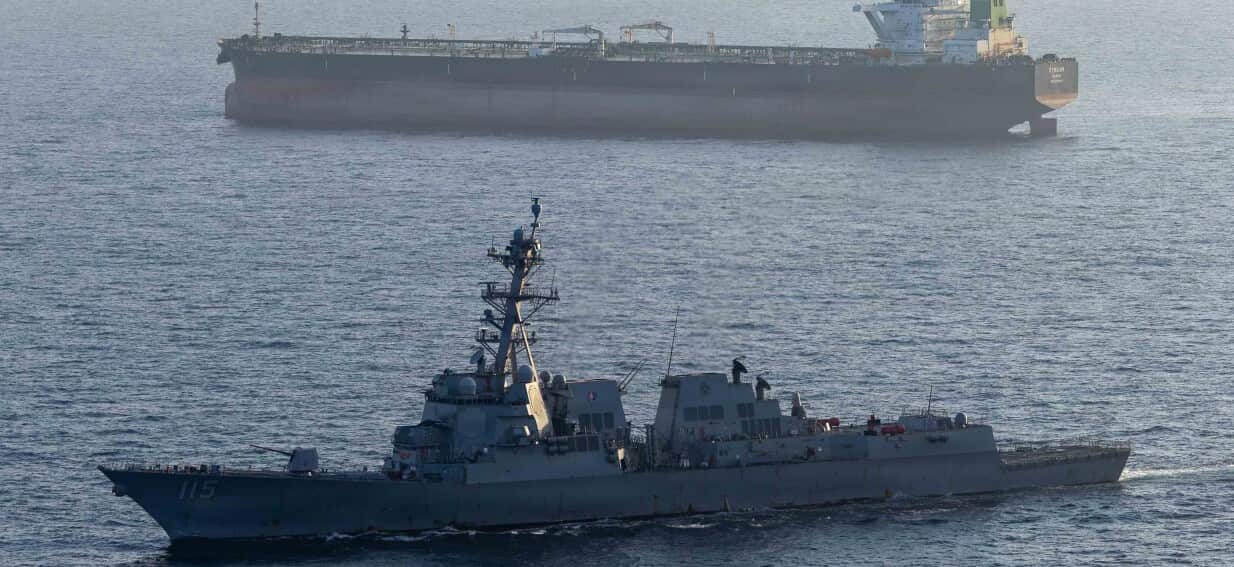
US fighter jets strike empty Iranian oil tankers in the Strait of Hormuz. — Source: sbsaustralia
Environmental Effects Reported
Satellite imagery reviewed by the Associated Press revealed an oil spill near Iran's Kharg Island, the country's main oil export terminal, adding an environmental dimension to the recent military activities.[3] The slick was first detected earlier this week, prior to the latest round of US strikes on Iranian vessels and coastal targets that occurred on Thursday and early Friday.[3] This timing places the spill in close proximity to heightened conflict zones, though direct causation remains unconfirmed in reports.[3]
Kharg Island holds critical importance as Iran's primary hub for oil exports, making any spill there a potential threat to both local ecosystems and the nation's export capabilities.[3] The Associated Press noted the oil slick's presence based on satellite data, prompting questions about the impacts on marine life and shipping operations in the Persian Gulf area surrounding the island.[3] The US Department of War, as referenced in reports, declined to comment on the possible connection to a recent strike near the terminal, leaving the environmental incident amid a cloud of speculation tied to ongoing hostilities.[3]
Observations of the spill highlight vulnerabilities in the region's infrastructure during periods of conflict, where military actions near export facilities could inadvertently or otherwise contribute to such incidents.[3] The detection via satellite underscores the role of independent monitoring in documenting effects that might otherwise go unnoticed, providing a factual basis for assessing the strike's broader repercussions.[3] While the spill predates the most recent strikes, its location near key assets amplifies concerns over environmental risks associated with naval and aerial engagements in oil-rich waters.[3]
Impact on Global Oil Markets
Oil prices surged following the renewed fighting, with Brent crude futures jumping as much as three percent on Friday in direct response to the US-Iran air strikes.[4] Traders expressed fret over the ceasefire's future and disruptions to shipping in the Strait of Hormuz, driving Brent crude futures to $101.47 a barrel, up $1.41 or 1.41 percent by 10:51 CDT (1551 GMT), after an earlier intraday rise of up to three percent.[4] Similarly, US West Texas Intermediate (WTI) futures climbed to $95.71 a barrel, gaining 90 cents or 0.95 percent.[4]
This market reaction stemmed from the immediate uncertainty injected by the traded strikes between the US and Iran, a day prior to the price spike.[4] The Strait of Hormuz's role as a vital artery for global oil supplies amplified trader anxieties, as any escalation threatened to constrict flows and push prices higher.[4] Despite the daily gains, both Brent and WTI contracts were still positioned for weekly declines, indicating a volatile backdrop where short-term spikes reflect acute conflict risks rather than sustained trends.[4]
The interplay between military events and energy markets was evident, with the tanker strikes contributing to perceptions of heightened supply risks.[4] Houston-based trading desks monitored the situation closely, as the potential for broader disruptions in Hormuz shipping lanes loomed large in pricing decisions.[4] This episode illustrates how swiftly geopolitical flare-ups in key oil transit zones can translate into tangible market movements, affecting consumers and producers worldwide.[4]

A satellite image shows an oil spill near Iran's Kharg Island export terminal. — Source: middleeasteye
US Claims and Justification
The US military provided a clear justification for the strikes, stating they occurred after the Iranian tankers attempted to breach a blockade on Iranian ports in the Strait of Hormuz.[2] This claim frames the fighter jet attack as a necessary enforcement measure against vessels challenging established restrictions, with the empty oil tankers positioned as direct participants in the attempted violation.[2] By highlighting the breach attempt, US accounts portray the action as defensive and proportionate, aimed at maintaining the integrity of the blockade amid ongoing tensions.[2]
Reports detail that the tankers' movements toward blockaded ports triggered the response, underscoring the US perspective that Iranian maritime activities necessitated intervention to prevent escalation.[2] The emphasis on the Strait of Hormuz location reinforces the strategic imperative, where control over access points is central to broader military objectives.[2] This narrative contrasts sharply with Iranian accusations, positioning the strikes as rule-based responses rather than reckless adventures.[2]
Broader Context of the Conflict
The US strike on Iranian tankers fits into a pattern of renewed fighting that has strained a fragile ceasefire and raised questions about diplomatic pathways forward.[1][4][5] Explanations of the fighter jet attack highlight its role in ongoing aerial engagements, including prior strikes on vessels and coastal targets, as observed in satellite data near key sites like Kharg Island.[1][3] Iranian reprisals have been sparked, with officials decrying ceasefire violations that hamper deal-making efforts.[5]
Oil market turbulence further contextualizes the event, as traders react to risks in the Strait of Hormuz, where shipping disruptions could cascade globally.[4] The interplay of military blockades, tanker movements, and aerial strikes illustrates deepening entrenchment, with both sides leveraging the strait’s importance to press advantages.[2][4] Potential implications include prolonged instability, as accusations of recklessness and violations erode trust essential for resolution.[2][5]
This conflict's dynamics, marked by traded strikes and environmental concerns, signal a precarious balance where military actions intersect with economic and diplomatic stakes.[1][4][5]
What to watch next: Monitor developments in the Strait of Hormuz shipping and ceasefire status, as trader concerns over disruptions and Iranian reprisal threats could influence oil flows and diplomatic progress.[4][5]