
UK Offers Air Defence Systems and Forward Operating Base to Nigerian Army
UK Proposes Expanded Defence Support Package to Nigeria
The United Kingdom has proposed supplying Nigeria with air defence systems, counter-unmanned aerial systems, enhanced military intelligence, a forward operating base and protected mobility vehicles to deepen their defence partnership. British Defence Adviser Brigadier Tom Harper presented the proposals during a visit to Nigerian Chief of Army Staff Lieutenant General Waidi Shaibu in Abuja. [1] The offers include expansion of tactical ISR to brigade level, transfers of protected mobility vehicles, specialised ammunition and expanded regional train-the-trainer programmes in combat drills, casualty care and patrolling. [1] Harper highlighted proposed UK support for the establishment of a reference Forward Operating Base within a cantonment environment. [1] The proposed measures form part of the United Kingdom’s continued commitment under the Security and Defence Partnership to strengthening Nigeria’s operational and institutional capacity. [1]
Nigerian Army Chief Outlines Capability Requirements
Shaibu highlighted needs for improved ISR, technical intelligence, aviation and 24/7 domain awareness to address asymmetric warfare in the North-East, plus requirements arising from the Nigerian Army’s expansion from eight to 12 divisions. [1] The Chief of Army Staff said the deepening partnership was critical to building a more adaptable, combat-ready and resilient force capable of responding effectively to evolving national and regional security threats. [1] Shaibu identified asymmetric warfare and operations in dense and difficult terrain, particularly in the North-East, as significant operational challenges requiring enhanced intelligence, surveillance and reconnaissance, technical intelligence, aviation capability and round-the-clock domain awareness down to battalion level. [1] He also highlighted the expansion of the Nigerian Army from eight to 12 divisions, stressing that the growth would require corresponding investments in advanced training, instructor development and Special Forces capabilities, including enhanced capacity at the Doma training facility. [1] The COAS further emphasised sustained engagement with trusted international partners to accelerate the Army’s transformation, particularly in capability development, professional military education, technology integration and the adoption of contemporary approaches to countering asymmetric threats. [1]
Regional Training and Interoperability Focus
Future Operation HADIN KAI training will incorporate troops from Niger, Cameroon and Chad to promote regional interoperability against shared threats. [1] Harper also disclosed plans to expand regional train-the-trainer programmes covering combat tactical drills, casualty care and advanced patrolling. [1] Future Operation HADIN KAI training cohorts are expected to include personnel from Niger, Cameroon and Chad alongside Nigerian troops. [1] According to the statement, the initiative would promote interoperability and strengthen collective regional capacity against shared security threats. [1] The Army said the discussions reflected a broader partnership focused on equipping the Nigerian Army to anticipate, deter and decisively respond to emerging threats. [1]
Ghana-Burkina Faso Defence Pact Signed
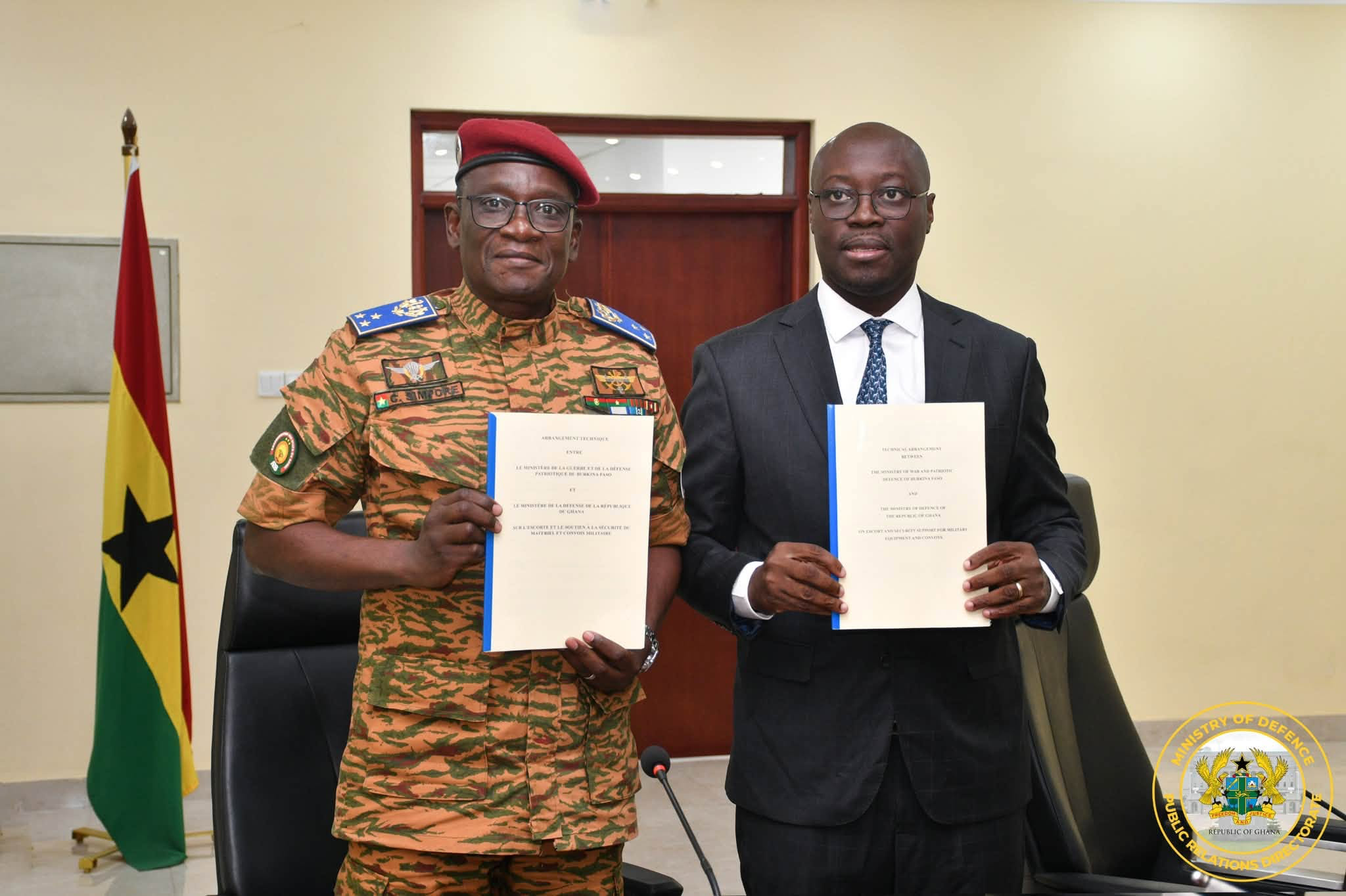
Ghana and Burkina Faso signed a Defence Cooperation Agreement to secure cross-border trade corridors. [2] Finance Minister Dr Cassiel Ato Forson announced the agreement in a Facebook post on Tuesday, August 11. [2] He said the pact is intended to safeguard economic activity and deepen defence cooperation between the two neighbouring countries. [2] Dr Ato Forson said he signed the agreement with Burkina Faso’s Defence Minister, Major General Célestin Simporé. [2] The agreement comes amid the importance of secure trade routes between Ghana and Burkina Faso, with both countries seeking to strengthen cooperation in protecting economic activity and cross-border movement. [2]
International Call for Missile Launch Notifications
Separately, the US, South Korea, Japan and 37 other nations issued a joint call for 24-hour advance notice of ICBM, SLBM and space launch vehicle tests. [4] South Korea, the United States, Japan and 37 other countries issued a joint statement Tuesday calling on countries to provide sufficient advance notification of launches of intercontinental ballistic missiles, submarine-launched ballistic missiles and space launch vehicles. [4] The statement came after China carried out a surprise launch of an SLBM into the open waters of the Pacific on July 6, drawing criticism from the U.S. and other countries. [4] The countries did not mention China by name in the statement. [4] In the statement, the countries called on all nations, particularly nuclear-weapon states, to provide notification of ICBM, SLBM and SLV launches no less than 24 hours in advance, noting that nuclear-capable missile tests without sufficient advance notice are dangerous and disrupt the peace of nations close to these tests. [4] Notifications should include such information as the generic class of the ballistic missile or SLV, the planned launch notification window, the launch area and the planned direction, they said. [4] They said countries should also provide clear notices for airmen and mariners consistent with international standards to reduce risk, including expected impact and landing areas. [4]
US Golden Dome Missile Defence Funding Warning
Gen. Michael Guetlein warned that the Golden Dome missile defence programme faces collapse without congressional funding. [3] The sprawling Golden Dome missile-defense program is in peril because the White House decided to seek the vast majority of its 2027 funding via a controversial budget maneuver, the program’s leader said Tuesday. [3] Gen. Michael Guetlein didn’t explicitly call out the administration’s decision to propose using reconciliation to fund about 97 percent of the program’s $17.5 billion request. [3] “If they don’t figure it out, there is no Golden Dome,” Guetlein told attendees at the Space and Missile Defense Symposium, “because there is no funding.” [3] He said that 90 percent of the roughly $24 billion allocated for the missile defense program through last year’s reconciliation effort has been obligated. [3] He also said there’s been two phenomenally successful tests tied to the effort, and that contracts have been awarded for many of the key parts, such as space-based interceptors, radars, and data networks. [3] The general also warned that progress could stall without consistent funding. [3]
What to watch next: Guetlein said the Defense Department is already planning for contingencies if it does not secure the requested funding in the 2027 budget, while the 41-nation statement urged all relevant countries to participate in arrangements for providing advance notification of ICBM, SLBM and SLV launches to affected countries.