
Two US Soldiers Die in Iranian Missile Strike on Jordan Base as Airstrikes Resume
Resurgence of Direct US-Iran Hostilities
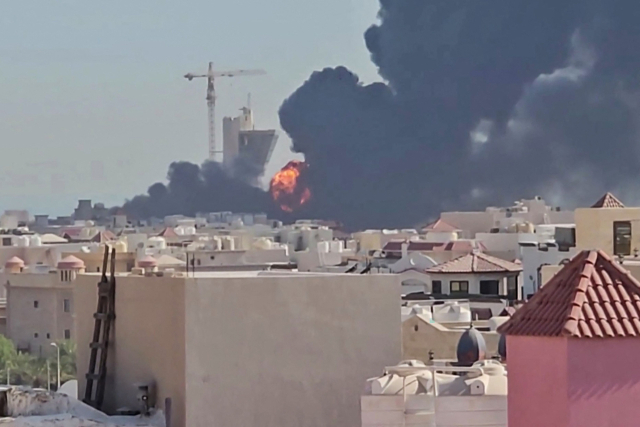
Iranian missile and drone strikes on a Jordanian base killed two US soldiers on July 17, 2026, marking the first US military fatalities from a direct Iranian attack since the ceasefire in early April 2026. [1] US Central Command reported that the strikes targeted the Muwaffaq Salti Air Base in Azraq, Jordan, resulting in two deaths and one missing service member. [1] The United States responded with more than five hours of retaliatory airstrikes on Iranian military targets, conducted from 6 p.m. to 11:30 p.m. local time on July 18, 2026, as the eighth consecutive day of such operations ordered by President Donald Trump. [1] US Central Command stated that the strikes successfully hit Iranian coastal surveillance facilities, air defense sites, naval capabilities, and missile and drone storage sites, along with an Islamic Revolutionary Guard Corps unit involved in the prior attack. [1] Iran then carried out retaliatory suicide drone attacks on two US bases in Kuwait, targeting an ammunition depot at Udairi base and Patriot radar systems plus aerial surveillance radars at Ali Al Salem Air Base. [1] Black smoke and flames rose over the Mangaf area south of Kuwait City on July 18, 2026, following the Iranian strikes. [1] Kuwait criticized Iran for targeting civilian facilities and key urban infrastructure. [1]
Political Statements and Broken Ceasefire

Iranian missile strike on Jordan base kills two US soldiers. — Source: gdelt The conflict between the United States and Iran began on February 28, 2026, when the United States and Israel initiated operations against Iran, followed by a temporary ceasefire in early April 2026. [1] A memorandum of understanding was signed in mid-June in Islamabad, but the ceasefire effectively collapsed in early July 2026. [1] President Donald Trump warned that if Iran did not agree to US conditions by the weekend, strikes would extend to infrastructure including power plants and bridges. [1] Reports indicated that US forces had already begun destroying some civilian facilities such as bridges. [1] Iranian Supreme Leader Ayatollah Seyed Mojtaba Khamenei issued a written statement to state television condemning the United States for repeatedly violating the previous memorandum of understanding. [1] Khamenei stated that the American president’s signature had no value or effect and described the resumption of war as further evidence of US dishonesty, irrationality, unreliability, and meanness. [1] He referred to the United States as the “Great Satan.” [1] US Central Command noted that the airstrikes focused on weakening Iranian military capabilities used to attack civilian vessels such as oil tankers near the Strait of Hormuz. [1] Iranian state media reported that US strikes on July 19, 2026, targeted ports in Sirik and Hajabad as well as Qeshm Island at the entrance to the Strait of Hormuz, where at least six missiles struck. [1]
Parallel Fighting in Ukraine
Russian forces launched a missile attack on Kyiv early on July 19, 2026, killing one person, injuring multiple civilians, and causing fires in several districts. [2] The strikes hit a student dormitory, a residential building, and a large store, with additional damage to warehouses, administrative buildings, and vehicles across five neighborhoods. [2] Ukrainian authorities reported that the attack caused fires and required ongoing rescue and damage assessment operations. [2] In response, Ukraine’s General Staff announced strikes on two Russian oil tankers in the Black Sea and a floating crane in the Azov Sea, all described as supporting Russian military operations in Ukraine. [2] Ukrainian forces also struck a command center, five Russian personnel groups, seven drone control points, and another significant target during the same period. [2] Along the front line, 249 clashes occurred in the past 24 hours, with Ukrainian units repelling 33 Russian assault attempts in the Pokrovsk sector around locations including Dorozhni, Hrishyne, Udachne, Molodetske, Nikanorivka, Biletske, Serhiivka, Novopidhorodne, Myrnyi, and Kocheriv Yar. [2] Russian media reported that Russian forces captured Volokhovskoye in the Kharkiv region and began fighting for Zaharivka, while also advancing in the Donetsk region. [2] Russian Chief of the General Staff Valery Gerasimov stated that Russian units had advanced across a broad front, taking control of Myrnyi and nearing completion of control over Shevchenkove, Krasnoyarske, and Svitlo. [2]
Separatist and Jihadist Violence in Mali and Papua

US soldiers stand near damaged structures at Muwaffaq Salti Air Base in Jordan after Iranian missile strike. — Source: antaranews Tuareg separatists from the FLA and al Qaeda-affiliated JNIM ambushed a Malian army convoy leaving the northern town of Anefis on July 18, 2026, killing at least 50 soldiers and taking at least 24 prisoners. [4] The attack followed weeks of fighting in which the groups briefly captured Anefis in early July and encircled a military base used by the Malian army and Russian paramilitaries from Africa Corps. [4] A local elected official described the toll as extremely heavy and the deadliest suffered by the Malian army in years, with some soldiers executed. [4] A Malian army source noted that an investigation was underway into tactical failures that left the convoy vulnerable. [4] Russian paramilitaries had already reached Gao and suffered no losses, while the dead belonged to the army and state-backed militias. [4] The army acknowledged that the convoy had fallen into an ambush by terrorist armed groups. [4] In Papua, armed separatists from the West Papua National Liberation Army attacked and burned a Pilatus aircraft operated by PT Associated Mission Aviation on July 2, 2026, killing American pilot Nicholas F. Goselin, aged 29. [3] Indonesian troops and residents cleared the wreckage from the airstrip in Balinggama Village to restore the region’s only air link. [3] Lieutenant General Lucky Avianto stated that the wreckage and Goselin’s death underscored the brutality of the attack by the OPM and described the group as a common enemy of Indonesia, people of all faiths, and the international community. [3] Avianto said restoring the airstrip was essential for humanitarian, church, and commercial activities and condemned the targeting of civilians providing essential services. [3] Goselin had supported Christian communities in Balinggama, and military personnel remained deployed to secure the area for resumed pioneer flights. [3]
Humanitarian Impact in Lebanon
At least 4,324 deaths and 12,224 injuries have been recorded due to hostilities in Lebanon since March 2, 2026, according to the Ministry of Public Health. [5] Since the June 20 ceasefire announcement, an additional 344 fatalities and 223 injuries have occurred. [5] A total of 741,111 people have returned to their areas of origin, while more than 412,700 people remain displaced, including 30,500 internally displaced persons. [5] The figures reflect the cumulative impact of escalation that continued even after the ceasefire. [5]
Regional Spillover and Proxy Involvement
A drone attack struck a base of the Kurdistan Freedom Party near Erbil in northern Iraq on July 19, 2026, injuring eight members. [1] The area had experienced multiple drone attacks over the preceding four days. [1] Responsibility for the attack was not immediately confirmed, though Iranian involvement or support from Iranian-backed Iraqi armed groups was considered possible. [1] Iran has long been concerned about the potential for ground intervention involving Kurdish groups opposing the Islamic Republic. [1] The Kurdistan region hosts US forces and members of groups such as the Kurdistan Freedom Party that oppose Iran. [1] Iraqi Prime Minister Mohammed Shia al-Sudani visited Washington the previous week to discuss economic cooperation with President Trump. [1]
What to watch next: Further US strikes on Iranian infrastructure remain possible if no agreement is reached by the weekend, while Ukrainian forces continue targeting Russian naval assets and Russian advances persist in Kharkiv and Donetsk; additional attacks by Tuareg and jihadist groups in Mali and separatist actions in Papua could prompt further military responses.